

Every Generation Of Submarine And How Their Capabilities Changed Over Time
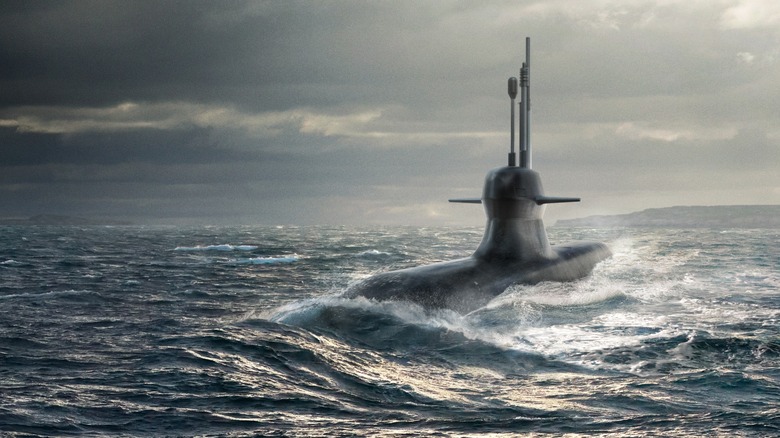
Submarines are quite possibly some of the scariest vessels any navy could operate. No, they're not as large as an aircraft carrier or as armed to the teeth as a destroyer, but their ability to submerge and remain hidden for weeks — sometimes months — at a time is terrifying. That wasn't always the case, though. Submarines used to only have the ability to submerge for a couple of hours at most, and they definitely couldn't stay out at sea for months. Meanwhile, modern-day submarines, as long as they're nuclear-powered, can stay deployed virtually indefinitely, with replenishing food being the only reason to return to port.
These vessels weren't always vital to military operations. It took decades of upgrades and evolution to get them to be as crucial as they are today. Now they're a critical component of America's nuclear triad, where a submarine with a nuclear-armed ballistic missile is always out at sea. With SAAB's announcement that it's developing the world's first fifth-generation military submarine, it gets one to wonder: What were previous generations like?
1st Generation (WWI and before)

While they were nothing like the vessels the general public has come to recognize today, World War I saw submarines used throughout the conflict. Submarines used prior to the 1900s were quite different, as diesel-electric propulsion systems weren't yet in use. However, this new system allowed submariners to use the diesel engine while surfaced and electric motors when submerged. These submarines were primarily used for coastal defense, as they didn't have anywhere near the range that modern vessels have.
Germany blazed the trails in submarine technology, with its first submarine entering service in 1906. These submarines, or U-boats, had between one and two deck guns and no more than four torpedo tubes. They weren't nearly as big as modern submarines that carry vertical-launching cruise missiles, measuring only 210 feet in length versus today's 377-foot Virginia-class attack boat. That's still significantly larger than the Royal Navy's E-class submarine, which was the British answer to the U-boat; the E-class, which went into service in 1911, was only 181 feet long and 15 feet wide.
These early submarines could only dive 200 feet below the surface. They weren't typically speedy, either; while submerged, the E-class couldn't go more than 9.5 knots, while their surface speed was 14 knots. This is nothing compared to the 25+ knots that modern submarines can travel while submerged. Submarines from this period were powered by diesel engines and couldn't go much farther than 3,000 miles on the surface before they needed to refuel, typically while sustaining a speed of around 10 knots (range while submerged was much shorter at just 65 miles at 5 knots). Periscopes were used to spot targets visually while submerged, and WWI-era subs relied on basic listening devices like hydrophones to pinpoint targets by sound.
2nd Generation (WWII to the 1950s)

World War II saw a new wave (no pun intended) of submarine technology. Improved diesel-electric systems emerged that gave second-generation subs the ability to stray farther from shore than their World War I predecessors. Easily the biggest breakthrough for submarines came in the form of the snorkel, an invention from the Germans (Schnorcel in their native tongue) that gave U-boats a huge advantage over Allied submarines. Diesel engines require oxygen to function, so the snorkel gave U-boats the ability to run their diesel engines while submerged. This meant that they didn't have to resurface as frequently. Unlike WWI, newer submarines were equipped with better sensors like radar, which they used to track surface ships.
Subs of this era not only carried more torpedoes, but they also used the newly invented homing torpedoes. On the American front, the Gato-class subs were the first built specifically for WWII. These submarines had some luxuries practically unheard of and by no means define the generation as a whole, but are worth mentioning. Since Gato subs typically operated in the warm tropical waters of the Pacific, they had air conditioning. This was more than just to provide comfort to the crew, though — as air conditioners remove humidity from the air, having them present on Gato subs was ideal for keeping their sensitive electrical equipment protected from excess moisture. Beyond air conditioning, these submarines also had washing machines for clothes, refrigerators, freshwater distilling units, and bunks for the entire crew.
The technical improvements to submarines during the WWII era proved how valuable a sub could be on the battlefield. In the postwar era, major powers and other nations quickly realized how their naval fleets would come to depend on the submarine's capabilities. The snorkel became standard issue on every diesel-electric sub thereafter, but upcoming technology would render it obsolete as a new type of propulsion system was underway.
3rd Generation (1950s to the 1970s)

After World War II, nuclear energy became an obsession for the world, so naturally, the military worked to integrate the technology with its vessels. The USS Nautilus would signal the start of the third generation of military submarines when it was launched in 1954. Goodbye diesel-electric engines, hello nuclear-powered subs. Nuclear vessels utilize a thermal reactor that heats high-pressure water that goes into a steam generator, which sends steam into a turbine where it produces electricity, thus powering the entire vessel. Since the system is a closed loop, there's no exhaust and fuel isn't lost, so there's no need for a nuclear submarine to refuel — at least not until it's time for a Refueling and Overhaul (ROH). With this new technology, submarines could submerge and remain at sea indefinitely. The new type of powerplant also improved the submarine's speed, easily reaching between 20 and 25 knots while submerged.
This new generation gave the submarine's appearance a slight overhaul, which also contributed to its better speed. Third-gen subs started using a tear-drop hull shape that was notably seen on the USS Albacore. This design reduced the amount of drag that subs experienced in the water. This time period also saw the formation of America's nuclear triad because third-gen boats became capable of launching ballistic missiles (SLBM), and while submerged no less. This led to the creation of ballistic missile submarines (SSBNs), a type of sub whose job is to remain hidden while carrying nuclear-armed SLBMs. This would be the generation with the biggest leap in submarine technology, especially when new long-range sensors and guided missiles were added into the mix.
4th Generation (1980s to the new millenium)

Fourth-generation submarines are the ones that are currently in operation. That's America's three Seawolf-class attack subs and its nearly two dozen Virginia-class submarines, Russia's Yasen-class boats, and more. The ones that would appear in any modern-day military movie. What set these boats apart from their predecessors was their ability to be quieter and more versatile. This is when stealth became a top priority for navies around the world, so they started implementing instruments that would reduce the acoustics that emanated from the ship, since the slightest sound could give away their position to sonar. American subs specifically used rubber tiles on the hull, raft-mounted machinery, and pump-jet propellers to improve a submarine's stealth.
While some submarines were classified as "attack subs," they handled much more than attacking other vessels. Subs like the Seawolf-class were designed to aid in special operations and were built with swimmer lock-out chambers that could deploy a team of commandos. Some Seawolf subs, like the USS Jimmy Carter, were also kitted out with highly advanced sensors that gave the ships the ability to tap into underwater cables and gather intelligence. Naturally, as time got closer to the early 2000s, technology improved even more, giving these subs even more upgrades, like network computing and enhanced periscopes.
Weaponry improved as well. Submarines got the ability to attack land-based targets by the '80s with Tomahawk land-attack cruise missiles (TLAM). Before long, submarines were deploying a variety of weapons, including torpedoes, mines, and missiles, making them quite the nuisance. It's difficult to fathom where submarines could even go from here.
5th Generation (2010s to the present)

Since America is a ways off before the general public learns what its fifth-generation submarines will bring to the table, SAAB is setting the standard as the only manufacturer announcing the kind of technologies going into this next-gen platform. The newest generation of military submarines is poised to take existing technology to the next level. SAAB's A26 promises to be extra stealthy, giving it the ability to gather intelligence without being detected, whether it's in the shallows or the deep blue. Beyond quieter acoustics, though, SAAB is building the submarine with radar-absorbing coating, much like what's found on the F-22 and F-35 fighter jets.
These advanced submarines will also utilize unmanned underwater vehicles (UUVs), launching them from modular payload bays for a number of tasks, including securing and monitoring communication cables. Unlike previous generations, the A26 will be able to engage in information warfare and intercept adversarial signals passively. Its electronic surveillance suite will enable it to even prevent those signals from reaching their intended destination, which would be a new means for submarines to engage in combat.
However, perhaps most surprising is that the A26 isn't a nuclear-powered vessel like America's more advanced subs. Instead, it uses air-independent propulsion, which utilizes diesel engines as well as a Stirling-type engine that burns liquid oxygen and diesel to power electrical generators. Going with this form of power plant is what most likely is helping the sub be as stealthy as SAAB is claiming, as one of the benefits of diesel-electric is reduced acoustics at lower speeds.