

14 Cars That Are Faster Than A C8 Corvette Z06
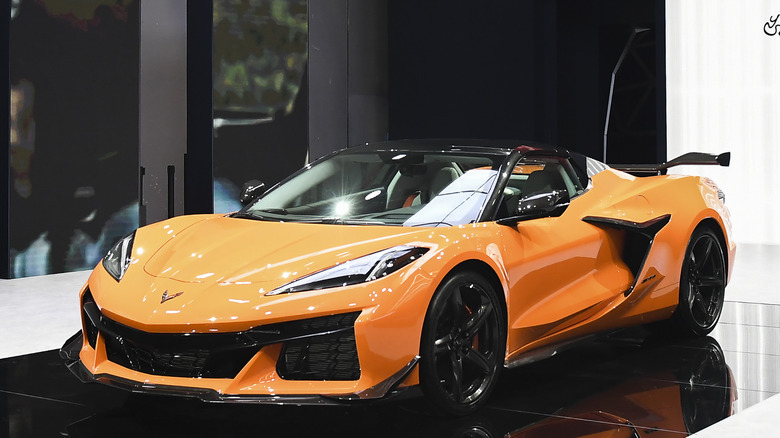
In recent years, the Corvette has become something of a superstar. The C8 generation, with its mid-engined layout and flat-plane crank V8 — which produces a wonderful noise — seems to have graduated into supercar territory. It certainly looks the part and plays the part, and it won't even dent your wallet as much as some of its competitors. The budget-friendly supercar has been a mirage for enthusiasts and while the Corvette has always been close, it has never been closer than now, with 2025 models starting at just over $70,000.
These characteristics have made the C8 Corvette a new benchmark in the world of performance cars. It sits in a goldilocks zone where anything below it might be more sports than super, and where anything above it enters the realm of absurdity. Similar to the C8's comfortable middle ground in the market, there is a middle ground in its trim levels too: the Z06. The benchmark trim of the benchmark car then, is the Z06, which enjoys performance upgrades all around. If the C8 Z06 represents the midpoint, the logical next step for any speed-obsessed gearhead is to wonder what cars lie above that midpoint. With the downforce-heavy Z07 performance package, the Z06 tops out at 189 mph, but the more slippery base model blasts all the way to 195 mph. Blasting by 195 is no easy feat, but the following cars might make it seem otherwise.
Mercedes-AMG GT63 S E Performance 4-Door Coupe
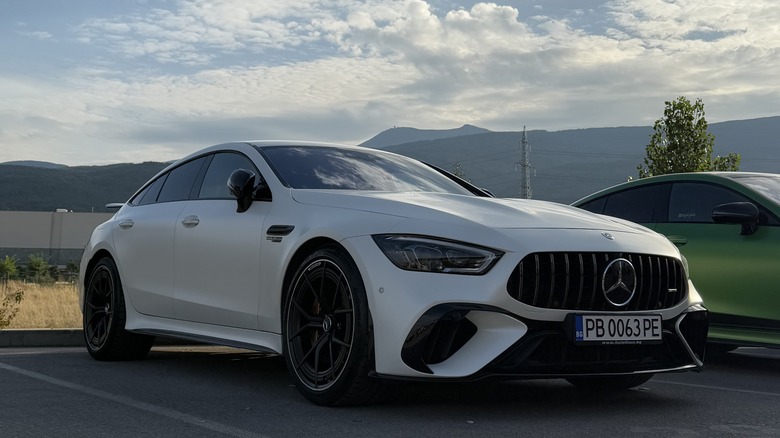
Despite having an incredibly sterile and jumbled name, the Mercedes-AMG GT63 S E Performance 4-Door Coupe is actually one of the most exciting cars on the market that has more than two seats. Originally coming to market in 2018, the GT63 was created to be a more usable version of the two-door Mercedes-AMG GT. The first generation hit that mark on the head, and as the nameplate has evolved, its abilities have only grown, especially after being blessed with the power of electricity.
The powertrain of the AMG GT63 S E is complex, drawing power from every corner of an engineer's playbook. The foundation is a four-liter twin-turbo V8. As if that wasn't enough, the gasoline-powered side is further supported by an electric motor. When it all somehow comes together, the AMG GT63 S E produces 831 horsepower and 1,032 lb-ft of torque. To help offset the weight of all this tech, the powertrain is distributed across the car as evenly as possible, with the ICE engine up front and the electric motor over the rear axle. The car is no slouch in a straight line either, allowing you, and up to four other people, to fly all the way to 197 miles per hour.
Porsche 911 GT3
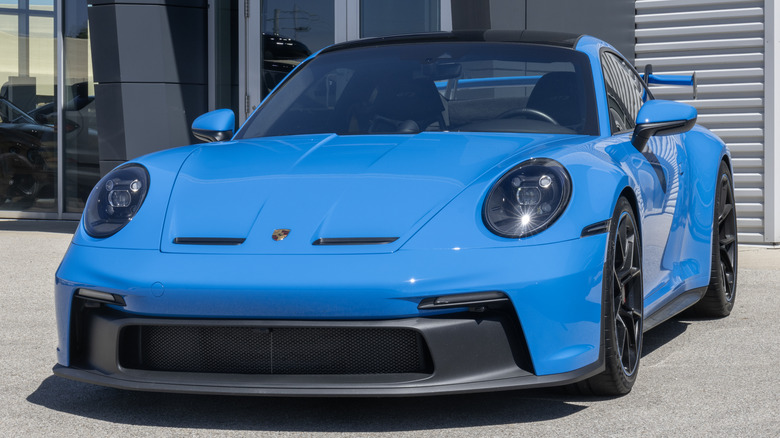
Atop the 911 food chain is the 911 GT3 RS. While technically the most advanced version of the 911, the GT3 RS is actually not the fastest of the bunch. The normal GT3 is actually faster in a straight line, thanks to its more conservative (but still crazy) aero parts. As part of the upper echelons of modern 911 performance, the GT3 should be able to give supercars a run for their money, which it does.
Equipped with a naturally aspirated flat-six, as any proper 911 should be, the GT3 can rev all the way 9,000 rpm. Once that redline is reached, the driver can shift via a six-speed manual, or Porsche's lightning fast PDK dual-clutch transmission, depending on which was spec'd. The GT3 produces 502 horsepower, which these days feels like a modest figure. However, when you put the car on a scale and it shows its 3,200-pound weight, you realize that 502 horsepower figure is more than enough. Flat out, Porsche's second in command will top out at 199 miles per hour.
Ferrari 296

The Ferrari 296 represents a lot of things for modern-day Ferrari, because it has changed what a Ferrari can be. The skepticism it was met with didn't come from what it was, but what it wasn't. For decades, the cornerstone of the Ferrari lineup was some kind of mid-engined supercar, powered by a naturally aspirated V8. After the 458 was replaced by the 488, the naturally aspirated V8 was gone, but it's hard to complain too much about getting a pair of turbochargers. The 296 changed everything, though, with its heart now having six cylinders rather than eight, which are supplemented by an electric motor.
The 296 has managed to fill the spiritual gap that the 458 left Ferrari fans with. Off the bat, that hybrid powertrain develops 819 horsepower. It does 0-60 in a blink at 2.4 seconds, with the electric motor filling in power gaps during gear changes, and it does all this while looking eye-wateringly pretty. Keep holding the pedal down past 60, and you will break 200 mph, with the 296 maxing out at 205 miles per hour.
Lamborghini Temerario
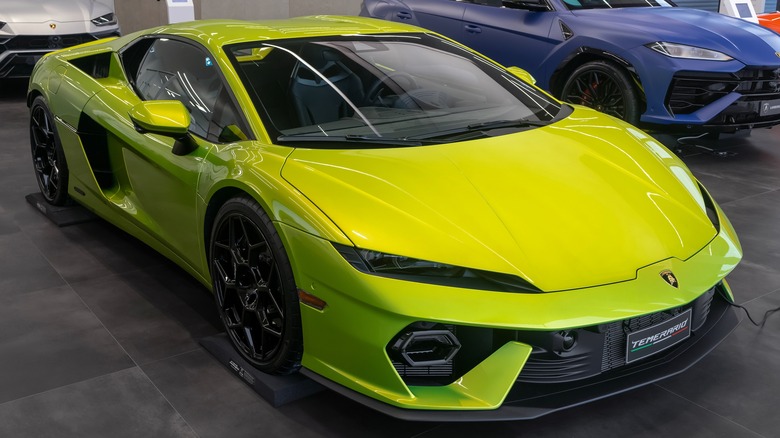
The Temerario is to Lamborghini what the 296 is to Ferrari. Rather than the gradual change in the model DNA that Ferrari went with, Lamborghini decided to rip the band-aid off all at once with the Temerario. The Gallardo and the Huracan had conditioned Lamborghini customers to expect the entry-level Lambo to come with a naturally aspirated V10 with no complicated hybrid system, and no turbos. With the Temerario, though, Lamborghini changed all that. Now, the baby Lambo rolls away from the factory with a twin-turbo V8 and three electric motors.
This may seem like a slap in the face to Lamborghini customers who come to the brand expecting a more classic powertrain, but this new era is by no means inferior when it comes to performance. The Temerario produces 907 horsepower, and can hit 60 in just 2.4 seconds. For those fearing this Lambo's vocal chords may be muzzled, fear not, as thanks to the V8's flat-plane crank the Temerario can shriek to 10,000 rpm. Beautiful all around, the Temerario is especially pretty from the rear, the angle you're most likely to see, as it's rather difficult to keep up with a 213 mph top speed.
Aston Martin Vanquish
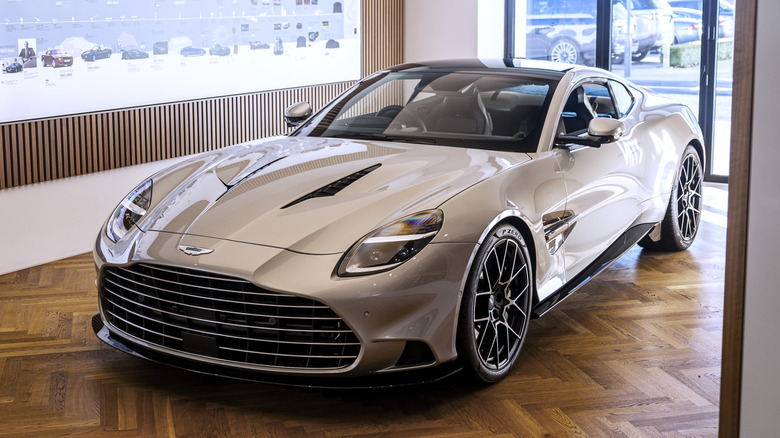
On the topic of pretty cars, the new Aston Martin Vanquish is particularly easy to swoon over. A new model for 2025, the Vanquish is meant to take the place of the DBS at the top of the Aston lineup. The Vanquish is a supremely beautiful car. From the side, its long hood, and refined muscular proportions just ooze capability and confidence. The grille, like most modern Astons, is quite large. Here, it serves more as decoration than distraction. Inside, Aston has completely revamped the interior, which was formerly a weak point in cars from the previous generation.
The Vanquish isn't just a pretty face, though. From the leather-clad cocoon, the driver and one lucky passenger get to experience the greatness that is the Vanquish's 5.2-liter twin-turbo V12. No hybrid systems here, but that doesn't stop the Vanquish from producing 823 horsepower, which is more than enough for a cruise down a twisty road or shooting down a racetrack. The Vanquish's interior thankfully features more physical buttons than many cars we see today, and though the gauge cluster remains digital, you'll likely forget all gripes when the on-screen speedometer reaches 60 mph in just three seconds. Beyond 60, the Vanquish will take you all the way to 214 mph in class.
Ferrari F80
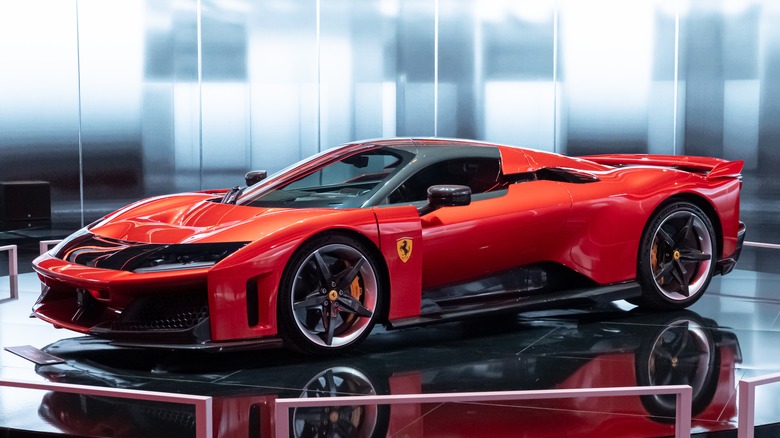
Scuderia Ferrari, Ferrari's racing team, has been around for 96 years. For having nearly a century of racing experience, you can expect a Ferrari halo car to be most at home on a racetrack. Enter, the Ferrari F80. With a predecessor like the LaFerrari, the F80 came into the game with big shoes to fill. No task is too great for the Ferrari engineers though, and the brand pulled out all the stops for the F80's development.
The F80 is powered by a twin-turbo V6 hybrid system similar to the one found in the 296. Everything is spread out in the powertrain: the turbos are mounted inside the V of the engine, and the two electric motors are split between the front and rear of the car. When it all comes together, the system gives the F80 a massive 1,184 horsepower. In the wrong hands, that kind of power is a one-way ticket to a wall, but thanks to the F80's silicon carbide CCM-R Plus brakes, courtesy of Brembo, the F80 can stop on a dime. Should you not wish to stop, though, the F80 will careen on to a 217-mile-per-hour top speed.
Mercedes-AMG Project One
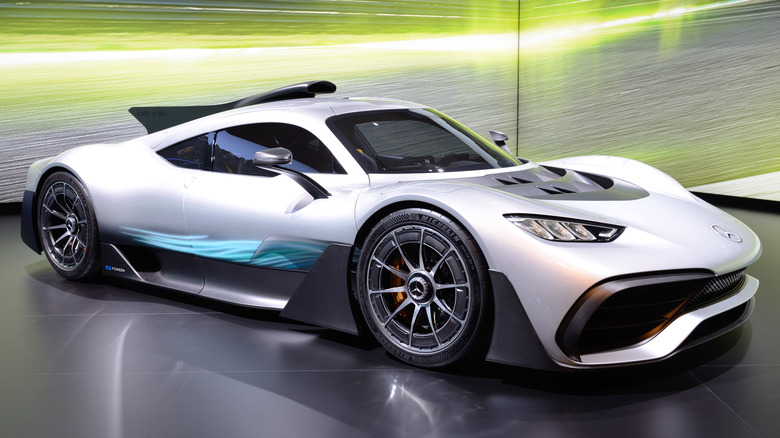
On the topic of hypercars born of racing pedigrees, we have the Mercedes-AMG Project One. Mercedes has learned a lot on the track which is why the madmen at AMG created the Project One, bringing Formula One technology to anyone with $3,171,120 to spend. Formula One car engines have absurdly short lifespans thanks to the immense stress they operate under. For a purpose-built racer backed by multimillion dollar corporations, engines can come and go as needed, but for a road car, it becomes more of a headache.
The AMG One does it though somehow, with a hybrid, turbocharged V6, producing 1,049 horsepower. The engine is mounted directly to the carbon fiber chassis, a rare engineering choice for a road car given the extra noise it produces, but one that also helps the car remain extremely rigid. The list of facts and engineering explanations goes on and on, but the benchmark figure remains the top speed which, in the case of the AMG One, is 219 miles per hour.
Lamborghini Sián
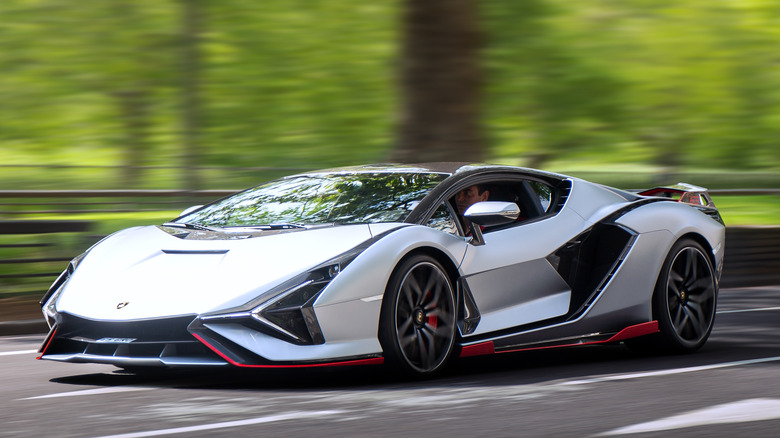
The Sián was Lamborghini's first attempt at mating its legendary V12 with an electric motor. Unlike other hybrids, though, the Sián used supercapacitors rather than traditional batteries. The benefit of the supercapacitors is their ability to produce about triple the power of a lithium-ion battery without any extra weight. They can deliver and receive power more quickly, allowing them to recover more energy than a traditional KERS system would under braking.
Beyond all the electronic wizardry, the Sián is fitted with the huge, 6.5-liter, naturally aspirated V12 borrowed from the Aventador SVJ which, combined with the electric power, leaves the Sian with 808 horsepower. The Sián also features an exhaust ventilation system that helps cool the pipes via a fully mechanical vent system that opens and closes when the exhausts get too hot. The system works without any electronics, thanks to some mystery material that contracts and expands under different temperatures. Those exhausts are bound to get hot, as the Sián races to its top speed of 220 mph.
Pagani Huayra BC

Where many of these cars take their power from some complicated hybrid system, the Pagani Huayra BC is a bit old fashioned, with its twin-turbocharged V12 engine. The Huayra BC, a more track focused version of the standard Huayra, if you can call a Huayra standard. Although it's fitted with some extra aero bits, like the big rear wing or the front canards, the Huayra BC is still more art than car. The interior is slathered in leathers that look like they belong on an expensive briefcase than a car seat, the metal switches create a tactile experience in a world of digital interfaces, and the inner workings of the sequential manual gearbox sits in open air equal parts art piece and gear lever.
To match this staggering beauty, the Huayra BC has staggering performance as well. The six-liter AMG-sourced V12 produces 791 horsepower, which is connected to a central-mounted quad-tip exhaust system that bellows a 95-decibel song. A car of this beauty seems so focused on being beautiful that it's hard to be prepared for the performance it can deliver; it's as if you opened up the frame of "The Kiss" by Gustav Klimt, and found a motherboard that rivaled a NASA computer. That's exactly what the Huayra BC does, though, as this rolling sculpture can fly all the way to 230 miles per hour.
Bugatti Divo
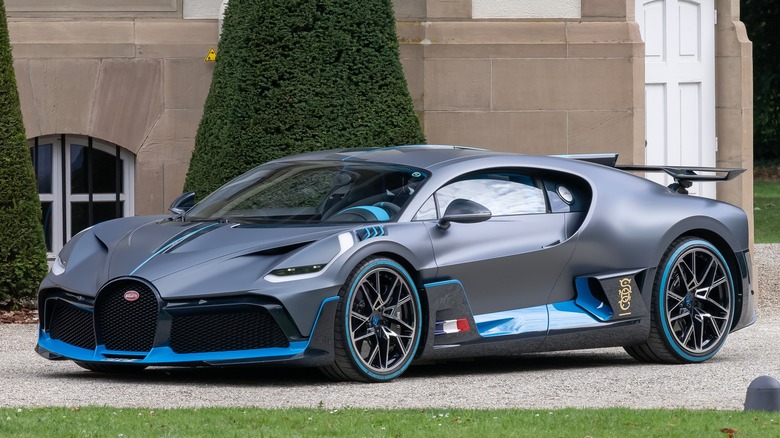
If they didn't have it before, Bugatti reached new levels of fame with the speed king, the Veyron, and became known for providing those with enough money the most elegant way to reach 250 mph without buying a private jet. However, the French company wants you to know they can just as easily make a track monster as they can make a straight-line missile. Their proof for this matter comes in the form of the Bugatti Divo. The Divo shares the Chiron's 8.0-liter, quad-turbo W16 engine, and it produces the same 1,479 horsepower here.
While the interior is basically the same as the Chiron's as well, that's where the similarities end. The Divo saves weight using carbon fiber in any corner it can, including the windshield wipers. It sports tons of aggressive aero components outside like the diffuser and rear wing, which help the Divo generate almost 200 more pounds of downforce compared to the Chiron. This makes the Divo slower than the Chiron, but certainly not slow, as it can rocket all the way to 236 miles per hour.
McLaren Speedtail
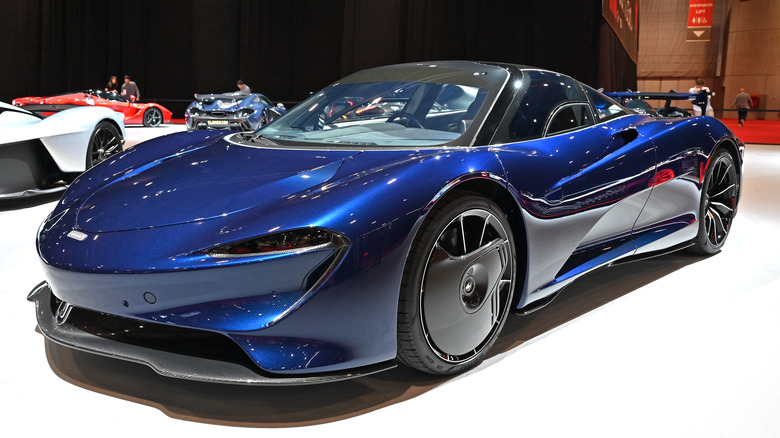
With the Divo existing purely for cornering on the track, the McLaren Speedtail is the perfect antonym, with its mission being one thing: go fast in a straight line. Being McLaren's first three-seater since the legendary F1, the Speedtail came into the world with high expectations. Comparing a car to a spaceship is a common expression among gearheads, but few are as deserving of this as the Speedtail. The most aerodynamically efficient car the brand has ever made, the Speedtail looks not like a car that was born in a wind tunnel, but the wind itself around the car.
As the name suggests, the Speedtail has a longtail design, with the bodywork extending past the rear wheel to smooth airflow near the rear as the car cuts through the wind. It has two active aero flaps on the end of the tail, whose surfaces aren't fully cut from the bodywork, which bends as the flaps raise. Powering the speedtail is a twin-turbo V8, supplemented by an electric motor for a total combined output of 1,036 horsepower and 848 lb-ft of torque. That huge reserve of power means the Speedtail has a top speed of 250 miles per hour.
Koenigsegg One:1
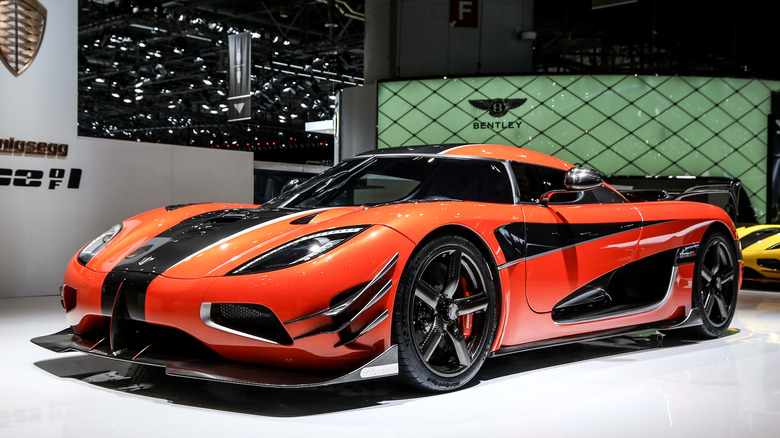
While many of the cars on this list boast technologies that are near the realm of unbelievable to reach their top speeds, the Koenigsegg One:1 might take the crown for mind blowing engineering. The first matter to address is the name. One:1 might seem a bit uninspiring, but the reason behind it is up to the car's power to weight ratio. When it came out, the One:1 is what Koenigsegg called the world's first mega car, meaning it has a perfect ratio of one horsepower per kilogram. The madness doesn't stop there though, as the One:1 rides on hollow carbon fiber wheels, built in house like everything else, and rides on Koenigsegg's Triplex suspension which is a master of all trades system that balances usability with performance.
For stopping power, the One:1 uses carbon ceramic brakes, which are certainly necessary for a car with this level of power. That level of power, to be exact, is 1,341 horsepower when the twin-turbo V8 drinks E85, which sends the One:1 to 60 in just 2.5 seconds. Outside, the aero elements like the LMP2-style shark fin, mean the car produces 1,345 pounds of downforce at 160 mph. That gives the Koenigsegg incredible stability, but it doesn't hinder its insane 273 mph top speed.
Bugatti Tourbillon
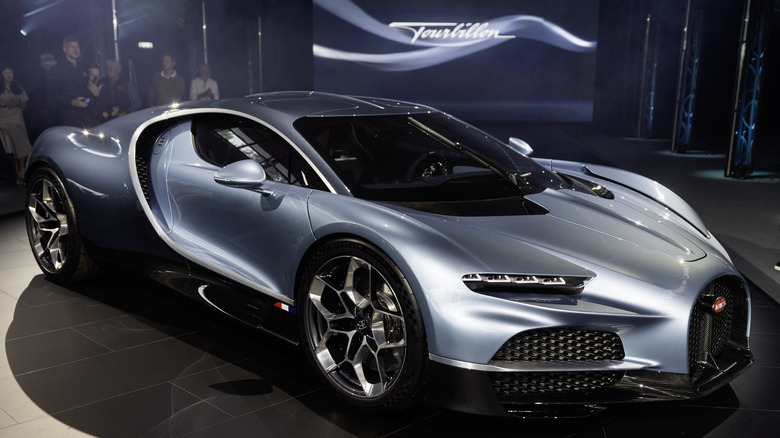
Replacing the Bugatti Chiron is no easy task, but the new Tourbillon (pronounced "tour-bee-yawn") is up for it. A lot is changing, but perhaps the biggest change is the absence of the now-iconic W16. In its place, though, comes something just as impressive. The Tourbillon is powered by an 8.3-liter naturally aspirated V16, combined with three electric motors for a total output of 1,800 horsepower. That V16, which comes courtesy of Cosworth, revs all the way to 9,000 rpm.
The name Tourbillon means "whirlwind" in French, and is a reference to a complex mechanism found in watches that helps keep the time exact. The Tourbillon takes inspiration from its name particularly in the interior, where the physical gauge clusters look like they've been pulled off a billionaire's timepiece. They look pretty, but with a top speed of 276 miles per hour, it's probably best to keep your eyes on the road.
Bugatti Chiron Super Sport 300+

Though it may be hard to believe, all the previously mentioned Bugattis weren't purpose-built for speed. There's one car that Bugatti dedicated to mind-blowing speed, and that car is the Bugatti Chiron Super Sport 300+. There's no point in beating around the bush — this Bugatti was the first production car to break the 300 mph mark. This was no easy feat, and the already rocket-like Chiron had to receive tons of upgrades and adjustments to do it.
Outside, the most noticeable difference is at the rear, where the Super Sport 300+ rocks a longtail design similar to the one on the McLaren Speedtail. Here, the extended rear also pushes the four exhaust tips together into two stacks of two, which are integrated into the diffuser to keep the car stable at high speeds. This was the final hurrah of the quad-turbo W16, which produces 1,578 horsepower in the 300+. Thanks to that enormous power figure, and the medley of other upgrades, the Super Sport 300+ can stretch the limit all the way to 304 miles per hour.