

Do Gator Lawn Mower Blades Need To Be Sharpened?
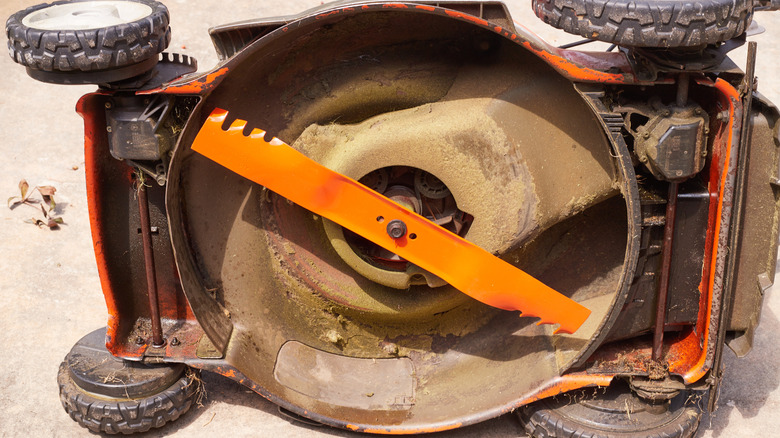
It is easy to miss the fact that they're quite versatile. That's because you can swap out the regular blades for specialized versions, like mulching blades, which chop grass cuttings into incredibly fine pieces, or gator blades, which mince clippings even finer. Gator blades are just one type of mulching blade introduced by Oregon. Like a mower's standard blades, these specialized versions need maintenance, mainly by sharpening the edges, or they'll dull over time.
In order to trim with enhanced precision, gator blades are not totally straight but instead have serrated edges on one side. The serrations look like jagged teeth. It might seem like the right idea to focus on and sharpen those teeth, but that's not actually good for the blade. You could end up damaging them, thereby reducing the blade's effectiveness. The serrations are for directing airflow and clippings back to the cutting edges. If you look closer, you'll notice the jagged pieces are angled towards the center of the blade.
The correct way to sharpen a gator lawn mower blade is to focus on the cutting edge. The straight edge is what you need to keep sharp, and on most gator blades, that edge is also slightly angled or tilted, so be mindful to preserve that as well. As long as you stick to the straight, sharp edges, you can follow the same sharpening process as you would use for a standard blade.
Gator blades are a type of mulching blade
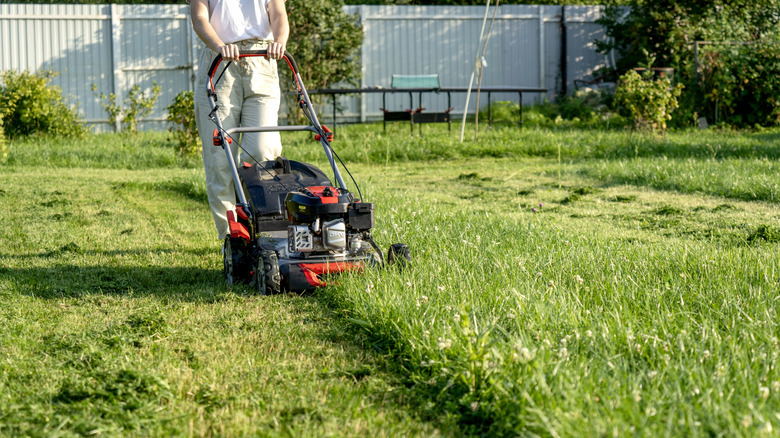
Gator blades are designed to "mulch" or mince grass clippings into incredibly fine pieces. They do this by trapping grass and debris inside the deck — the enclosed mowing section — for longer, and as it passes around and around, it's chopped finely again and again. The clippings can be left as-is and don't need to be bagged or disposed of elsewhere, therefore giving your lawn a natural fertilizer.
Not all mulching blades have teeth or serrated sides. Conventional mulching blades are designed similarly, but tend to have a curved or angled shape versus the straight edges of a standard blade. These are also referred to as 3-in-1 blades because they do more than just cut grass; they mulch it, too. Conventional mulching blades use the curve of the metal to circulate grass clippings rather than relying on a specialized edge. The difference between them is that gator blades are great for heavy-duty tasks with more debris, thicker grass, and during seasons like autumn, when those things are in abundance. Mulching blades are the better option when your grass is thinner or easier to manage overall.