

What Does An Orange Triangular Sign With A Red Border Mean On A Vehicle?
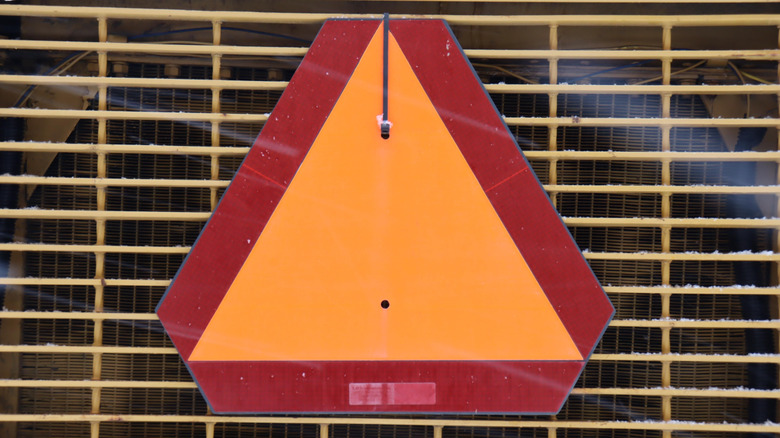
There are a lot of different road signs to keep track of, some more common than others, which means at any given time you could encounter one and have absolutely no idea what it signals. Sometimes, it's easy enough to infer the meaning based on where a sign is or how it's presented. That's precisely the case with the triangular sign that has a red border. If and when you encounter it, you'll find it attached to the back of another vehicle. What is it actually telling you, though?
The sign is the slow-moving vehicle emblem, used for vehicles that travel at 25 miles per hour or below on public roadways. It's actually an equipment marking found on construction vehicles, farm machinery and the like. You might even find one attached to the back of a horse-drawn cart. When you see the sign, you're supposed to reduce your speed, increase your following distance, and avoid passing until its either safe or legal — when the lines indicate passing is acceptable.
The sign or symbol serves two purposes. The bright orange center is fluorescent, making it easier to see during the daytime. The dark red border is reflective, so it lights up in headlights at night.
Why the slow-moving vehicle sign uses orange and red
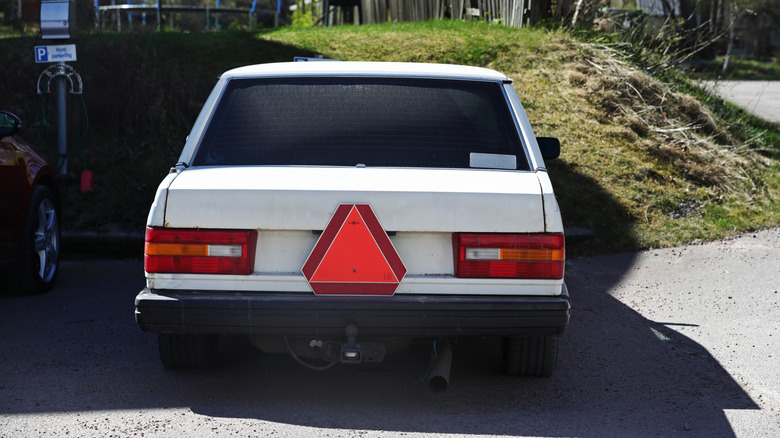
Beyond day and night visibility, the colors are also a general standard for road signs and warnings. You might notice elsewhere, for example, some speed limit signs feature an orange diamond, not unlike the bright orange of the slow moving vehicles emblem. The Manual on Uniform Traffic Control Devices (MUTCD), the national standard maintained by the Federal Highway Administration, reserves orange for temporary traffic control. Another great example is the orange stripes some states are testing on highways; they mean you're inside or entering a construction zone, and they're directing you to slow down and be cautious.
Colors are very important for road traffic signs and indicators, and they're used in many ways to help convey a generalized message. Yellow road signs are almost always used as a warning for upcoming hazards or changes on the road, like no-passing zones, slippery when wet warnings, and more. In the MUTCD, red is reserved for stop or prohibition messages, which explains why stop signs are red. Interestingly, yield signs used to be yellow until they switched to red and white in 1971. The slow-moving vehicle emblem borrows from the same playbook — bright orange to catch your eye by day, reflective red to flag it at night.