

What's The Difference Between A Red And Yellow Yield Sign? One Is Nearly Extinct
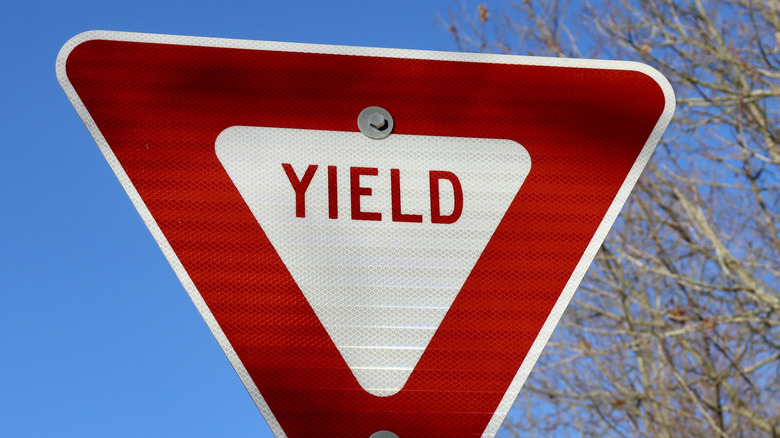
The color and shape of U.S. road signs is a fascinating language all on its own. For example, there are some very interesting reasons why the familiar stop sign is octagonal instead of round or square, and the colors of highway distance signs all signify something unique. If you drive, you should also be aware of the meaning behind the red triangular yield signs often found at intersections or highway off-ramps. However, you might not know that some yield signs used to actually be yellow instead of red.
Yield signs were yellow prior to 1971, when a new convention for a white triangle with a red border was established. This became the standard across the United States and, indeed, around a lot of the world. Any yellow ones on the roads today are remnants of rules set down in 1954 by the Manual on Uniform Traffic Control Devices, predated by an early version first placed in Tulsa, Oklahoma four years before. This version bore the legend "Yield Right Of Way," and was a five-sided shape instead of a triangle.
For around two decades, drivers would have been familiar with a yellow yield sign. Today, they're all but unheard of. If any still exist, they would be a very rare occurrence on a road where they may not have been replaced, such as a distant rural area. Their meaning is, or was, exactly the same: You must yield right of way as needed.
Similar yellow road signs mean merge and more instead
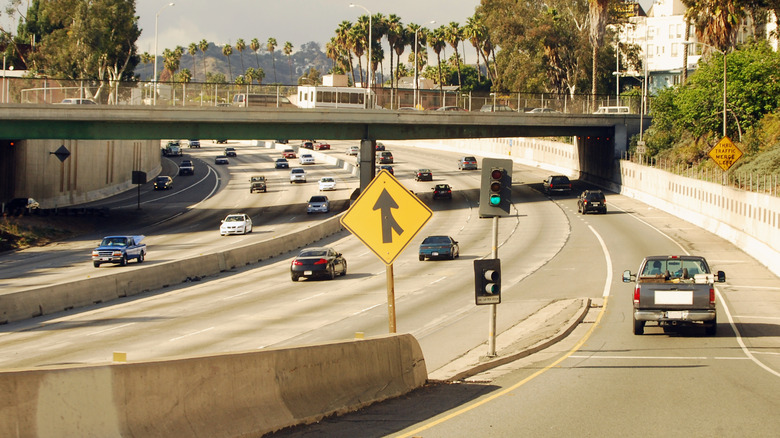
Stop and yield signs are close relatives on the world's roads, as indicated by their shared red color. While the former mandates vehicles coming to a complete stop before proceeding as appropriate, yield is not so restrictive. Here, drivers must instead slow down, take stock, and then proceed.
However, there are other types of road sign that could easily be confused for the old yield sign that are still yellow. Merge signs and their variants, which are typically yellow, are placed to alert drivers to the fact that there is a merging of two lanes ahead. These are warning signs rather than regulatory ones, which denote legal restrictions such as speed limits. However, these warning signs usually have a diamond shape.
There are other signs in the same color and shape that also boast a similar design. "Yield Ahead" signs, for instance, shorten the black arrow seen on a Merge sign and places an inverted red triangle with a white border and interior beneath it. Though road signs are designed to be distinguishable at a glance, some have very similar purposes, and so similar designs. You may think you've seen a yellow yield sign, but it's easy to mistake one of these old relics for a modern sign of a different type.