

New Hyundai Patent Transforms Your Wheels While You Drive
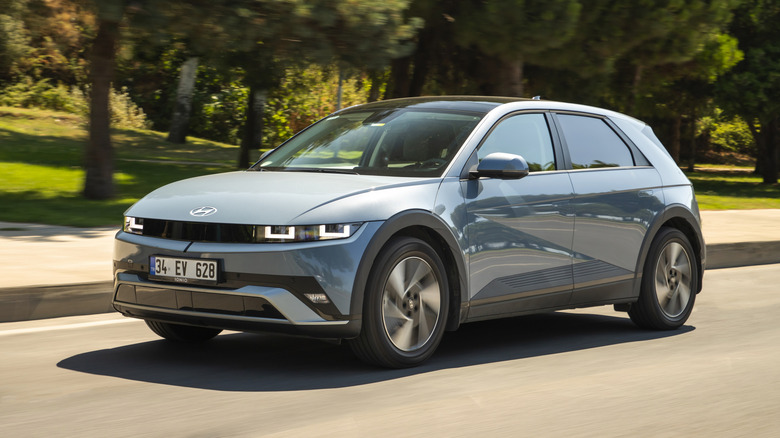
Wheels predate modern human civilization. Sure, the quality of modern car wheels varies depending on the major wheel brand you buy, but they are all still essentially metal circular frames surrounded by rubber tires. Every now and then, a company tries to literally reinvent the wheel, and now Hyundai is joining their ranks with a wheel that morphs at different speeds.
Earlier this month, the U.S. Patent Office awarded Hyundai and Kia US 12,779,902 B2, a patent for a wheel with blades that can move around the spokes and seal up gaps between them. The blades are connected to a rotating ring, and when the wheel starts moving, the ring moves via one of several systems (potentially a linear motor, hydraulic compressor, or air compressor) to seal up the gaps, and when the wheel stops or slows down, the blades move again to expose the gaps. It's not transformation in the most literal sense, but it's more shapeshifting than you get out of most modern wheels save for wheels with free-spinning hubcaps.
The idea behind the wheel is simple: Sealing up the gaps between wheel spokes decreases wind resistance, which in turn improves fuel economy. It's the same reason you shouldn't drive with the windows down, especially on highways. However, closing the space between spokes is a double-edged sword, since doing so makes it difficult (if not impossible) to cool brake discs and dissipate the heat they generate — too much heat wears them down and makes them stink. The technology behind the patent is designed to find a middle ground that improves wind resistance/fuel economy without making brake pads suffer.
Less of a concept, more of a general idea

Just because Hyundai and Kia filed the patent, that doesn't mean they plan to use the wheels in upcoming cars. After all, if a patent automatically meant a consumer product was forthcoming, even the weirdest technology patents ever filed would be real. Last time we checked, we aren't wearing gravity-powered shoe air conditioners.
If you read the patent, you might notice that while its designers know what they want to do, they don't really know how to do it. For example, the linear motor, hydraulic compressor, or air compressor that moves the blades to cover the gaps in the wheels are only a few of the ideas that engineers did not hammer out in the patent. Also, the openings that the blades close could come in any number of shapes, including straight with constant width or flared. Even the blade and the central rotating ring are just one potential idea to produce the desired effect. The mechanism that closes the gaps might even be nothing more than a shape-memory alloy that pushes the blades and an elastic portion that pulls them back, or vice versa.
While the U.S. Patent Office just published the document this month, Hyundai and Kia originally filed it back in 2023 or 2024. That's plenty of time to evaluate potential ideas and sneak closer to a design that can deliver what the patent promises. However, until the companies actually announce anything, we don't know exactly how such transforming wheels will function, let alone if cars will ever use them.