

How Much Could You Really Save At The Pump By Getting 10 More MPG?
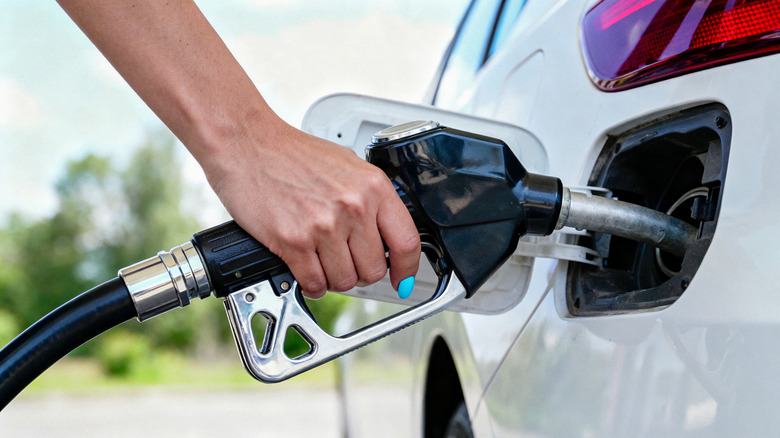
The cost of travel, even on a day-to-day basis, has increased in recent years. Although gas prices are beginning to drop in some states, there's still plenty of uncertainty about their long-term trajectory. Drivers shopping for new cars have increasingly been switching to hybrid vehicles in order to cut their fuel bills, while those who aren't looking to upgrade can take advantage of various driving techniques to boost gas mileage of their current vehicle.
There's no question that higher fuel efficiency can result in big savings at the fuel pump, but exactly how much you can save will vary based on a range of factors. Even calculating your savings from a fixed jump in fuel efficiency — say, an improvement of 10 MPG — isn't quite as straightforward as it might initially seem. However, the key thing to remember is that the lower your vehicle's starting gas mileage, the more you'll be able to save.
To illustrate the potential savings, we can compare the cost of driving from New York City to Washington, D.C., and back using AAA's fuel cost calculator. That journey totals about 450 miles, and, at the time of writing, the average national gas price is hovering around $3.91. A vehicle that averages 15 MPG will drink roughly $130 of fuel during the round trip, but a vehicle that can hit a 25 MPG average will require only $78 to make the same journey. That represents a savings of $52. Switch from a 25 MPG vehicle to a 35 MPG car, and you'll pay $56 at the pump, saving yourself a further $22. Meanwhile, a 45 MPG vehicle will consume only $43 of fuel, saving $13.
The savings add up over the course of a year
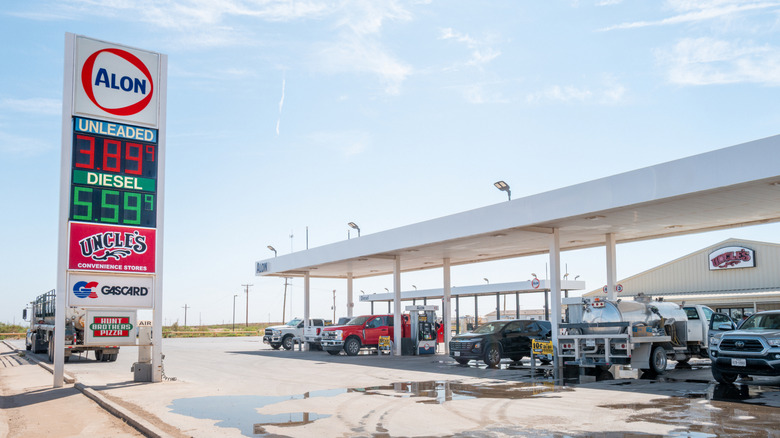
Even across a single longer journey, you can make notable savings on gas by switching to a more economical car, and those savings can really add up. According to the EPA, the annual cost of fueling a vehicle that officially gets 15 MPG combined is around $5,000, assuming you do a varied mix of highway and urban driving and cover 15,000 miles per year.
In comparison, a 25 MPG vehicle will cost around $2,400 in fuel to cover the same distance, saving you roughly $2,600. The higher your starting gas mileage, the smaller the savings you'll make by increasing your fuel economy — a 35 MPG vehicle will cost around $1,700 to keep fueled, saving you $700 or so annually compared with the 25 MPG vehicle. In order to shave another $600 off your annual fuel costs, you'll need a 55 MPG vehicle like the current-generation Toyota Prius, which costs around $1,100 per year to fuel, according to EPA estimates.
The reason that savings decrease as your starting fuel efficiency gets higher becomes clearer when you compare each jump in percentage terms. An increase from 20 to 30 MPG is equivalent to a 50% jump in economy, while an increase from 40 to 50 MPG represents only a 25% jump in economy. Therefore, drivers with the least efficient vehicles have the most to gain by actively trying to boost their average gas mileage.
New vehicles are more efficient than before
Since 2004, the fuel economy of the average new vehicle in the U.S. has been slowly increasing. Back then, the average sat just below 20 MPG, but by 2025, that average had jumped to almost 28 MPG. The most fuel-efficient cars on the market offer figures above 40 MPG, and drivers who cover a lot of miles on urban roads at lower speeds could see their fuel economy hit even higher numbers if they buy an electrified vehicle.
If you're not in the market for a new car, there are still plenty of ways to help reduce your fuel bill. Where possible, it's best to be as gentle on the throttle and brakes as you can, since smooth driving can result in less fuel use. Various tests have also proved that driving with a roof rack can have a bigger effect on fuel economy than you might think, so be sure to remove any roof racks or other drag-inducing car accessories when you're not using them.
It's also worth checking your tire pressure to make sure it's not too low, since low pressure can lead to lower fuel efficiency. Many drivers likely have underinflated tires on their vehicles without knowing it. A 2009 study by NHTSA estimated that 28% of drivers had at least one underinflated tire.