

5 Disadvantages Of Stand-On Lawn Mowers
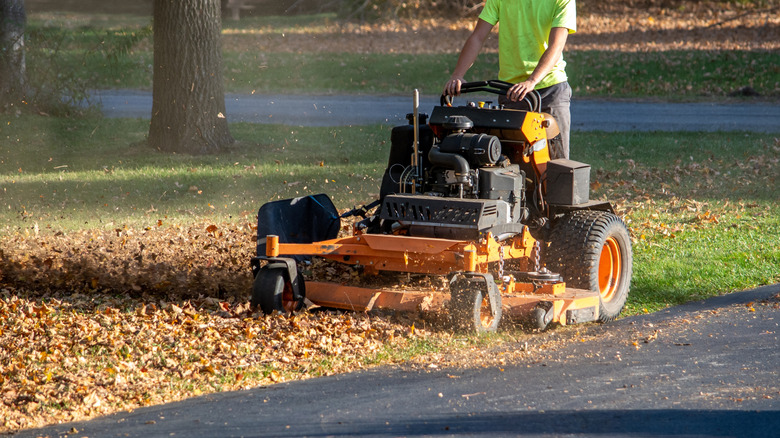
Broadly speaking — and putting aside automated, robotic models — lawn mowers fall into three categories: the classic push-behind mower, the comfortable ride-on, and the heavy duty stand-on. All three of these mower types will cut grass, but the precise way in which they do it and for which jobs they are respectively used for largely what determine which type is most effective and comfortable for you.
Standing mowers, in particular, see most frequent use as professional-grade tools. You've probably seen them being used to mow and manage public land like roadside strips or parks. Indeed, for these kinds of large stretches of grass, particularly those dotted with small obstacles in tight confines, a standing mower would be a very efficient way to cut grass. However, standing mowers definitely aren't for everyone or every lawn care scenario. Their major drawbacks include, but are not limited to, potentially uncomfortable usage, a lack of secondary features like grass collection, and prohibitive pricing.
Stand-on mowers are excessive for a small yard
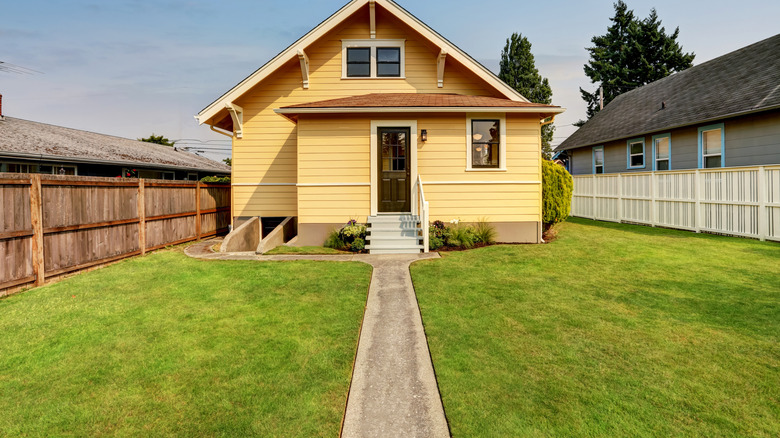
If you have an especially large yard, particularly one that consists almost exclusively of empty swaths of grass, a standing mower would be the most optimal choice. There's a reason they're so frequently used for large public care projects; their large mower decks cut large quantities of grass quickly, and their extra maneuverability makes it easy to make quick turns and pivots. Inversely, if you've got a relatively small yard, and especially one with a lot of obstacles like stumps, rocks, or scattered toys, a standing mower becomes substantially less attractive.
If your yard is smaller and full of obstacles, then that large mower deck is going to be constantly bumping up against walls and fences, not to mention the risk of accidentally shredding a carelessly-dropped soccer ball. It doesn't matter how maneuverable it is if there isn't any room to actually maneuver in. Even if you do have a sufficiently large yard, standing mowers also take up a lot of space, so finding a good place to stash it between yard care seasons can be a headache.
They are not the most comfortable

The obvious difference between a stand-on lawn mower and other mower types is that you're standing still on a platform while using it instead of walking and pushing or sitting down. Some manufacturers of standing mowers claim that they're a better choice than riding mowers from a health perspective, as sitting on a riding mower while it rolls around can be very hard on your lower back. There's certainly some truth to this; if you're of a good physical disposition and want to stay off your rear, a standing mower is a good choice in a similar way that a standing desk is.
Unfortunately, not everyone has the constitution for that. Those who live with problems in their backs or knees won't find that standing operation to be particularly comfortable, especially since, much like how the bumps of terrain are transferred to your lower back on a riding mower, you're going to feel every little lurch in the rest of your body. Even putting that aside, standing up straight for potentially hours at a time is just generally uncomfortable.
There's a learning curve if you're used to other mowers
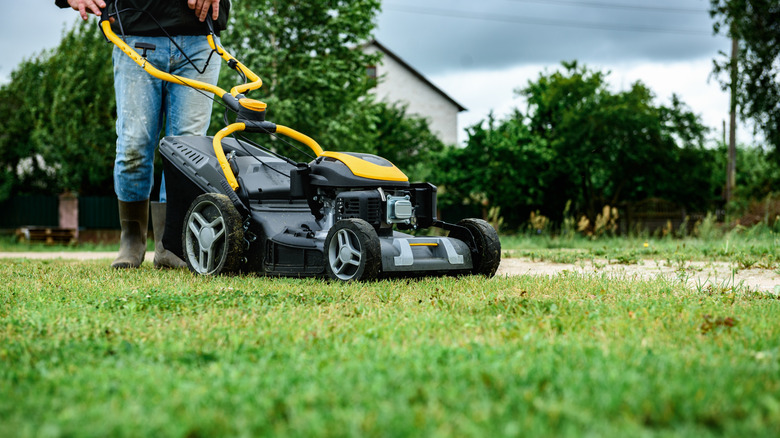
If you're already used to using a particular type of lawn mower, specifically a walk-behind or riding model, switching over to a standing mower will take a bit of practice. The controls are laid out differently, and there's more of an emphasis on speed control and maneuvering. Landscapers who have spent years using one of the other types of mowers may find standing mowers disagreeing with them, at least for a few weeks until they properly get used to it.
Obviously, there's a learning curve to all types of landscaping equipment, but this particular point ties back to the initial matter of whether or not your yard actually necessitates one. If you're finding it difficult to wrap your head around the usage of a standing mower, you might need to consider whether or not it's optimal for your particular lawn situation, or if just sticking with what you know would be better.
There's less room for collection bags
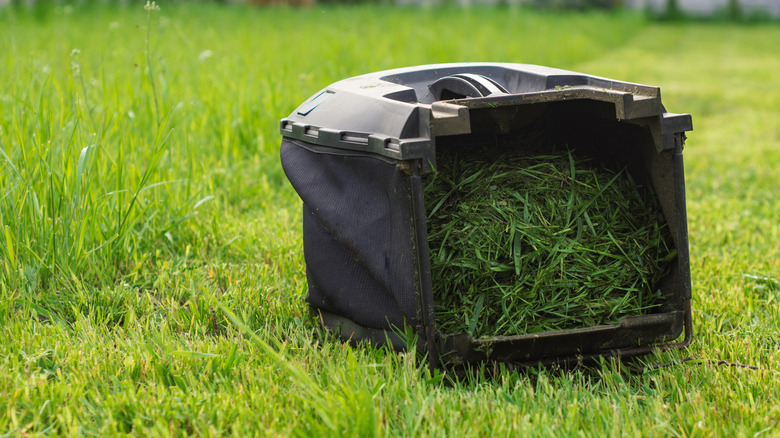
The most readily-apparent benefit to a standing mower is its massive, muscular mower deck. However, standing mowers are a bit overspecialized in this regard; that massive mower deck is impressive, and will cut up a lot of grass, but because it's so massive, it doesn't really leave any room for secondary features that may come standard on other mower types. For example, some models of standing mowers don't even have collection bags.
Without a collection bag, even after you're finished mowing the lawn, there's going to be a lot of loose clippings all over the place, which you'll have to either clean up by hand or just hope don't get blown by the wind close to your home. Granted, some standing mowers do have collection bags, but they're generally smaller than those present on pushing or riding mowers, which means you'll need to hop off the mower more frequently than usual in order to empty them out. With the kinds of large lawns that standing mowers are best-suited for, that's going to result in a lot of obnoxious stopping and starting throughout the day.
They usually have professional-grade pricing
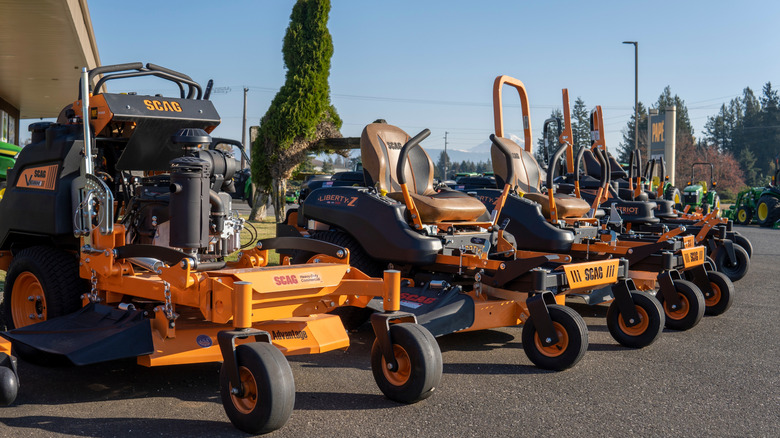
As we've mentioned, stand-on lawn mowers are used first and foremost by professional landscapers handling large-scale jobs on either public land or large, private yards. Putting aside all of the aforementioned sizing concerns, the simple fact of the matter is that a standing mower is a professional-grade tool, and professional-grade tools are seldom cheap.
A professional-level stand-on lawn mower can easily cost somewhere in the $30,000 range. While this might be a typical expense for a professional landscaping company, it can be an exorbitant, life-altering amount of money for a single homeowner. In fairness, that is an extreme example; there are also more cost-effective standing mowers that are more designed for casual use, but even these will still run you somewhere in the ballpark of $5,000 to $10,000.
Compared to the around-$500 a typical pushing mower would cost you, or even the approximately $3,700 a zero-turn riding mower would cost you, your most cost-effective choices amongst lawn mowers should be readily apparent. If you don't absolutely need a standing mower for an exceptionally large lawn, it's probably not going to be worth the investment.