

These Buoys Produce Very Useful Sounds - Here's Why Most Boaters Never Hear Them
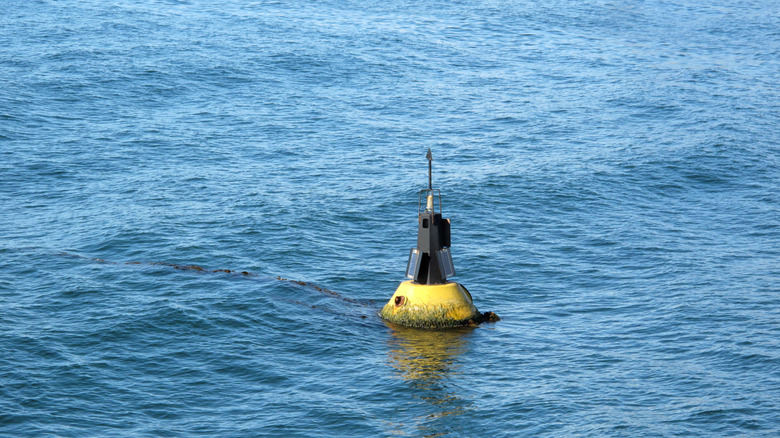
A classic staple of maritime life is the distinct tones of a bell buoy out on the waves. While not all buoys have bells, the ringing tones they produce are part and parcel with coastal and harbor towns. However, bell buoys are not the only type of buoy that utilizes sound in some form. There are at least two other types of buoys that create sound to indicate their position: whistle buoys and gong buoys.
In contrast to the buoys that measure waves, these buoys produce their own distinctive tones through the use of whistle and gong apparatuses, signaling their position to passing boats in the midst of low-visibility conditions. However, their usage is more specific than the common bell buoys, which the U.S. Coast Guard has attempted to replace with more advanced GPS-based positioning systems in some locations. Even so, if you listen carefully out on the foggy waters, you might just hear the mournful wail of a whistle buoy or the multi-toned ringing of a gong buoy.
Whistle and gong buoys produce distinct sounds with the movement of the waves
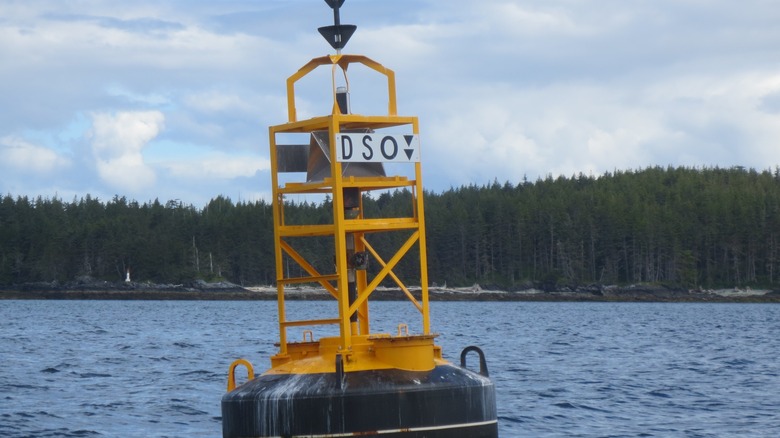
Both whistle and gong buoys, broadly speaking, function on the same principles as a bell buoy. All three types produce distinctive audible tones as they're rocked around by the movement of the waves, which in turn clues sailors into their positions even if visibility is poor. When you know a certain type of buoy is nearby, you'll know where you are, even if you can't see signage or coastlines.
The original whistle buoy was patented in the late 1800s in the village of Cornwall-on-Hudson, New York. It featured a long, hollow tube attached to the bottom of the buoy with a whistling mechanism at the top. As the buoy bobbed up and down on the waves, air was pushed up through the tube and out the whistle opening, producing a low, almost groan-like tone. Whistle buoys can be found near hazardous areas or open sea channels.
Gong buoys, meanwhile, date back to the early 1920s. Using a similar design principle to bell buoys, their soundmakers are located in the center of the body where a bell would usually be. The difference is that instead of a single bell and ringer, a gong buoy uses several gongs and clappers arranged in patterns. As the waves roll the buoy around, the clappers tap on gongs of different sizes, producing a handful of different tones, which can be used to distinguish one buoy's placement from another.
Tone-producing buoys have become gradually rarer

While tone-producing buoys can be helpful for informing boaters of where they are even in low visibility, advancements in maritime technology have made that particular function somewhat redundant. After all, a few distinct tones aren't as helpful for determining your position as a constantly updating map, and even buoys themselves are becoming smarter. This is why bell buoys have gradually been phased out, and since whistle and gong buoys are even rarer, you're far less likely to hear them.
There are still a few buoys out there that maintain their positions either due to their particular function or an affinity with locals. For example, in 2025, the U.S. Coast Guard proposed removing a particular gong buoy located at the southern tip of Damariscove Island, off the coast of Maine. This region, known locally as The Motions, is home to rocky off-shore ledges that have caused more than a few shipwrecks. This is why locals campaigned to maintain the buoy in order to keep vessels away and protect the island's nature preserves.