

How Do Ocean Buoys Measure The Height Of Waves?
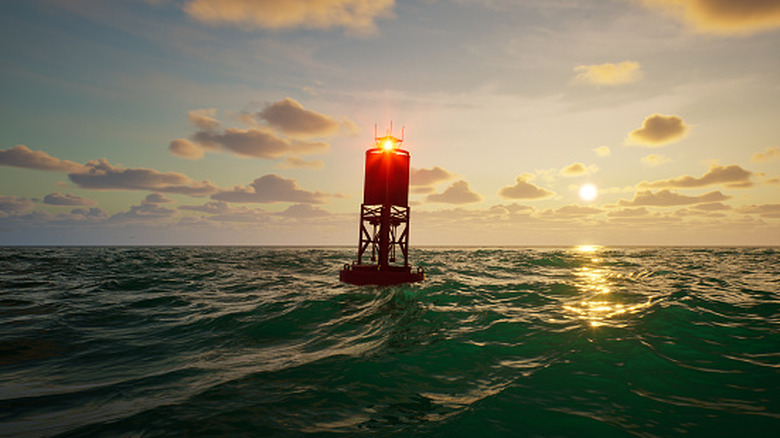
Different types of buoys can serve different purposes. While many buoys are essentially the traffic signs and signals of the water, providing boaters with valuable information about everything from speed limits to safe water zones, others are meant to gather data via sensors. Some buoys specifically gather data relating to wave activity including collecting data relating to wave height.
Those buoys aren't constantly collecting wave data; doing so would require too much power usage. Instead, they collect data during a window known as the "wave acquisition time." During this period, either accelerometers or inclinometers will measure either a buoy's heave acceleration or its hull's vertical displacement. A processor on the buoy then applies a Fast Fourier Transform (FFT) algorithm that takes the buoy's temporal domain data and translates it into frequency domain data.
To ensure hull and electronic noise doesn't interfere with the results, response amplitude operator processing must also be applied to the data. The transformed data can then provide a range of information about a wave. This includes information about its height.
Buoys collecting wave-related data often measure more than a wave's height. Thus, the data collection and generation process needs to be such that it can gather multiple pieces of important data at once.
Buoys measure wave height and related data

Buoys such as this can be equipped with a lot of other sensors. They might also collect data regarding water temperature and salinity or be equipped with a receiver that allows them to detect the presence or location of tagged fish. Some also have a current profiler, a device meant to help determine the speed and direction of ocean currents.
On at least some of these buoys, onboard computers relay the data collected back to shoreside databases as often as every six minutes, ensuring a reasonably consistent collection of data. The hull must also be strong to protect all these components out on the water.
Just keep in mind that buoy technology is always evolving. For example, today's smart buoys offer capabilities that buoys from the past may have lacked. That means the way buoys measure wave height could change (and theoretically improve) in the future.