

What Are Drifting Buoys & Where Are They Found In The Ocean?
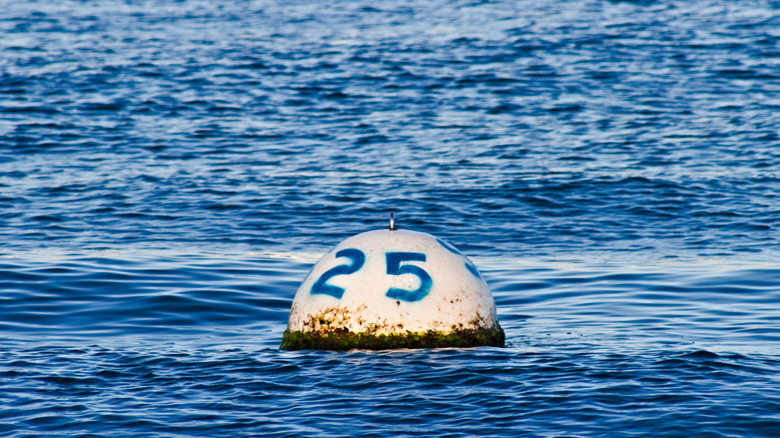
If you're new to boating, there are quite a few rules and regulations you're expected to know before launching your boat for the first time. It'd also be wise to spend a little time studying up on things like the 100-feet rule in boating, as well as reading up on what the various buoys you come across in the water mean for your vessel.
There are, after all, several different kinds of buoys you might see when you're out on the water, and their size, shape, and color can signal different things to approaching boaters, including some vital safety warnings. Then there are other buoys that are not positioned to function as warnings or navigational aids, or even for mooring. That list includes drifting buoys, which, as their name implies, are not tethered to a fixed point in a body of water, and instead are meant to drift freely with the currents.
Those free-floating fixtures are performing an important task, however, as they tend to function as research tools. Most drifting buoys are equipped with various sensors that provide meteorological and oceanographic information to those who deploy them either at sea or in larger closed aquatic bodies. That includes data such as water temperature, surface circulation, and air pressure, among others. While there is no designated color for the buoys, they tend to be painted in bright colors to make them more visible.
Where you might see a drifting buoy on the water and how they work
According to the National Oceanic and Atmospheric Administration's Atlantic Oceanographic and Meteorological Laboratory, more than 1,000 drifting buoys are floating free around the globe. Given their purpose, you won't be able to find any of those drifters in one designated location, as they are designed to move freely through the world's oceans. That means you could potentially see one whenever you take your boat out into open ocean waters anywhere in the world. While they are not typically deployed long-term in larger lakes, some researchers have used them for short-term studies there too.
The buoys are equipped with satellite tracking tools, so the groups that have deployed them at sea can keep track of where their drifters are. As for what you might actually see when you come across a drifting buoy in the water, assuming it's in proper working order, the surface floating fixture should be the only element visible to the boater's eye.
That surface float will likely be fitted with sensors transmitting some of the aforementioned data back to whoever deployed it. The buoy will also be connected by a tether to a drogue, which is essentially an underwater parachute that helps it follow ocean currents without being pushed around as much by wind and waves. If you do come across a drifting buoy in the water, it's best to leave it alone and float right on by.