

7 Ways AI Is Ruining Gaming

The promises of a future powered by artificial intelligence feel increasingly hollow, and the negative effects of this AI boom are rippling through other industries. People are being laid off and replaced by programs, artists are constantly threatened with having their creativity plundered, and environmental concerns have grown because AI data centers consume vast amounts of power.
Even the beloved video game industry isn't safe from AI. In fact, one might argue it's the most affected, since one of the leading graphics card developers has pivoted fully into AI, a move many gamers aren't exactly fond of. People who just want to enjoy their hobby and unwind with their favorite video games now will have to deal with the constant AI threat hanging out in the background. From companies forcing some semblance of artificial intelligence down their throats to both consumers and developers feeling their wallets lighten as a result of the AI boom, there's no shortage of ways AI is slowly but surely changing gaming for the worse.
Higher price of components

As big as the other problems AI causes in gaming are, they pale in comparison to the elephant in the room—price hikes. Sam Altman's lampooned comment on RAM hoarding shows just how irritated gamers are by the memory shortage affecting the industry right now. RAM and SSDs are hit hard, with higher-capacity modules four to five times more expensive than they were just half a decade ago. Basically, the era of affordable high-RAM laptops and pre-built PCs is ending.
GPUs aren't far behind, with NVIDIA spearheading the push to develop AI-powered cards for data centers and enterprises. This shift has been significant enough that the company no longer prioritizes consumer-grade graphics cards, delaying the RTX 60 Series. After all, PCWorld reports that AI chips have a 65% profit margin, compared with 40% for GPUs.
If that wasn't bad enough, these cards constantly face price hikes. At the time of writing, another rumored GPU price hike could raise MSI's RTX 5080 by up to $1,200, while the RTX 5070 Ti could see a similar hike of up to $600. It's a dire time for PC gaming, especially since both GPUs already have the worst price-to-performance ratio in NVIDIA's lineup.
Vibe coded AI slop

AI-generated art and music were already bad enough, lacking the creativity that makes these two artistic mediums so beloved. Now, it seems that the age of AI-generated games is also upon us. Vibe coding has become the next big thing in this AI boom, and its effects are very negative for the gaming industry. It has reached the point where we've said you should never use AI for vibe coding. The most recent Steam Next Fest was full of vibe-coded slop, and it became a huge problem. Gamers are demanding an AI filter so they don't have to look at low-effort titles.
This problem will hit small-time developers hardest, who rely on searchability and the Steam algorithm to reach new eyes. With AI-generated games flooding the market, all the hard work they've put into an indie game could be for naught, as a deluge of AI slop prevents people from finding it in the first place.
Vibe coding has also been used to recompile console games to run natively on PC. Instead of running through an emulator, which takes up more processing power, these games can run by accessing your PC's hardware directly, which should make the process far more efficient. Unfortunately, because people aren't analyzing the code to see exactly how the game operates and just let an imperfect AI model handle this task, recomps like the "GoldenEye" project have come with their fair share of bugs.
Developers having their games stolen

Vibe-coded games affect a developer's livelihood in many ways. We've already touched on searchability, but a far more serious problem is that it dissuades new devs from showing their game in the first place. Titles like "Drunken Goddess Reflux" and "ReVamp" chose not to provide a demo, while "Spookitchen" had to pull their demo in two days. These decisions stem from changes in vibe coding.
"Spookitchen" learned that people were using their demo to train AI models to vibe-code a game "inspired" by them, which could be interpreted as IP theft. Both "Drunken Goddess Reflux" and "ReVamp" cited this issue in their statements, saying they were scared people would take their IP assets and code to generate a game faster than they could release one of their own.
This is a huge problem for indie devs who rely on word-of-mouth marketing and a strong first impression to attract people to their project, potentially as backers if they're relying on crowdfunding. Demos are finally returning to the video game scene after an indefinite hiatus, but people don't like them, so these game previews could fizzle out again. Clearly, vibe coding is just as problematic as everyone thought.
Mass layoffs

The video game industry was already struggling with layoffs long before the AI boom. With AAA development becoming more taxing than ever, most companies hired a bunch of employees as release dates neared to speed up development. Not only do these people have to deal with major crunch times when this method fails and games are delayed anyway — a far more common occurrence than anyone would like — but there's a strong chance that companies will lay off employees following the release period when people don't need to balance this intense workload anymore.
To no one's surprise, AI has made this problem exponentially worse. Wired conducted a 2024 investigation and found that major AAA companies, including Activision Blizzard, used generative AI to develop games after firing a chunk of their workforce. According to a study by FMC Group, AI has helped cut over 175,000 jobs in the US since 2023, and the video game industry has borne some of these losses.
Sam Selker, the Global Subsector Leader for Gaming at Stanton Chase, discusses how AI is taking over tasks once reserved for entry-level roles. This can have a domino effect, where the industry's output worsens in quality because fewer people have the opportunity to learn, build their careers, and eventually become leaders. Then there's Krafton, a company riding high on the success of games like "PUBG" and "inZOI." Even then, the gaming company moved to replace employees with AI in 2025. As a result, many players understandably called for a boycott to protest the practice.
DLSS 5 taking things too far
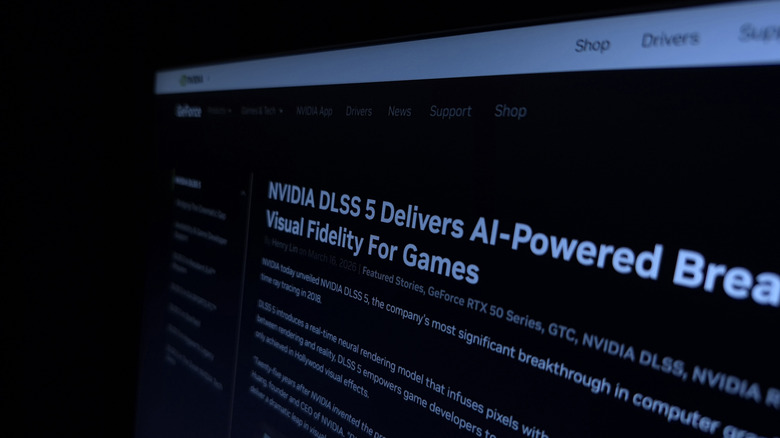
If there's one positive effect of AI in gaming, it's the advent of deep-learning predictive algorithms that predict each frame's visuals, using AI to generate them and significantly reduce a GPU's rendering workload. Well, this used to be a positive thing, until DLSS 5 reared its ugly head. Instead of using simple upscaling algorithms, DLSS 5 resorts to a very intrusive solution that fundamentally changes the look of your game, especially character models.
Kotaku asked multiple game devs about this "feature," and all were as perplexed by DLSS 5 as most gamers. For what it's worth, NVIDIA CEO Jensen Huang has said developers can tweak this advanced form of DLSS to work accurately instead of recreating the results in their infamous reveal trailer, so this feature may not be as intrusive as we'd assume. The recent integration of DLSS 5 in "Hogwarts Legacy" is a great example, with the game doing a decent job of using the feature without making the visuals too overprocessed.
Cheating in multiplayer games is easier than before
Cheating was a problem in multiplayer video games long before AI came into the picture. Most of these cheats worked by altering game code to change things, ideally in the player's favor. This isn't a major issue in single-player games, but people who want to enjoy a fair multiplayer experience won't appreciate another player tweaking the code in their favor. Widespread cheats like wallhacks and aimbots made these alterations, which anti-cheat protocols could spot as long as they were efficient enough.
Now, with machine learning in the picture, a game's code can remain perfectly untouched. Instead, an AI model can analyze a screen capture to determine when a target is on screen. The model can be programmed to send commands to a controller emulator that fires your gun or uses any other weapon with near-perfect timing. Given how much competitive multiplayer games depend on a person's reaction speed, it's no wonder this refined AI-powered cheating has become such a major problem in the latest "Call of Duty" game, "Counter-Strike 2," "Valorant," and other titles.
Big corporations becoming increasingly reliant on AI
Epic Games recently announced that it uses vibe coding extensively in its operations. This was followed by a lofty claim that the Epic Games Store was now more efficient than Steam—a claim Valve hilariously disproved a day later, beating Epic's 5.47-second boot time with an update that cut Steam's loading time to 5.23 seconds.
As funny as this "gotcha" moment may be, Epic's focus on vibe coding isn't great for the gaming industry. Unreal Engine remains the go-to engine for most people who want to make modern-looking games with state-of-the-art graphics, and Epic's proud promotion of vibe coding for Unreal Engine 6 paints a sad picture. This is especially true given how the company had sacked a thousand employees in March 2026, citing a "downturn in Fortnite engagement."