

These Critical US Buoy Colors Are Flipped In Most Other Regions - Here's Why
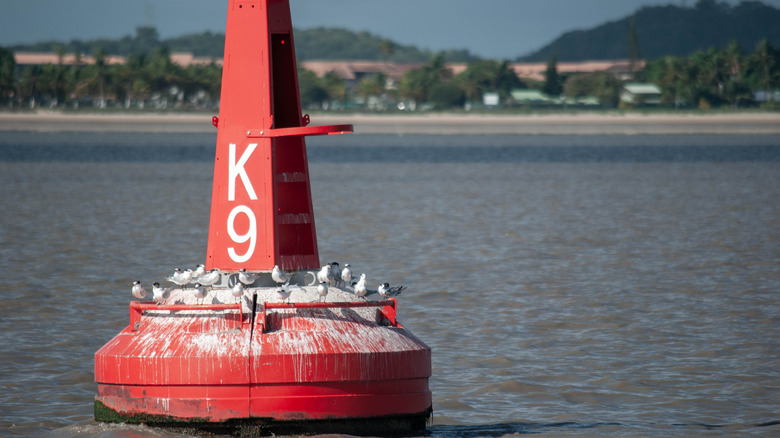
Buoys are essentially street signs of the water. They can tell boaters which locations to avoid and where to go, and special navigation buoys can help save lives. But as with street signs, navigating by buoy often relies on adherence to design standards. Unfortunately, the buoys that direct boat traffic vary by country.
To navigate certain waterways and channels, mariners rely on the International Association of Marine Aids to Navigation and Lighthouse Authorities (IALA) buoyage system. Unlike street signs that help drivers determine right of way, these buoys tell deck officers which way to go to avoid collisions and come in two shapes: can and cone. Can-shaped buoys are always meant to stay on a ship's port side (left for laypeople/landlubbers), while the cones should remain off a ship's starboard (right) side. However, to make these veritable floating signs more visible, manufacturers paint them red and green and install red and green lights, respectively. However, depending on your port of origin and destination, you might encounter two different shape and color combinations.
The IALA buoyage system is divided into two regions: Region A and Region B. The U.S. is part of Region B, alongside Mexico, South America, Canada, Japan, the Philippines, and Korea. Everywhere else is in Region A. Here's where the confusion starts. If you are in Region B, the port IALA buoys are green and the starboard ones are red, but everywhere else it's flipped. That means if you visit a dock in the U.S., you need to have red cone buoys to your right, but when you stop at a dock in the U.K., green cone buoys should be on your right.
Why the IALA chose these colors (and why they aren't universal)
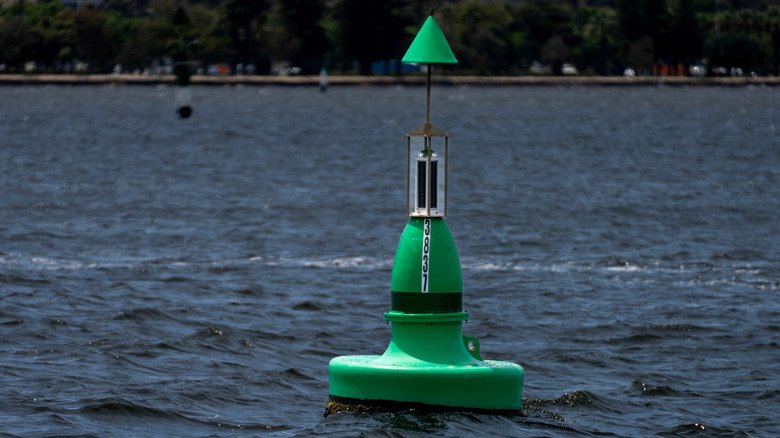
If we're being honest, the IALA buoy system sounds a lot like how different countries treat vehicle traffic. In the U.S., cars drive on the right side of the road, and boats have green buoys on the left; in the U.K., cars drive on the left, and boats have green buoys on the right. But how did this system get started? With several boat crashes that claimed 51 lives.
The IALA buoyage system can be traced back to the Dover Strait (or Strait of Dover), the narrowest part of the English Channel. In 1971, a Panamanian tanker and Peruvian freighter accidentally rammed into each other due to thick fog. While most of the crews were rescued, the wreckage remained, creating a snowball effect that claimed two more ships and several more lives. An investigation determined that if the strait had used more visible and recognizable navigation markings, the crashes could have been avoided.
Technically, countries have been using colored buoys to mark the sides of waterways since 1889, but nobody could agree on which buoys should use which colors of lights. The Dover Strait disaster served as a catalyst for a second attempt at universal buoyage systems. Ironically, IALA achieved this by realizing true uniformity would be impossible, so along with representatives from numerous countries, the organization split the world into two regions: those that use green buoys to represent port side and red buoys for starboard, and those that do the opposite. This time, the changes stuck, not unlike how drivers got used to the time when U.S. stop signs changed from yellow to red.