

Stop Signs Used To Be Yellow - Here's When (And Why) The US Made The Switch To Red
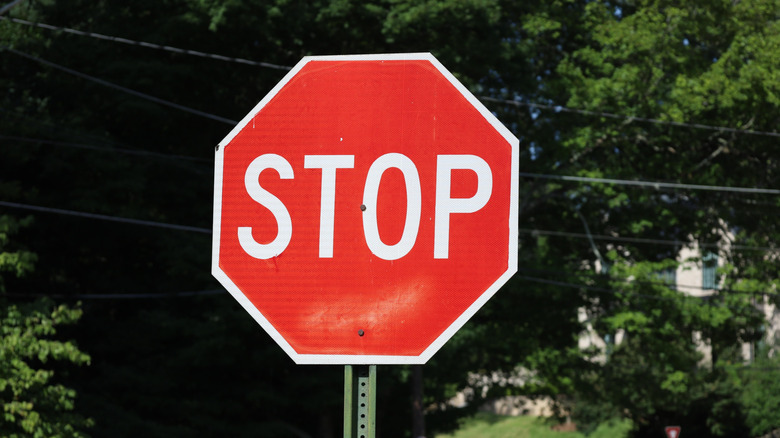
There are two things almost everybody knows before they get behind the wheel of a car for the first time: Green means go, and red means stop. This goes back to the very first traffic lights created by J.P. Knight in the 1860s, when gas lamps were used for illumination, and continued with the first electric traffic light in 1912 in Utah. Even with the addition of the yellow light in 1920, those two colors still held their meanings. Because of this strong bond between stopping and the color red, it comes as a surprise that the first stop signs weren't red. They actually went through a couple of color changes.
There's some debate as to its true origins, but the commonly held opinion is that the first stop sign popped up in Detroit, Michigan, in 1915. This sign had black lettering on a white background and was a 2-foot by 2-foot square, designed by William Eno. Stop signs started showing up around the country and came in a variety of different colors. It wasn't until 1923 when the Mississippi Valley Association of Highway State Departments created the stop sign that resembles our current one. It was an octagon with black lettering on a yellow background.
It resembled the yellow warning road signs we still have today, which was the intention. This color is meant to denote the most hazardous of roadway conditions, and yellow is a particularly good color to catch the human eye, whether it's dark or light outside. Naturally, needing to come to a stop would warrant such a warning. By the end of the decade, yellow was the standard color.
Stop signs stayed yellow until the 1950s
Stop signs would remain yellow for decades, but even with that yellow background, they still underwent some evolution. The first Manual on Uniform Traffic Control Devices was released in 1935, detailing all of the national standards for road signs and more. This not only cements the stop sign as an octagon to signify its importance among all road signs, but also clarifies that stop signs have yellow backgrounds and can use either black or red lettering.
It also stated that the word "Stop" needed to be illuminated in order to be seen best at night, and the word needed to be visible from at least 350 feet away. This could be done with a light from within or behind the sign, a floodlight fixed directly on the sign face, or reflective elements in the sign face. The MUTCD would keep this in place for subsequent editions and revisions until 1954.
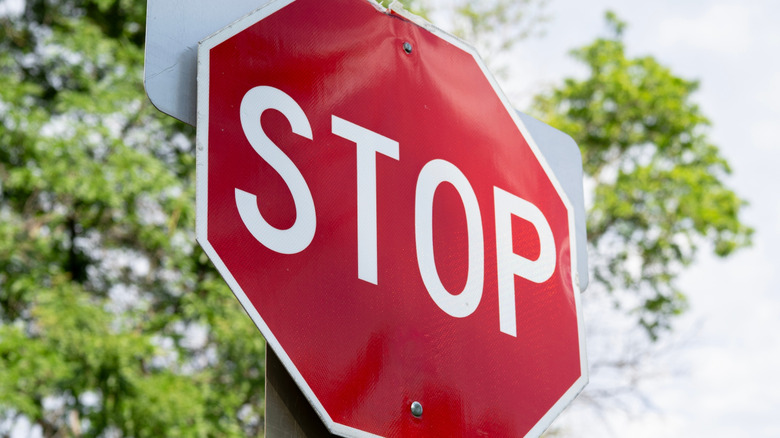
That year, it was decided to change the stop sign to the white lettering on a red background design we use to this day. This resulted from the development of a fade-resistant red coating that you could apply to signs that also made them visible at night. Without this coating, red is a very difficult color to see in low light. This is why it was never adopted as the background color prior to this, despite the association with the color and stopping at traffic lights. Making the sign red also further signaled the sign's overall importance in traffic safety. The 1954 revision also stated that no other text could appear on a stop sign besides the word "Stop."
Differentiating regulatory and warning signs
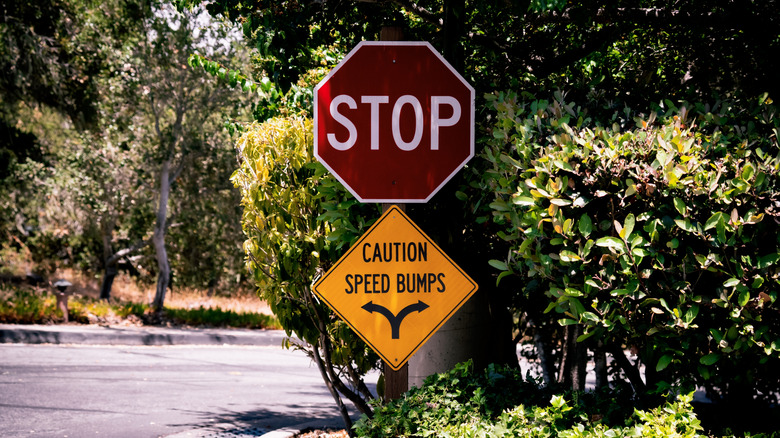
There's more than one reason the stop sign changed from yellow to red. Beyond the material advancements that allow this color change, it also makes an important distinction about what kind of sign a stop sign is. Every sign on the road is a certain color not just because of its visibility, but because it falls into a particular road sign category. Yellow signs are warning signs, but stop signs are known as regulatory signs.
Regulatory signs are road signs that are legally enforceable markers of road safety. These include speed limit signs, movement regulation signs, and parking regulation signs. Stop signs are also regulatory signs, which means that you are breaking the law if you don't abide by them and can result in tickets, fines, or worse. Most regulatory signs have a white background, but stop signs stand out with red.
Warning signs, on the other hand, are the yellow signs you see that are there to make sure drivers exercise caution while driving in certain scenarios. While a cop may pull you over and issue a punishment if you flagrantly disregard these signs, they don't have the same legal weight as regulatory signs. Having a stop sign — one of the most important signs on the road for safety — be the same color as a run-of-the-mill warning sign could cause serious issues, and changing it to red significantly reduces those. The yield sign would undergo a similar change several years later, going from yellow to red and white, increasing the regulatory importance of that road direction.