

History-Making Nuclear Aircraft Carrier USS Enterprise Takes Its Final Voyage At Sea
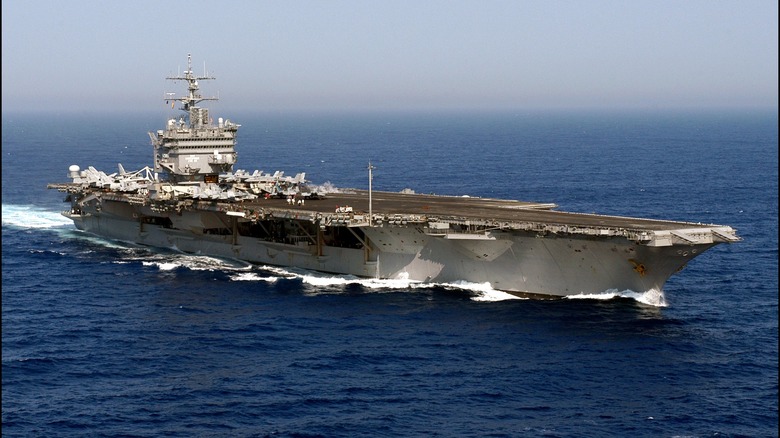
Aircraft carriers have a long history on the world stage; just by itself, the U.S. Navy has fielded 12 major classes of aircraft carrier over the past 100 years. However, the stress of battle and sailing the oceans takes its toll, and eventually all aircraft carriers are retired. However, few carriers carry quite a noteworthy legacy as the USS Enterprise due to its length of service and its origins.
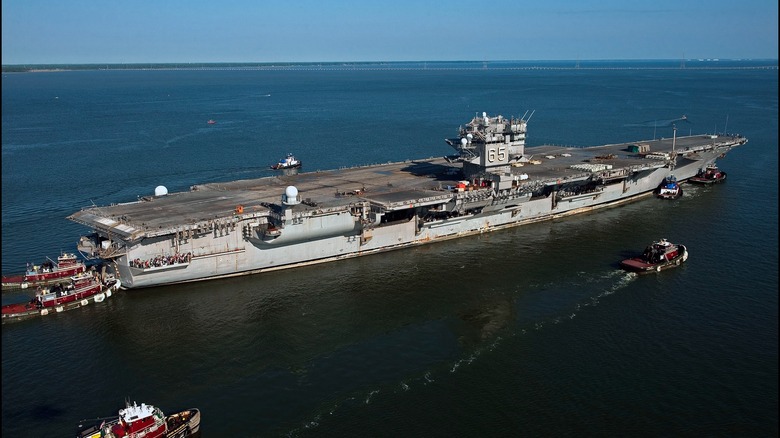
At the beginning of November, the U.S. Navy announced that CVN 65, better known as the USS Enterprise (sometimes "Big E"), would begin its final journey from Newport News Shipbuilding in Virginia to Mobile, Alabama. Once there, the vessel would be dismantled. Technically, the process has already started, as the "ex-Enterprise" is little more than what is known as a "hulk" — a large ship that has either been stripped down or can no longer sail under its own power. Either way, while the once proud Enterprise can still float, another vessel will tow the ship to its final destination.
The CVN 65 Enterprise was the world's first nuclear-powered aircraft carrier. The ship was commissioned in 1961 and stuck around for many historical conflicts, including the Cold War, the Vietnam War, and Operations Enduring Freedom and Iraqi Freedom. However, nothing lasts forever, and the US Navy began the long and arduous process of decommissioning way back in 2012. Technicians weren't able to fully remove all nuclear material until 2017; the Enterprise's trip between Virginia and Alabama is merely the final leg of its graveyard-bound journey.
This death is only the beginning
Aircraft carriers aren't the only seafaring vessels that rely on nuclear power. Plenty of countries around the world use advanced nuclear submarines, and while new ones are built every day, navies likewise decommission aging submarines and their nuclear power plants. However, knowing how to disassemble one style of nuclear reactor doesn't always transfer over to other styles.
As the USS Enterprise was the first nuclear-powered aircraft carrier ever built and commissioned, it will also be the first one ever disassembled, which is as noteworthy a place in the history books. Engineers will learn how to do it as they go. As Captain William B. Cleveland, former Principal Assistant Program Manager in the Aircraft Carriers Program Office, said in 2024, disassembling ships like the Enterprise will create "a blueprint for the Navy on how to dispose of [nuclear-powered, large-deck carriers]."
One might assume that technicians would be able to apply experience decommissioning other nuclear-powered vessels to the Enterprise. After all, the world's first nuclear submarine, the USS Nautilus, was decommissioned in 1980. However, that isn't possible because of the sheer difference in size. While nuclear submarines aren't small vessels by any means, they are compact to the point of claustrophobia, so engineers can excise the reactor compartment and ship it out for disposal.
The nuclear plant of an aircraft carrier, meanwhile, is so much bigger that engineers can't remove it without disassembling the hull first. The USS Enterprise's decommissioning process will act as much as a final farewell for the vessel as it will be a learning experience for the engineers involved.