

5 Disadvantages Of Rear-Wheel Drive Cars
For some, a car's driven wheels are about as important as last week's lunch. For others, they're one of the most important things in a car. If you're a high-horsepower car enthusiast, you likely fall closer to the second category. That's because high power and rear-wheel drive are the typical recipe for a performance car.
The rear wheels take care of power delivery while the front wheels focus on steering, and it's the fundamental idea behind classic American muscle cars, modern performance sedans, and track-focused supercars. It's also what makes good old burnouts and crazy drifts possible, which is a big part of its appeal. However, rear-wheel drive isn't perfect, and if the car has too much power going to the rear, it can struggle to deliver traction.
A greasy on-ramp or a snowy morning commute can quickly turn a fun RWD car into a handful, especially if the driver isn't used to catching a sliding rear end. That's a big part of why RWD cars are becoming rarer. As we explained in our article on why many car brands are offering fewer rear-wheel drive options, for the average buyer, "the name of the game is fuel efficiency, interior room, and safety," and those are the areas where front- and all-wheel drive tend to have the edge.
Even if you're a dyed-in-the-wool RWD fan, it's worth knowing what you're giving up before you sign on the dotted line for your next car. Some of these drawbacks are obvious, while others only reveal themselves after you've lived with one for a while. Here are five disadvantages of rear-wheel drive cars.
Oversteer
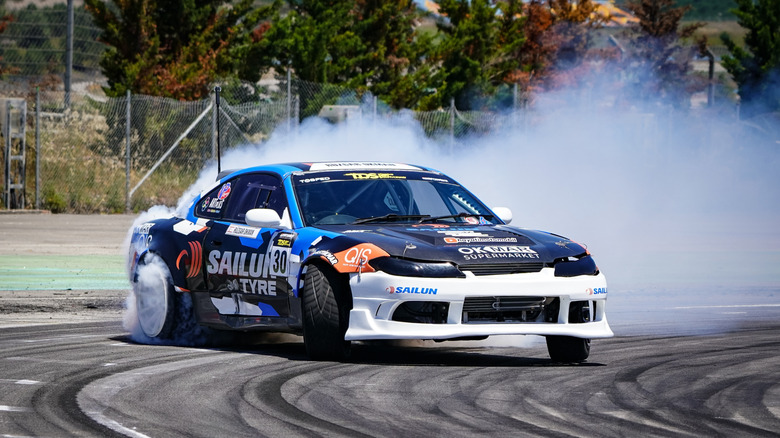
If you love RWD performance cars and you have some experience driving them, you're likely familiar with the feeling of the rear end coming loose during direction changes. This happens because the rear tires break traction and swing wide, which is what's called oversteer. For the experienced driver who likes the excitement of controlled drifting in an RWD car, it's one of the best things ever. However, for someone who isn't experienced, or who is used to FWD or AWD cars, oversteer can be extremely dangerous.
Take the Honda S2000's snap oversteer as an example. When you take a corner at higher speeds and keep your foot planted on the accelerator, much of the car's weight is planted over the rear wheels. If you lift off, the rear end suddenly becomes lighter as the weight transfers to the front wheels. This weight transfer can "snap" the rear end wide and cause the car to oversteer, lose control, or spin out. For some, this is amazing. For others, it's terrifying.
With an FWD or an AWD car, oversteer isn't nearly as likely, either because the driven wheels can maintain better traction during cornering, or simply because the rear wheels aren't driven, so the engine can't spin them loose. It's not just snap oversteer during a mid-corner lift-off, either. An RWD car can also start oversteering if you add too much throttle while steering. FWD cars are more prone to understeer, while RWD cars are more prone to oversteer, but the problem is that oversteer is more difficult to catch and control, and it's more likely to cause an accident than understeer.
Subpar traction in inclement weather
Most of the pros and cons of FWD, AWD, or RWD cars come down to basic physics. Which wheels are doing the driving, which wheels are doing the steering, how much weight is pressing down on the tires, how much power is applied, and how much steering angle is applied. All of these factors can make any of the three better or worse than the others in given situations.
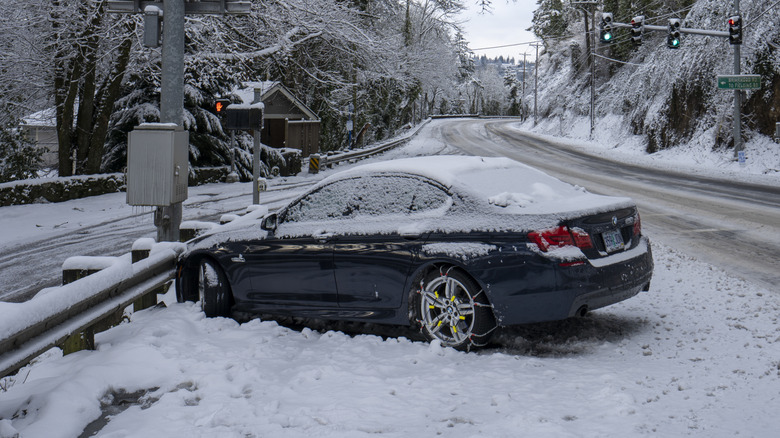
One notable factor that exposes many inherent RWD drawbacks is bad weather — specifically, greasy roads, snow, or ice. Most sporty performance cars out there are front-engined, like the RWD Ford Mustang GT, for example. When Late Model Restoration put a 2024 Mustang GT on the scales, Motor1 reported that it carried 55% of its weight up front and 45% in the rear.
Since the Mustang is an RWD car, the driven rear wheels have less weight on them and are more likely to break traction compared to something like a Golf GTI, which is an FWD car and has 61% of its weight over the front axle. In the latter case, there is simply more weight pushing the driven tires to the ground, and therefore, the chances of breaking traction are not as exaggerated.
Moreover, RWD can also be trickier to control on snow and ice because of the oversteer we noted in the previous slide. Of course, the drivetrain is only half the story, and the physics of why tire traction is so important apply to every car, so an RWD car on dedicated winter or snow tires will behave very differently than one on summer tires.
Less cargo and interior space
One component you'll typically find in an RWD car but not in an FWD car is the driveshaft. The driveshaft is the long, spinning shaft that runs from the transmission, which sits right behind the engine, all the way to the rear differential. This driveshaft is tasked with sending the engine's power to the rear wheels. Since it is so long and so important, automakers typically run it down the middle of the car's underside, and the cabin has to make room for it.
That big hump you see on the floor between the front seats and under the middle rear seat is called the transmission tunnel, and the driveshaft is the reason it's there. Another component besides the driveshaft is the rear differential, which distributes power from the shaft to the left and right rear wheels and lets them spin at different speeds in corners. It sits between the rear wheels, and along with the rear axle and suspension hardware around it, it takes up space that could otherwise go to the trunk floor or the spare tire well.
In an FWD car, the transmission and differential are combined into a single unit called a transaxle that sits right next to the engine up front, so the rear of the car doesn't need any of that hardware. The result is often a flatter floor, a more usable middle rear seat, and a bit more legroom for rear passengers. For a sports coupe, that might not matter much, but for a family sedan or a compact hatchback, every inch counts, which is one reason so many everyday cars are FWD.
Complex and heavy packaging
We already noted how RWD cars come with a big, long driveshaft and a rear differential. Compared to FWD cars, they also need a separate transmission and differential housing instead of a single, compact transaxle, along with extra hardware like universal joints, a center support bearing on longer driveshafts, and axle shafts running out to each rear wheel. All of this adds complexity and weight, and the reason, once again, has a lot to do with physics.
With an RWD car, the power the engine creates needs to travel a longer distance before it is turned into tire rotation. Instead of going straight from the transaxle to the front wheels sitting right next to it, the power has to make its way through the transmission, down the length of the car, through the differential, and then out to the rear wheels. Each of those parts needs to be strong enough to handle the engine's torque, and each one adds weight. More parts also means more things that can wear out over time, from U-joints to differential seals.
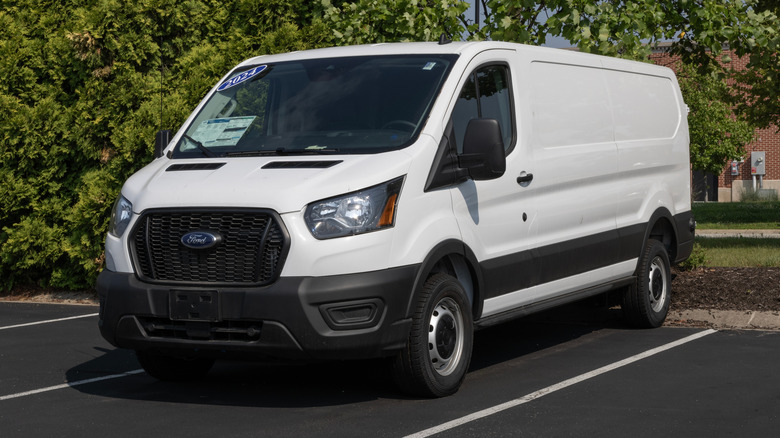
That's why rear-wheel-drive configurations can also carry a weight penalty. For instance, the 2024 Ford Transit 350L LWB weighs 5,309 pounds in RWD form, compared with 5,057 pounds for its FWD counterpart, according to Autotrader. That's a difference of approximately 252 pounds, and both versions share the same body length. Moreover, some owners of RWD pickups add weight to the truck bed for extra traction in winter, which can mean hauling around another 200 to 300 pounds in a midsize truck, making the weight penalty even bigger.
Costs and efficiency penalties

All the extra hardware we covered in the previous slides has one more downside: it costs more money. A driveshaft, a separate rear differential, U-joints, and the structure needed to house them all add to the cost of building a car, and much of that ends up on the bill. Ford's Transit van in Australia is a good example. Drive reported that the 2024 350L LWB RWD van listed at AU$62,990 (about $44,100), while the FWD version started at AU$59,990 (about $42,000).
That's an AU$3,000 (roughly $2,100) gap, though the two also use different automatic transmissions, so not all of it comes down to the driven wheels. The extra parts cost more to maintain, too. A rear differential has its own gear oil that needs periodic changing, and having a shop do it will typically run $144 to $179, based on RepairPal's estimates.
Every spinning part between the engine and the wheels loses a bit of energy to friction, and an RWD drivetrain has more of them, plus the extra weight. This can also show up in the fuel bill, one of the biggest downsides of van life. In 2015, What Van? reported Ford's official combined figures for the 2.2-liter diesel Transit L2H2: 35.8 mpg for the RWD version and 37.7 mpg for the FWD one. Those are UK figures, which convert to roughly 29.8 and 31.4 mpg in U.S. gallons. The gap isn't massive, but for a fleet covering thousands of miles a year, it can add up.