

5 Electronics That Can Help Monitor Indoor Air Quality
We may receive a commission on purchases made from links.
Air quality is one thing that's easy to lose track of, even though it's something that's important to stay on top of. Unless somewhere is smoky or dusty, you can't literally see the culprits behind bad air with the naked eye. So, it can quickly become an "out of sight, out of mind" kind of situation. That's where air quality monitors come in. These devices help you track what's happening in the air around you.
Most monitors track air quality by assessing exactly what pollutants and gases are in the air, alongside things like temperature and humidity. They tend to monitor particulate matter of a certain size and gases like carbon dioxide, nitrogen oxides, and volatile organic compounds. Exactly what's measured varies from one device to another, but you can generally expect it to be some combination of those things. Together, this paints a picture of how good (or bad) the air quality is in your home.
Learning about your home's air quality is useful for protecting your health, as poor air quality may lead to worse health outcomes. For example, breathing in dust can irritate your respiratory system, while poor ventilation can cause a buildup of CO2 or increase your chances of breathing in viruses and pathogens from the air. When you use an air quality monitor, it makes it much easier to keep track of when to turn on your air filter or open up a window.
Qingping Air Monitor 2
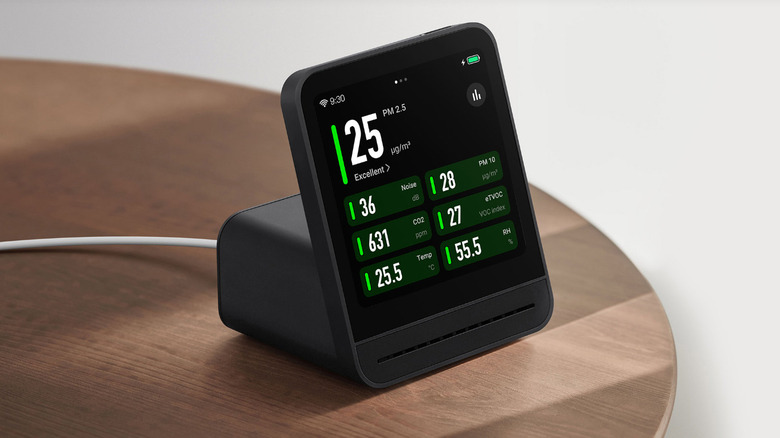
Qingping makes all kinds of home devices, ranging from sensors and alarm clocks to air monitors. The Air Monitor 2 is a comprehensive home device that tracks your home's air quality across seven areas, including particulate matter, carbon dioxide levels, humidity, and temperature.
The monitor measures the concentration of small particles known as PM2.5 and PM10 in the air, which can potentially have adverse effects on your health if inhaled. It also approximates the levels of total volatile organic compounds (known as TVOCs), which are a large, varied group of common compounds that can contribute to indoor air pollution. It can also measure high levels of carbon dioxide in your home, which can be a tell-tale sign that you need to ventilate your space more.
There are a couple of other neat features that set the Air Monitor 2 apart from other devices. It can measure the decibel level of your home to help protect your hearing and your home's peace. The monitor tracks each measurement every second, so you don't have to rely on outdated data. With the right integrations, you can then set the device to automatically switch on a compatible air filter when air quality drops below a certain level. The only catch is that you'll have to have an air purifier that's already smart-enabled for it to work.
Airthings Wave Plus
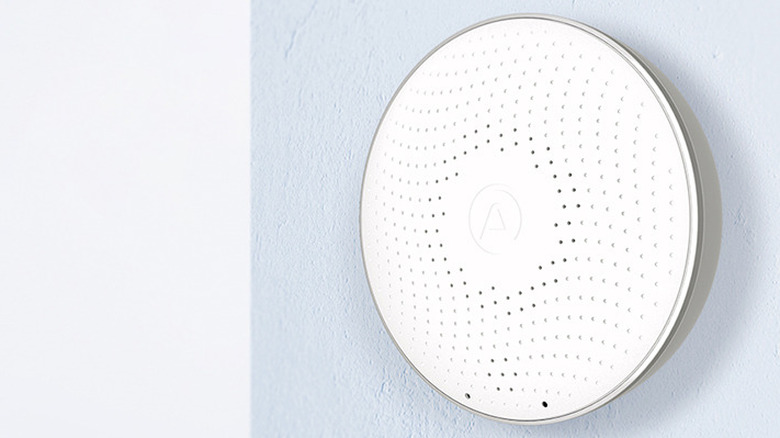
Much like other indoor air quality monitors, the Airthings Wave Plus' six sensors measure the amount of CO2 and VOCs in the air, along with your room's temperature, air pressure, and humidity. But it also tracks something a little unusual for an air monitor: radon. Radon exposure can have serious consequences for your physical health. According to the Government of Canada, it's the leading cause of lung cancer among non-smokers. It can build up in your home over time, as it seeps out of nearby soil and rocks. Since it's an odorless gas, it's easy to miss. So, you can do a lot to protect your health by monitoring its levels and dealing with it appropriately via a radon reduction system.
Although the Wave Plus' radon sensor is unique and useful, it has its drawbacks. The radon sensor is fragile, particularly when it comes to dampness and humidity. For that reason, you can't use the monitor in areas where the humidity exceeds 85%. That means bathrooms are off-limits. Airthings also recommends keeping the monitor away from vents, windows, and external doors to ensure accurate readings. The monitor hooks up to smart apps to help you better understand the overall air quality in your home. You can also use it with a range of smart home hub devices and systems for automation and monitoring purposes. That includes Homey Bridge, Homey Pro, and IFTTT, over Bluetooth or the internet.
AirGradient One
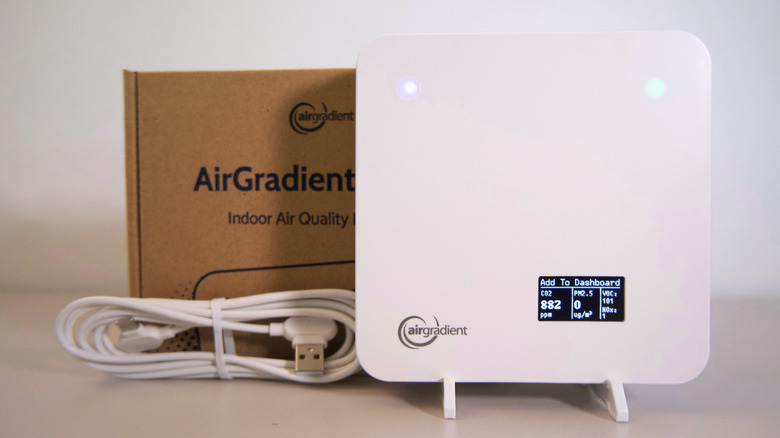
The AirGradient One is an open-source indoor air quality monitor with sensors for measuring carbon dioxide, nitrogen oxides (NOx), TVOCs, temperature, humidity, and fine particulate matter all the way down to a tiny PM1 size. This data is measured in real time and sent over Wi-Fi to your device of choice. Since it's open-source, it's highly flexible in this regard, and you can connect it to any server of your choosing. Alternatively, you can use AirGradient's data platform instead. In fact, according to the company's website, the monitor is specifically "Works With Home Assistant" certified, so you can customize it to fit your needs and run automations entirely locally. It's also Homey Certified.
At $230, it's not cheap. However, you do have the option of saving some cash by making an unconventional compromise. If you're willing to build and assemble it yourself, you can pick it up for $138. Besides the time you spend putting it together, you are put at one other disadvantage by doing so. You waive your right to a warranty, and your device won't come with any certifications or test reports to assure you of its functionality. Pre-assembled models usually come with a 12-month warranty and are pre-tested in a controlled environment. But if you're willing to take a gamble, then it's certainly not a discount to be sniffed at.
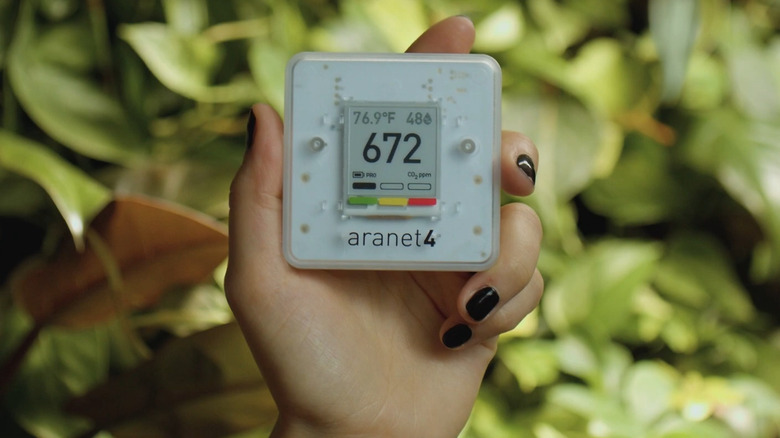
Aranet4 Home
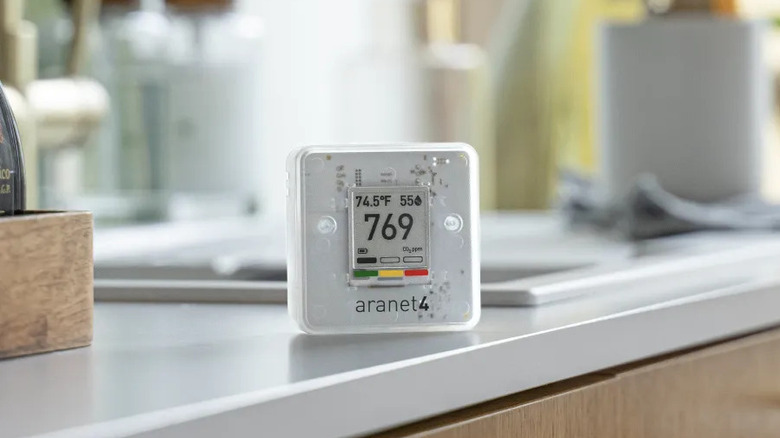
The Aranet4 Home is a popular option when it comes to air quality monitors for a few reasons. Firstly, it's small, light, and portable. That means you can move it from room to room in your home without needing to spend ages plugging in wires or finding an extension cord to get it up and running. It can also fit in your bag, making the gadget a handy addition to your travel kit – particularly if you're headed somewhere extra polluted. Another reason the Aranet4 Home is popular is courtesy of its app integration. You can use the company's bespoke air quality app to track and monitor your indoor air quality, including CO2 levels, temperature, humidity, and air pressure in real time. Again, that makes it a useful choice for knowing when you need to get proactive with an air filter or respirator.
There are some downsides to the monitor's portability, though. It's battery-operated, meaning you have to stay on top of replacing its batteries (and keeping some in stock). However, according to the Aranet website, its batteries should last up to four years thanks to its low-power consumption. It's also a somewhat simpler device than some of its competitors; it primarily measures carbon dioxide concentration, alongside temperature, humidity, and pressure, so you won't get a super detailed picture of what's happening to your air quality in your home. But if your main concern lies with keeping a space well-ventilated, then it's a pretty useful gadget.
GoveeLife Smart Air Quality Monitor H5140
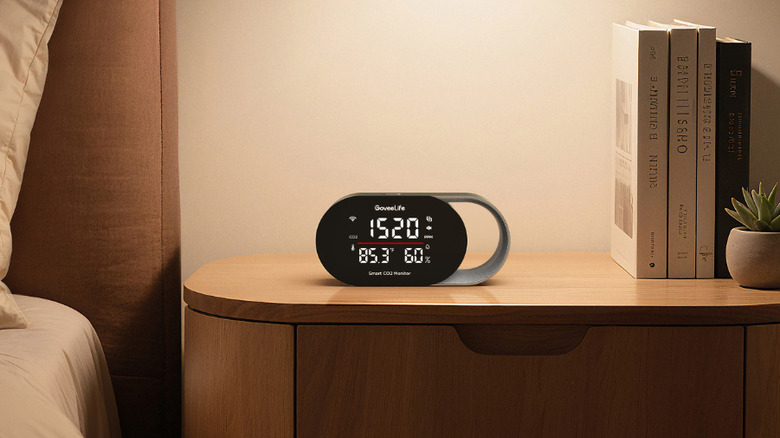
Although air quality monitors are useful, a lot of them aren't cheap. But thankfully, that doesn't always have to be the case, as there are some budget options on the market, like the GoveeLife H5140. The $90 air monitor measures your home's temperature, humidity, and CO2 levels in real time, as well as doubling up as a clock. Despite its relatively lower price, it's also smart-enabled, meaning you can hook it up to other selected GoveeLife smart products, like dehumidifiers, humidifiers, and tower fans. Unfortunately, you can't connect it to the company's home air purifiers.
At around five inches wide, it's a fairly small device. That's useful if you want to be able to tuck your monitor out of sight most of the time. The Govee App helps make that possible, too, as your monitor can send poor air quality notifications directly to your device. Moreover, the 4.8" LED screen has customizable brightness settings, so you can decide exactly how bright or dark you want the display to be, all the way down to toggling it off altogether.
Like the Aranet4, the H5140 only monitors CO2; it doesn't monitor pollutants like particulate matter. But the company also offers another cheaper model, the H5106. That one does measure PM2.5 particles, although it doesn't monitor CO2. So, when you pick a GoveeLife device, you are making a bit of a compromise.