

4 Disadvantages Of Using A Hover Lawn Mower
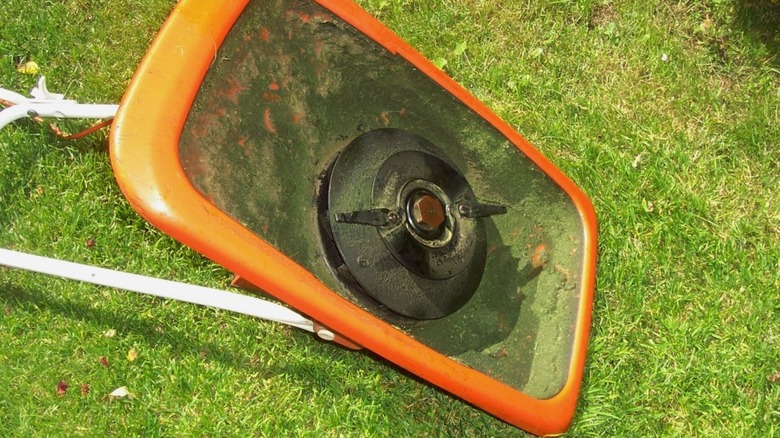
A hover mower works through unique technology, as the name implies. These systems use air cushions propelled through the mower's vents via an impeller, thereby keeping them off the ground (albeit just slightly) as they're moved along your lawn and perform their work. Though not as futuristic as they might sound, they're a variety of mower that has its strengths like any other. A ride-on mower, for instance, has the considerable advantage of helping the rider to cover stretches of land much quicker than they may otherwise have been able to.
By the same token, though, every type of mower also has its distinct disadvantages, when viewed through the lens of a specific customer's needs. A hover mower tends to be more lightweight, and is typically more maneuverable without being constrained by wheels, but there are also some important disadvantages and downsides of hover mowers that you should bear in mind if you're considering a purchase.
It's all about what you're used to from your machines, how you utilize them, and the type of ground you need to cover. Every variety of lawn mower has different terrain and other types of concerns that they struggle with, and so it might not necessarily be a bad choice, but maybe a more challenging one, depending on your preferences. From the different motion required to use them, to the potentially time-consuming process of changing cutting lengths, here are some reasons why a hover mower may not be the most fitting option for you.
Cutting to precise heights can be difficult
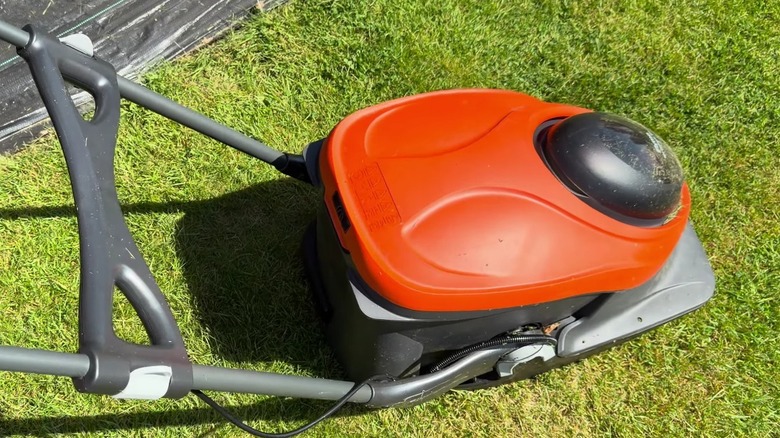
One of the primary factors that sets a hover mower apart from a lot of more conventional push-along models is that it typically doesn't have wheels. For some users, this is quite a boon, as it means that you're more able to maneuver it around tighter angles and so on without having to allow for the turning circle. That small air cushion keeping it off the ground can mean that the weight of the model, and even some more modest lawn mowers can be distinctly hefty, especially if you're going to be using them for extended periods of time, is more easy to manage.
Despite this, though, it still means that the model is largely off the ground, and this has to be compensated for for one very important reason: They key to a successful grass cut is, typically, consistency. There's a risk of ruining the look of a lawn or even causing it harm if you don't take care with the length settings, and hover mowers can make this challenging. In fact, they often struggle with maintaining an even lawn as a whole, because of their design.
The Flymo brand is a big global name in hover mowers, though its models are rather rare in the United States. Flymo notes that, depending on the specific type of hover mower you have, you might have access to a lever that allows you to raise or lower the cutting height, or you might have to manually adjust a series of spacers to best suit the blade.
They require different motions to adapt to
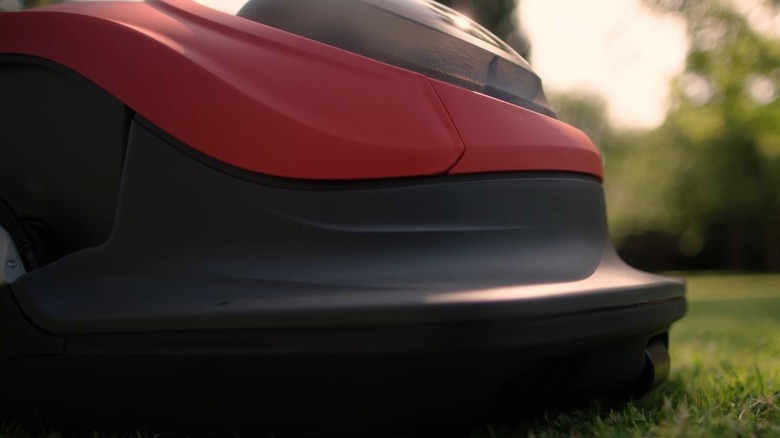
It can often be quite jarring to go from one brand or variety of a given device to another. This is just as true for different types of lawn mower. Though a robotic version may save you from much of the manual labor of mowing your lawn for yourself, learning to set it and allow it to do its thing optimally after years of a manual approach will surely feel very odd. So, too, can using a hover mower.
The most critical thing about a hover mower is that it can be used in all directions, making it far more versatile than its conventional wheeled counterparts. This is helpful for maneuverability, but it does also mean that it can be difficult, at least for those newer to the technology, to direct it to the best effect, and it can require wide, arcing movements.
Those neat lines backwards and forwards that are the mark of a painstakingly manicured lawn cannot be achieved to the same degree using a hover system. One big issue with these mowers from a visual point of view is that they can't create those stripes on the lawn that you might be accustomed to seeing. These are produced by a separate roller that compresses the freshly-cut grass, which creates that attractive pattern through reflecting sunlight.
Cylinder mowers, or reel mowers, which use a cylindrical drum of curved blades alongside a straight blade, are effective for this, because they cut evenly, smoothly, and thoroughly. More conventional rotary mowers also have rollers in a lot of cases, allowing them to both cut the grass and neatly flatten it into a shape that's optimal for striping. Unfortunately, hover mowers typically don't have this capacity, with weight being so important.
They are still notably heavy, manually-powered models
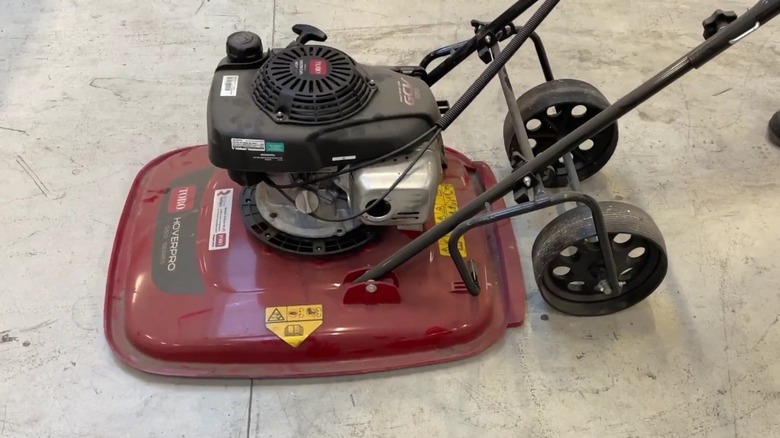
As noted, advancements in artificial intelligence have led to a rise in more sophisticated robotic mowers. Their capacity to work — and even clean themselves autonomously, depending on the specific model — can be very valuable. Even if there are some vital things to know before buying a robotic mower. Many of us, after all, will struggle a lot to maneuver a heavy, manual mower around their lawn. This is another issue with hover mowers; you have to do all the manual work yourself.
For many owners without the physical capacity to push a walk-behind mower, robotic ones can be a real lifeline. Pushalong models, after all, can require considerable physical strength, and this can be especially difficult if you have a lawn that requires a lot of maneuvering or tricky bumps to negotiate. While it's true that a hover mower will often be less heavy than its manual counterparts, because of the way it's designed and the sweeping movements the user can have to make, it can still absolutely be hard work to use one for long periods.
Some hover mowers, particularly more budget-friendly ones, are somewhat scaled down in order to save on weight and so make their central hovering capacity as practical and effective as possible to achieve. In some cases, this can mean dispensing with some storage for clippings or with mulching capacity, which can potentially result in another several passes over your land or lawn to pick up the resultant clippings. Not to mention, the weight increases as it fills up.
They can struggle to manage heavier or wet grass

When it comes to timing a mow, you want to wait long enough that there's been some healthy growth, but not so long that the grass has become overgrown and could potentially take much longer to cut, and you might have a limited time to mow, due to the weather conditions.
Users will often find that a gas-powered model could be a better fit for tackling particularly overgrown grass more effectively, as they have the additional, regular power offered by their engines to potentially avoid stalling or struggling. By the same token, though, even the most formidable, professional-grade appliances won't usually be at their best when tackling wet grass. It's very important to stop mowing in the rain if you have an electric model. Hover mowers won't really perform at their best when cutting wet grass, either.
A lot of today's models are equipped with features that make them better suited to these more challenging conditions, such as turbo fans, but hover mowers have a unique setup, and a unique way of cutting and the treatment of the cuttings left behind. Alsowetter grass can stick together and lay horizontally, which is particularly problematic for these models.