

Fitbit Air Vs Fitbit Edge: What Does The Higher Price Tag Get You?
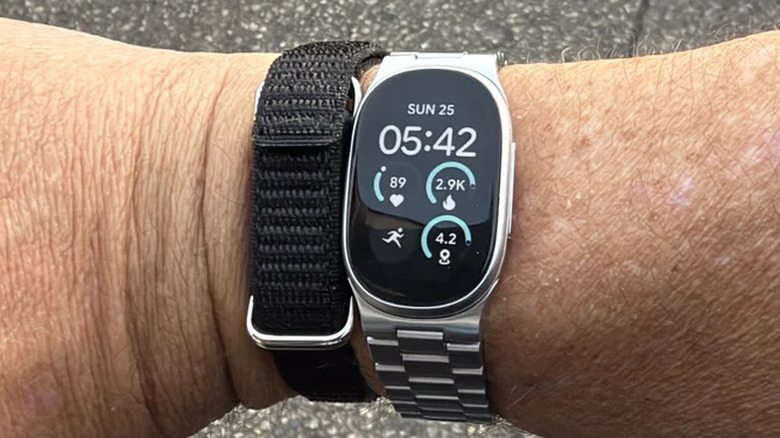
Just over five months after launching the Fitbit Air — one of the best screenless trackers you can buy — Google has launched a slightly more expensive model: the Fitbit Edge. The Fitbit Air starts at $99.99, while the Fitbit Edge will set you back $179.99, which is $80 more. That $80 price hike begs the question: what exactly do you get in return, and is the Fitbit Edge worth paying $80 more than the Fitbit Air? One obvious difference between the Fitbit Air and Edge, which you don't need to check the spec sheet to notice, is the display.
Unlike the screenless Fitbit Air, the Edge offers a 1.3-inch color AMOLED display, which Google says is the largest and brightest panel in its tracker lineup. Thanks to the built-in display, the Edge lets you glance at your metrics on your wrist as you continue to exercise, unlike the Air, which must always be paired with a phone to view them. Additionally, it comes with an app that supports over 50 workout modes, making it easy to track your exercises and get real-time guidance, all thanks to the availability of a display.
The build quality is also different. While the Air uses a plastic case, Google switched things up and went for the more durable aluminum on the Fitbit Edge, and you can also pair it with a metal wristband. However, both models offer IP68 dust and water resistance and are 5ATM-rated, thus able to withstand water pressure at a depth of 164 feet, which makes them safe to wear while swimming. The two also differ slightly in size, with the Edge being slightly taller, thicker, and wider, likely to accommodate the available display.
The Fitbit Edge is more feature-packed than the Air
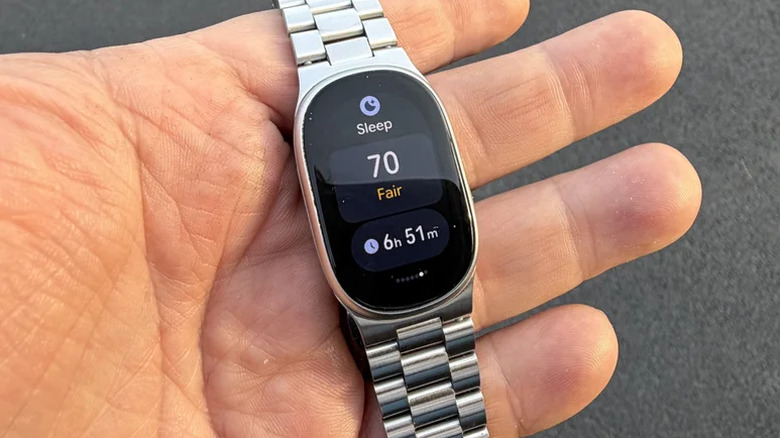
Beyond the better materials, display, and included goodies, the Edge also beats the Air in tracking features. For one, the Fitbit Edge has built-in GPS, so you can track your location without a phone, which isn't possible with its smaller, affordable sibling. Both the Air and Edge track several metrics, including heart rate, blood oxygen saturation (SpO2), stress, sleep, and skin temperature. For activity tracking, they also offer more of the same features, such as all-day activity tracking, daily readiness score, automatic activity recognition, cardio load, active zone minutes, cardio fitness score, step tracking, calorie tracking, and more.
However, the Edge goes the extra mile to offer electrocardiogram (ECG) readings thanks to its built-in electrical sensor and a couple of extra activity-related metrics like the number of floors climbed and a workout intensity map. The Edge also has several extra sensors that you won't find on the Air, such as an altimeter and ambient light sensor. Because of the availability of a display, the Edge also offers a couple of extra features. It can mirror your phone's notifications if you'd like to keep up with new updates on your wrist, and you can even respond to messages.
You can also control your music from your wrist. Additionally, Google ships the Edge with a lightweight version of Google Maps preinstalled, which is handy. The only catch is that you have to start navigation on your phone first, as the built-in app doesn't allow you to search or browse locations.
Is the Fitbit Edge worth the extra money?
When compared side by side with the Fitbit Air, the Fitbit Edge has its advantages. Its biggest selling point is the display, which lets you view your health and activity metrics in real time on the tracker and do more on the device itself without relying on your phone. Overall, the Edge doesn't offer many extra features for its $80 premium. You get a display, ECG readings, built-in GPS, and the ability to track a couple of extra activity-related things. But are those features worth the extra $80? It really depends on your needs.
If a screen is a priority, the Edge is worth it, as it offers slightly more features, some of which are available on the pricier Google Pixel Watch 5. However, if you're one of those people who prefer a tracker that stays out of your face, then you'll be much better served by the Fitbit Air. We have reviewed the Fitbit Edge and loved its excellent battery life, handy tracking features, lightweight design, metal band, and price.