

Why Cities Might Paint Fire Trucks Lime Yellow Instead Of Red
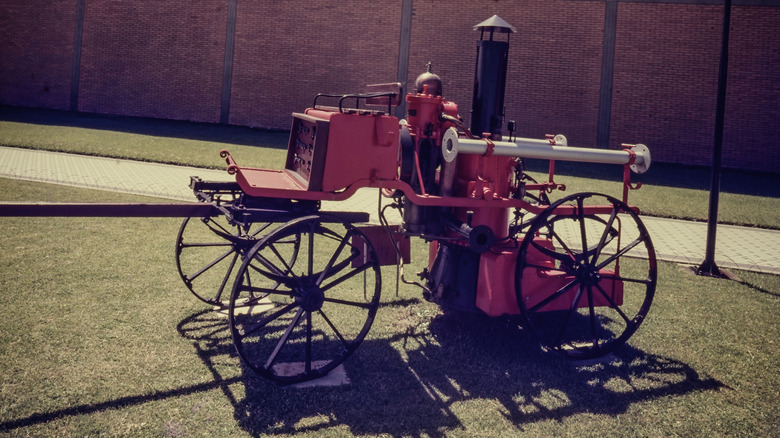
In 1721, an English inventor by the name of Richard Newsham filed a patent for a device that let firefighters aim a directed stream of water straight at a fire. He filed a second one in 1725 for a long, narrow, wooden contraption on wheels, equipped with two single-acting pistons and an air vessel inside a tank, best described as a very early fire engine — just not one you'd recognize as such today. Still, his invention was painted red (for reasons that remain a mystery), and the red fire truck was born.
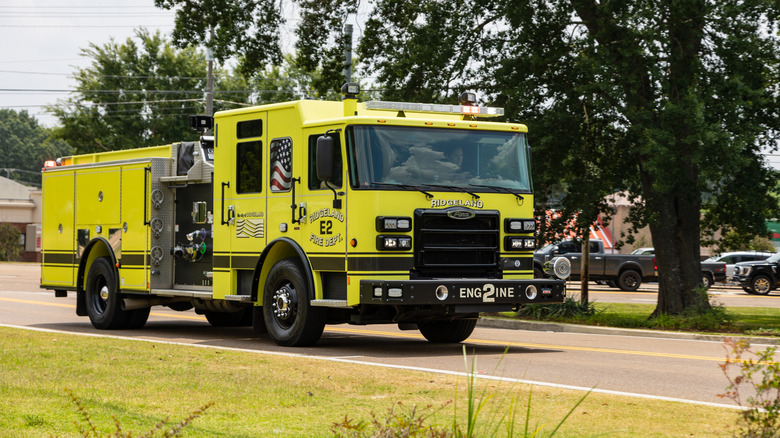
Red became the de facto color for most trucks around the world. One theory even suggests that Queen Elizabeth had the royal fire department paint every truck red because it looked more regal. But it certainly wasn't the only color to grace these fire-quenching rigs. Nearly every color of the rainbow, from pink, purple, and green (lime or otherwise) to yellow, white, orange, black, and even Carolina blue have all been used. Lime yellow, however, didn't really start appearing until the late 1960s, with some of the first fire trucks in this color appearing at the Chesterfield County Fire and EMS Department in Virginia. This all occurred thanks to a yellow tow truck and an optometrist.
Red is recognizable, but hard to see at night
At the time, Chesterfield had a fleet of aging, old-school fire trucks that were in serious decline. One was in such bad shape that it wouldn't start when the crew tried to leave to respond to an incident. What showed up to save the day was a freshly painted yellow tow truck. Fire Chief Robert L. Eanes told FireRescue1 that he recalls asking an optometrist friend in New York, Dr. Stephen S. Solomon, about the color yellow, who confirmed it was, in fact, "an appropriate and safe color." With that, Eanes decided the department's new rigs should be painted lime yellow.
Not long after Chesterfield County's department switched colors, other departments began following suit. Pinellas Park (Florida) Fire Department ordered its first lime-yellow truck in 1972. Dallas transitioned to lime-yellow in 1974 to make their rigs stand out during emergency runs. By the mid-1970s, the Jeffersontown and South Dixie Fire Departments (both in Kentucky), along with many others, began repainting their trucks.
After additional research and analysis of accident data, Solomon published an article in the journal "Ergonomics in Design" in 1997 arguing that red was one of the hardest colors for the human eye to perceive, especially in dim light. He found that trucks painted lime-yellow (aka fluorescent green) were far more visible at night and under changing light and weather conditions. Solomon's findings were so impactful that the National Fire Protection Association (NFPA) recommended that all departments switch to painting their emergency vehicles lime green or other greenish-yellow colors.
Lime yellow endures despite the red tradition
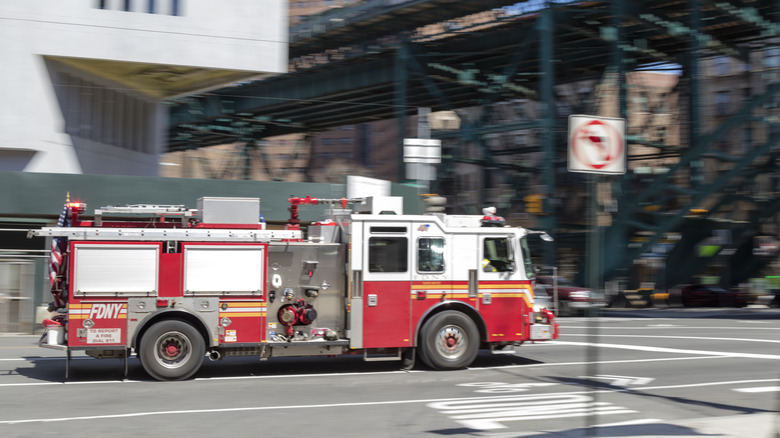
In 2009, a report from the U.S. Fire Administration (USFA) in cooperation with the International Fire Service Training Association found that both visibility and recognition matter. In other words, people need to identify something at a glance, especially high-visibility emergency vehicles like fire trucks or water trucks. According to Pinellas Park Fire Department Chief Doug Lewis, "Red is the most recognizable color for fire trucks in the United States," likely because they've almost always been red.
Although the trend has largely swung back toward red, some departments still use yellow (in any shade), white, or other colors entirely — all for different reasons. For those that stuck with the yellow color scheme, it's likely become a local tradition, a source of pride, and a way to uniquely identify a certain fire station. The color can also signify special operations units within a department or honor a high-ranking official's background. For instance, the Maple Grove (Minnesota) Fire Department chose a white-over-red paint scheme to acknowledge Chief Roger Kochera, who helped organize and manage the new department and became its first full-time fire chief.