

What Are The Risks With Buying A High-Mileage Mini Truck?
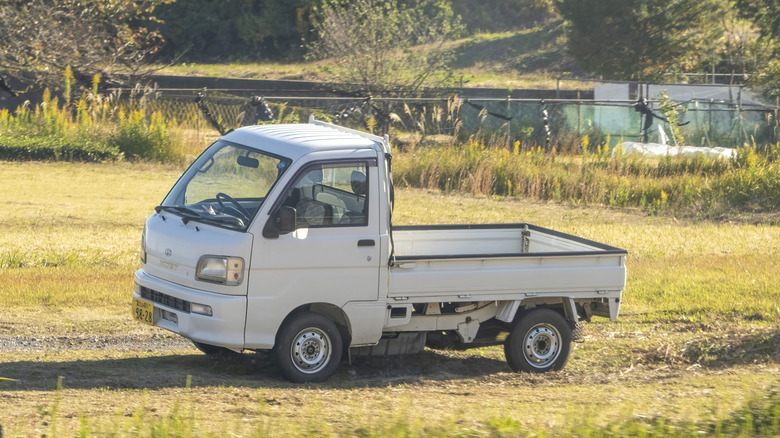
Kei trucks are a funny topic, and not just because they look adorable parked next to a full-size truck that happens to have a similar bed length. They're basically what happens if you min-max a character in a video game — you're fitting the absolute largest bed possible in the given size constraints of Japanese kei vehicles. That's their whole point, after all — kei trucks are designed to be do-it-all city haulers, capable of negotiating the narrow streets and alleys of Japanese cities and rural pathways to deliver goods.
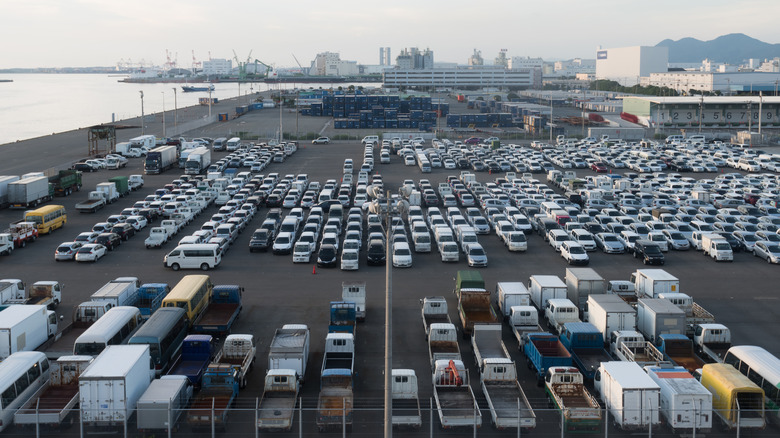
But that brings up an interesting question: With the vast majority of these things used purely for commercial purposes in Japan, how high mileage is too high to consider with one of these? They're certainly plentiful as JDM imports go, so you'll see a ton of kei trucks parked dockside if you import a JDM car yourself. And there are all sorts of configurations, conditions, makes and models, and so on. But like any commercial vehicle, it's more to do with how it's been treated by its previous owner(s).
Put simply, because kei trucks were commercial vehicles, their odometers don't tell the whole story. Kei trucks are appliances — they're cheap, millions are all over the place, and they're easily maintained. A business could pile a bunch of stuff on the back and run it into the ground in less than 50,000 miles, whereas another place could've faithfully maintained their kei truck for many years. Mileage is not a guarantee, but it may give you some idea of the truck's history. Let's explore how to read the odometer in this way.
Auction grades are your friend
When you buy a Japanese kei truck to import into the United States, you'll likely be given a special grade sheet that provides various details about the vehicle. This applies to any Japanese import car, not just kei trucks, mind you.
First up, you have the overall grade, which ranges from 1 to 5. A grade 1 is a flooded vehicle, so let's discount that. Grade 2 is absolutely shabby, like the floors have melted away; you'll rarely see auction grade 2s if you're looking. Grade 5, by comparison, is basically a brand-new vehicle, either something meticulously restored to showroom condition or an extremely low-mileage example that's been garage-kept its whole life. You'll rarely see these as well — most fall between grades 3 and 4. Sometimes you get a grade R, which means it's had accident repair work done.
Next will be the exterior and interior condition, which is graded on a scale from A to E, with A being as-new. Most decent kei trucks will fall between a B and C, though Ds can still be fixed up depending on your skill.
This can be the real litmus test for whether or not a kei truck is any good because higher-mileage examples that have particularly good auction grades likely mean that they've been well-maintained. It's just common sense — if you take good care of your vehicle, don't have any accidents, and keep it clean, it'll likely run better than a sloppy example with less mileage. Remember, you have to change your oil after just 5,000-10,000 miles; that's all the travel distance it takes to potentially ruin an engine.
How to buy a high-mileage kei truck

First thing's first: What defines a kei truck as high-mileage? Anything with about 150,000 kilometers, or 93,200 miles — bear in mind that these trucks use three-cylinder engines off 660cc or less, basically scooter engines by U.S. standards. So they have to work extremely hard if they're operating at higher speeds or with large cargo loads in hilly terrain. If you have a choice in the matter, go for something used in the city or a rural runabout vehicle that barely sees full-throttle.
There are generally two ways to go about this. The first is the most foolproof — go to the dealership and get eyes on the car. Get its history if you can; export documents will show its last registration. Take it to a mechanic if you're unsure. The second way is to buy it sight-unseen, in which case you'll be looking at pictures for any telltale signs. Things like rust spots, cracked rubber, or egregious dents are a no-go. Bear in mind how many kei trucks there are; odds are you'll find another relatively easily.
That said, once you actually own it, it's still important to check all of the usual boxes associated with importing Japanese classics. Rubber likes to crack and fail after disuse. The car may be filthy from the ride over, so be sure to clean and inspect it thoroughly. Stuff like bushings, hoses, timing belts, fluids, brake pads, tires, and other perishables should be checked and replaced if needed. It's a lot of work, but it's also incredibly rewarding — kei trucks are fantastic at what they do, which is haul 350 kilograms of cargo (about 770 pounds) with ease.