

Why Do Some Ships Have Bulbous Bows?
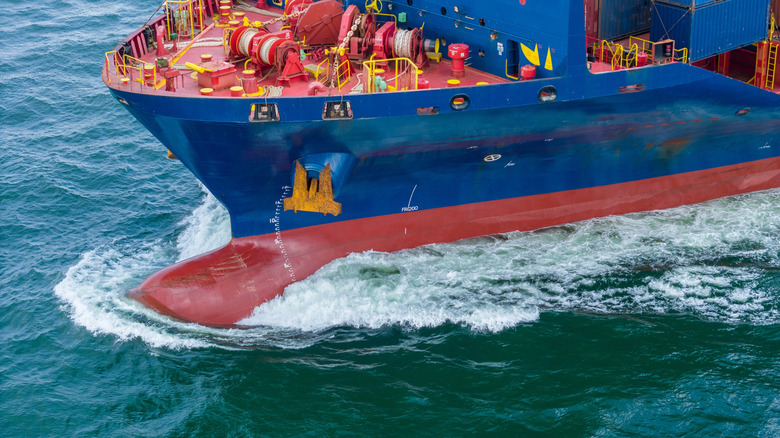
Modern ships come in a huge array of shapes and sizes, but aside from some super-specialized ships that look different from almost anything else, many of them have a few shared characteristics. One of those is a bulbous bow, which can be seen around the ship's waterline and usually protrudes from the main hull. Bulbous bows have been used for decades because they can improve a ship's efficiency by reducing drag.
Assuming that a ship is traveling sufficiently fast, the bulbous bow creates a separate wave from the one that is generated by the ship's hull. When the two waves interact, they will be out of phase, and they can either partially or totally cancel each other out. A reduced or canceled-out wave reduces resistance on the ship as it travels through the water, which in turn can help make it more efficient. Depending on the ship's speed, the design of the bulb, and the shape of the hull, the efficiency gains can vary significantly. The type of conditions the ship is operating in can also make a big difference, with ships navigating icy waters gaining an extra advantage because the bow can tip ice floes to slide more easily along the side of the hull.
Researchers have spent decades developing models to create an optimized bulb relative to the shape of an individual ship's hull, but even so, some ships still don't benefit from having one. In particular, ships that travel too slowly for the wave-reducing effect to take place are not good candidates for fitting bulbous bows. In some cases, these slow-moving ships might actually see a drop in efficiency with one fitted, which can lead to increased fuel consumption.
Bulbous bows can help reduce shipping emissions

In addition to affecting the operating costs for ship owners, changes in a ship's fuel efficiency also have environmental implications. Since most ships use diesel engines, an increase in efficiency can decrease greenhouse gas emissions, and likewise a drop in efficiency will have the opposite effect. When it's designed correctly, a bulbous bow can be a relatively affordable way for shipbuilders to reduce the lifetime emissions and running costs of a new ship.
Retrofitting a ship with a bulbous bow doesn't provide the same clear-cut benefits, and so many older ships simply don't have them. However, some researchers have argued that given the long service lives of smaller ships like fishing vessels, it might still be a change that's worth considering if the ship spends a long enough time traveling at speeds high enough to justify the cost of modification.
While bulbous bows can be a useful way to improve ship efficiency in certain circumstances, they are far from the only trick that shipbuilders use to reduce fuel usage. Among other things, some commercial ships blow bubbles underwater to reduce drag, and many feature red anti-fouling paint to discourage the growth of drag-inducing hitchhikers like barnacles and worms.