

The 2027 Hyundai Tucson's New Design Is Different In All The Right Ways
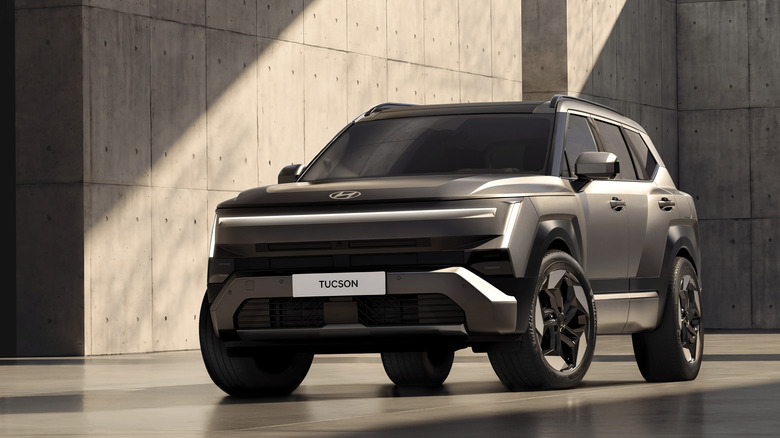
At the beginning of October 2026, we got our first glimpse at the 2027 Hyundai Tucson, a reveal that was certainly noteworthy to say the least. We're so used to seeing compact crossovers more closely resemble big cars, sometimes with flared plastic fenders in the case of those "off-road" focused variants, that seeing something so outlandishly blocky is a breath of fresh air.
I gave myself a couple of weeks to ruminate on this. After all, I've had a classic Jeep Cherokee for the past 16 years now. If anyone's going to be partial to small SUVs with blocky exteriors, it's going to be me. Not to mention that I think of myself as an artsy person with an eye for cars, judging from the piles of notebooks featuring all my early childhood drawings of fictitious and real cars. Naturally I was drawn to this as well.
Now, this isn't going to be a critique on the new Tucson's powertrain or anything like that. I've not driven the car, and it comes with the usual turbo four-cylinder and optional hybrid that we're used to seeing on so many other compact crossovers, so no sleeper status here. But the aesthetics — well, that's where I'm loving what I'm seeing.
This thing looks like a concept car someone accidentally put a dealership sticker on. Hyundai have been cooking since the N Vision 74 debuted in 2022, building a reputation as a marque invested in these sharp, angular, cyberpunk-inspired cars, and I'm all here for it with the Tucson as well. Here's why.
Analyzing the aesthetics of the 2027 Tuscon
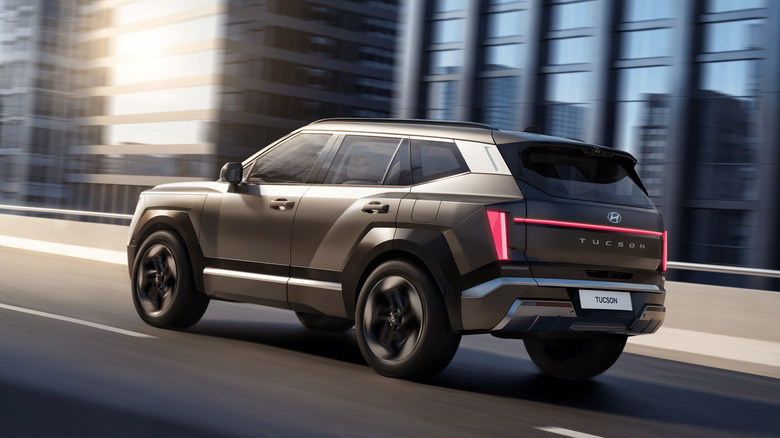
The exterior is truly where this vehicle shines. Much like the Elantra N and 641-hp Ioniq 5 N, the company's new styling language appears to be shifting away from the usual pedestrian-looking blobs we've seen throughout the past two decades and into more striking territory. The new Tuscon in particular really evokes that image through its heavy use of blocky, straight-walled design language. It's not full-on brutalist minimalism like the Cybertruck; rather it's a tasteful combination of angular shapes that emphasizes a muscular frame without being just a huge, offensively flat slab.
Let me use a more concrete example. Take a look at the front end; the wheel arches don't protrude and the sides are dead-vertical, so it looks like a truck from this angle. The headlights are moved out to the extreme sides, further emphasizing width through optical trickery — it's just a crossover, but it feels bigger. It doesn't have a hyper-aggressive snout, either, instead placing emphasis on the chin, which again raises the vehicle's eye line higher. It's clever use of available space in a way that feels natural to the company's ongoing aesthetic.
I have no notes for the rest of the exterior as well. Big windows for good visibility, plenty of usable ride height; its sharp, continuous lines flow from front to back. It feels visionary, which I think gives it character. It also makes the Tucson functional — the recessed headlights are partially visible from the side, making it easier to spot at night, the wheels and rear wing are classic low-drag implements, and so on. Is it perfect? No, but it's certainly an improvement.
The 2027 Tuscon is a small car with a big presence
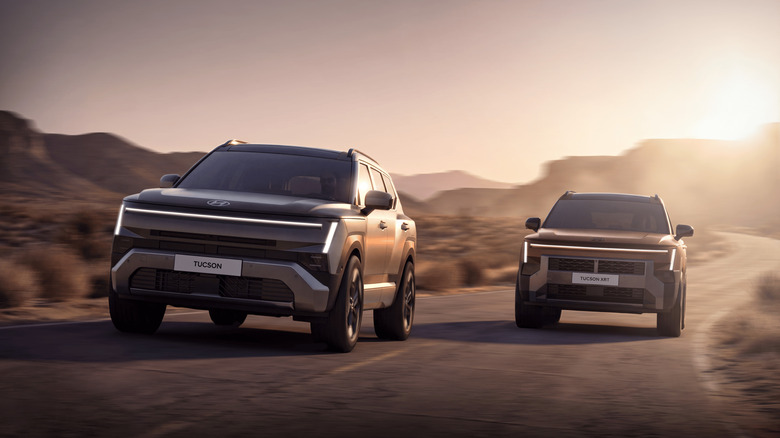
As someone who's lived by New York City her whole life, I've grown jaded to seeing suburban families driving around in full-size trucks. It's just a thing on American roads — we love our big pickups. They have a commanding presence and are perceived as status symbols, forgetting the fact that the bigger they get, the more dangerous they are to pedestrians and other cars. But therein lies the point — if we as a society enjoy having these tall, aggressive vehicles, why not create something with that presence but in a smaller (and safer) package?
That's where my only real gripe comes in — the interior. While Hyundai has outdone itself in the styling department, it still has that gigantic touchscreen replacing basically everything apart from the steering wheel. More to the point, the car has this rugged, retro-inspired exterior aesthetic, which puzzles me when Hyundai insists on fitting it with this screen which has been proven to be a safety hazard. You have to pull your eyes away from the road to do anything from climate control to fiddling with the radio, decreasing awareness. As a roller skater and lifelong city girl, I detest this design decision and enjoy not having vehicles with huge touchscreens.
Personal gripes with the interior aside, it does fill the role of feeling big in other ways, like providing plenty of storage and continuing that blocky vibe with the dashboard. The drivetrain tunnel even appears to have usable cupholders, which for some reason isn't a given on some modern cars, so kudos there. In short, expect older Tucson models to depreciate even more — there's a new look in town, and it is good.