

12 Classic Tech Inventions From The 1960s That Shaped The Modern World
If you grew up in the 20th century, odds are you're a little disappointed that we're not all zipping to work with flying cars or jetpacks. However, while modern technology might not mirror science fiction, there's no denying that today's tech is significantly more advanced than what we had previously. If you're reading this article on your cellphone, you're holding an incredibly fast computer thousands of times more powerful than any desktop system folks used in the '90s.
The same can be said of gaming consoles like the PlayStation 5 or Nintendo Switch 2; each of which represents the current pinnacle of consumer electronics technology, built upon the efforts of systems from the past. All modern tech owes its existence to incremental advancements made previously, and if you look back far enough, you'll find that more than a few classic tech inventions from the 1960s helped shape the modern world and the technology we all take for granted.
While they may have looked differently or produced archaic results compared to what you'd expect nowadays, numerous '60s tech inventions went into just about everything we use today. Each invention listed below was created over 50 years ago, and the modern world we live in would look very differently without them.
Lasers
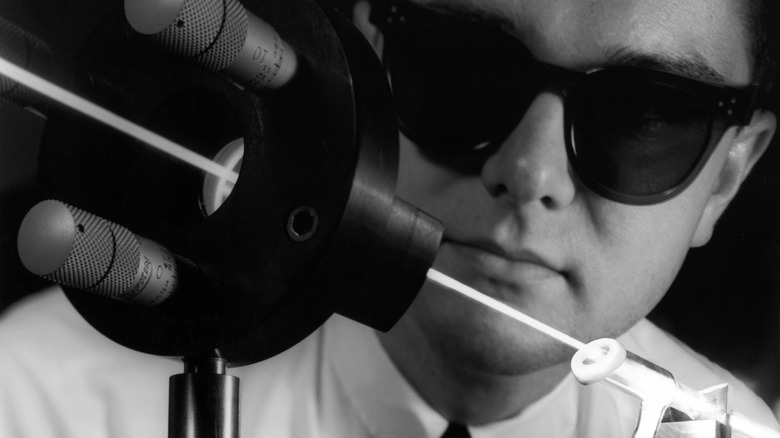
One technology that most people today don't think too much about is the laser, which is actually an acronym that stands for light amplification by stimulated emission of radiation. Lasers were first theorized by Albert Einstein, but it took considerable time and research to produce the first one in 1960. Like any technology, it took several discoveries to finally produce the first laser, which sci-fi took no time reproducing as a weapon found in all kinds of movies and TV shows.
Lasers have widespread applications, used in everything from relatively simple laser pointers to military applications. Modern military lasers don't annihilate a target from space, but they are capable of shooting down drones and missiles, which makes them ideal for air defense. In the civilian world, they're used for even more applications, including laser cutting, surgery, communications, and photolithography. While all these innovations of laser technology are important, they don't impact everyone the same way.
Most people benefit from lasers and don't ever realize it, but you wouldn't have optical disk drives, barcode scanners, laser printers, and lidar without them. Lidar is a pivotal technology in self-driving cars, so if you've ever gotten into a Waymo, you've benefited from lasers. That's saying nothing of telecommunications and fiber optics, which enable high-speed connectivity via lasers, so even if you don't use a laser pointer, you likely benefit from the tech.
Robots
The concept of automata, or machines that emulate a person or animal, dates back to antiquity, but that's not what we think of today when the word robot is spoken. Modern robots are more in line with what science fiction once predicted, though we've yet to create fully autonomous androids like C-3PO. Still, what exists today is vastly more advanced than the earliest attempts at robotics.
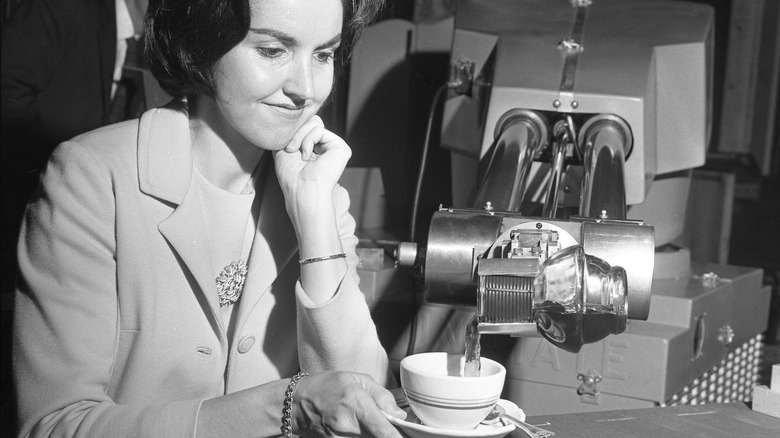
The first programmable robot was conceived in the 1950s, though it didn't arise as a commercial product until 1961. That's when Universal Automation, later renamed Unimate, the world's first industrial robot, began operating for General Motors. It was installed at the Inland Fisher Guide Plant in New Jersey, and its task was to remove hot metal parts from die-casting machines. Unimate, pictured above serving a woman tea in 1964, was a robotic arm invented by George C. Devol.
It may seem pretty rudimentary, but Unimate paved the way for industrial robotics, and it opened up robotics for numerous applications, including consumer electronics. These days, modern automobiles are largely built by industrial robots, while AI models are being used to automate drones and other military machines across the world's battlefields. It's now even possible to purchase your very own android or robotic dog, with many cool robots available on Amazon.
LEDs
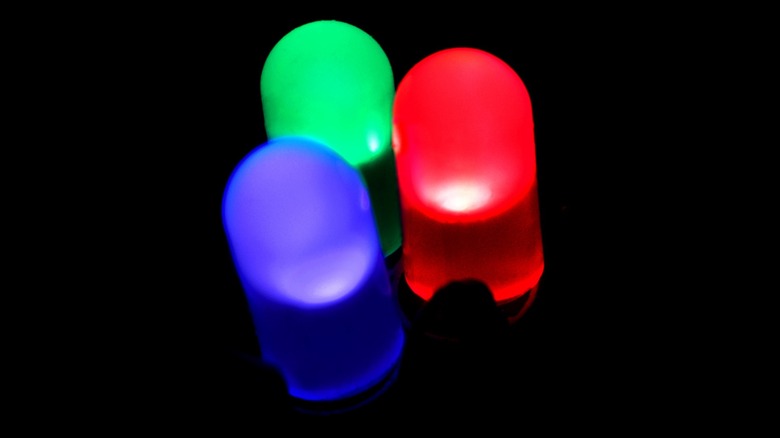
Practical semiconductor light-emitting diodes (LEDs) were invented in 1961, though the concept of producing light from a diode was discovered accidentally in 1907. Several inventions over the subsequent decades evolved the concept, but it wasn't until '62 that commercial LEDs arose. They were invented by engineers at Texas Instruments who developed a process of emitting light from a tunnel diode, which the company sold as the SNX-100.
The SNX-100 emitted infrared light, which isn't visible to the human eye, but red-light LEDs soon followed. In the 1970s, the technology advanced significantly, becoming less expensive while emitting additional colors. As the color spectrum expanded, so too did LED brightness, and over time LEDs of all kinds came to cost as little as a nickel a piece. The 1980s saw LEDs in all manner of consumer products, appearing in everything from alarm clocks to digital watches. In fact, the first digital watch released in 1972 used red LEDs to display the time.
Since then, LEDs have found their way into just about everyone's lives. If you've ever been to a sporting event with a jumbotron, odds are it used LEDs to display the game. LEDs are also utilized in billboards, and these days, many LED light bulbs have replaced traditional incandescent bulbs, as they last considerably longer and use up to 80% less energy, making them incredibly efficient.
Cassette tapes
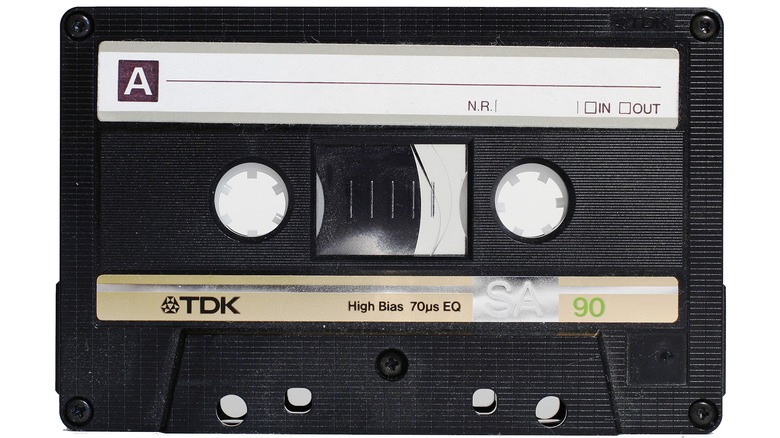
Audio cassettes have made a comeback of late. The technology was largely replaced by CDs in 1991, but for decades cassette's were the primary means of listening to music on the go, whether in the car, on a boombox, or on a Walkman. Cassette tapes debuted to the world in 1963 at the Berlin Radio Show, an evolution of analog magnetic tape, which first arose in 1928.
The cassette tape was a game-changer in audio recording and playback. That was their first marketed use, when Philips began selling cassette tapes to the public alongside cassette recorders in the '60s. In time, they advanced from mono sound to include stereo, and cassette tape popularity soared from there. Outside of audio playback, cassette tapes were used to store and play programs on early home computers like the Commodore 64.
Most people used cassette tapes to listen to music on the go because prior to their invention, portable music was largely limited to radio. Tapes changed that by introducing a low-cost, portable option that helped grow the music player industry. Eventually, CDs replaced tapes, which were in turn replaced by digital media in the form of MP3s. Nowadays, we play music digitally on a myriad of devices, but before cassette tapes, it wasn't a thing.
The Picturephone
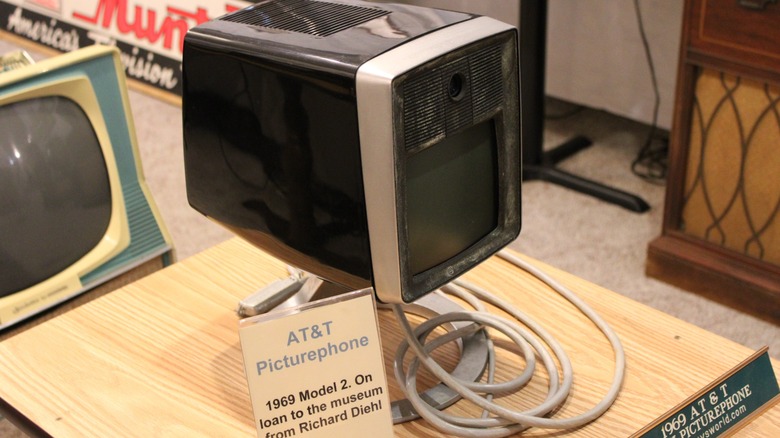
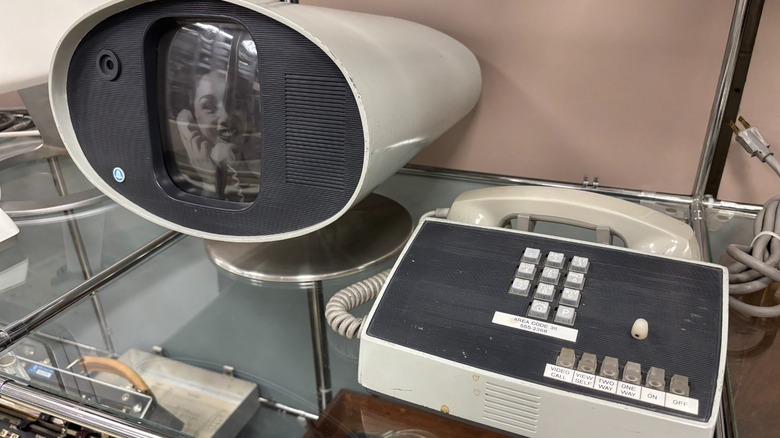
These days, video calling someone is so common that most people hardly give it a second thought, but for most of the 20th century, it was the stuff of science fiction. Video calls showed up in movies and TV shows, but it took a long time for the technology to evolve into apps like FaceTime. While the technology didn't really come around until the 21st century, it dates all the way back to 1964.
AT&T's Bell Labs debuted the Picturephone at the 1964 New York Worlds Fair, a legitimate commercial product that actually worked. You could use it to call anyone who had their own Picturephone, and the video was live, which is impressive when you think of telecommunications technology from the '60s. While it launched in the '60s, the Picturephone was one of the weirdest products sold in the '70s because that's when it made it to consumers.
In 1970, the Picturephone was made available for rent in two cities. Unfortunately, it was incredibly expensive to own, operate, and use, so it never achieved commercial success. Regardless, it launched a technology that's so often used today that most people take it for granted.
Computer Mice
If there's one piece of computing technology that few people give more than a passing thought, it's the computer mouse. It's so ubiquitous that it's a given when someone needs to operate a computer, and while there are a plethora of options when it comes to modern mice, they're all fundamentally the same. A mouse lets a person interact with a graphical display, and it works similarly whether it's a traditional mouse, a gaming mouse, or a trackball.
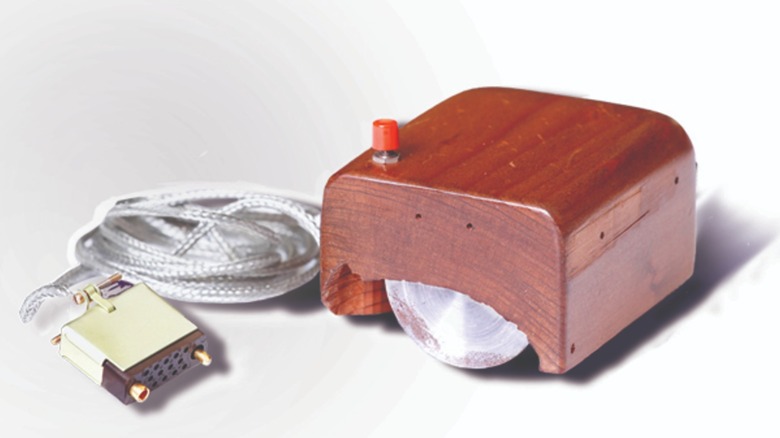
Like any computing device, the mouse had to start somewhere. It was first conceived of in 1961 during a lecture given by Doug Engelbart, who later patented the design, which featured rolling wheels encased in a wooden box with a single red button. By 1964, the first prototype (pictured) came into being, made by Bill English at the Stanford Research Institute.
While nobody recalls who named the device — according to Engelbart, "It just looked like a mouse with a tail, and we called it that."
As time passed, the mouse evolved, adding buttons, wheels, and more. Today, you can buy wireless mice of various types, some of which come with haptic feedback, color-changing LEDs, and more. However, fundamentally, the modern mouse functions in much the same way as the original prototype.
Touchscreens
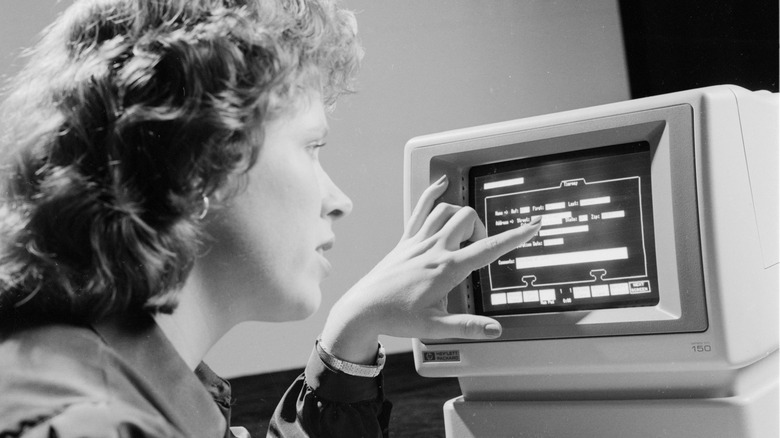
While the computer mouse was an innovative way to interact with computers, it wasn't the only one invented in the 1960s. The touchscreen also came about in the decade. If you're reading this article on your phone or tablet, you're a little piece of this technology, albeit a fare more advanced version than what was first developed in 1965.
The capacitive touchscreen was invented as a means of improving air traffic control in the United Kingdom. Touchscreens improved controller response time, and the first one worked via copper wires connected to circuits. When a finger touched the wire, it detected contact and executed commands. The U.K. utilized that technology until 1995.
CERN developed the first practical touchscreen for complex applications in 1972, and more advancements followed. Modern touchscreens are significantly more advanced than what those British air traffic controllers were using — they can accommodate multi-touch; some are pressure-sensitive for artists working with a stylus. Modern smartphone touchscreens even embed sensors behind the screen to function as fingerprint readers.
DRAM
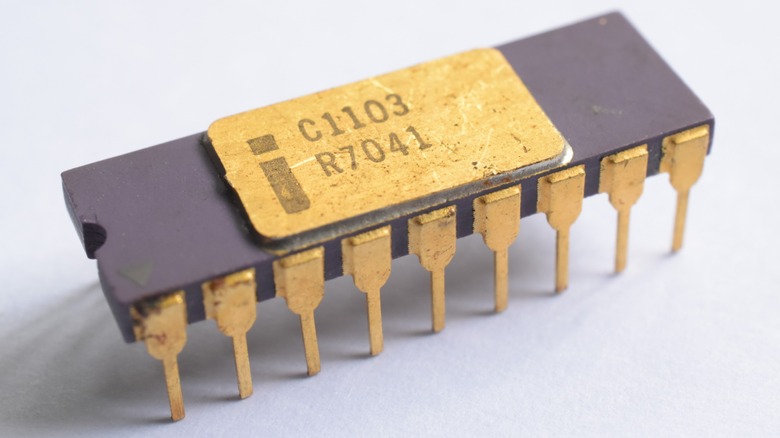
Unless you build your own computers, you probably don't think too much about dynamic random-access memory, or DRAM. It's something that's instrumental to our daily modern lives, but it's hidden within much of the technology we use. You rely on it all the time if you're in possession of a smartphone, and it's in so many other vital pieces of consumer tech that without it, life wouldn't look the same.
Robert Dennard invented DRAM in 1966 when he was lying on his couch thinking about computing tech. He worked with colleagues at IBM on memory that was large and expensive, using six transistors to store 1 bit of information. He reconfigured this process to use a single transistor, and in doing so created a semiconductor-based memory architecture that completely revolutionized computing, mobile phones, video game consoles, digital cameras, and most consumer electronics.
DRAM temporarily stores active application data, background processes, and operating system tasks, speeding up computer systems so they can function more efficiently. It's an important consideration when upgrading your computer's graphics processing unit; DRAM speeds up tasks on an SSD, and it's useful in other components. DRAM is arguably one of the most important inventions from the '60s, as much modern tech couldn't function without it.
The Apollo Program's guidance software
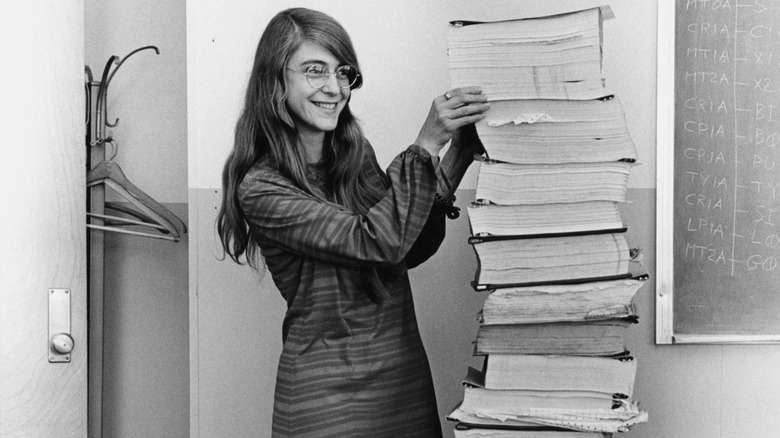
When President John F. Kennedy declared that the U.S. would go to the Moon by the end of the decade, he tasked NASA with an incredibly difficult challenge. Getting to the Moon took thousands of brilliant people working on all aspects of spaceflight, from takeoff to landing. What's not spoken about enough is the software that guided the Apollo astronauts to the Moon, but it was absolutely revolutionary.
You may have seen the above image of Margaret Hamilton standing beside stacks of books, as it makes the rounds on social media every now and again. Those books consist of the Apollo Program's guidance software, which Hamilton wrote with her team — this was also when she coined the term "software engineer." In many ways, Hamilton was indeed the first software engineer. Her work literally guided mankind to the Moon and back, making it vital to the operation. It was coded onto long wires integrated into the Apollo Guidance Computer's memory, which was arduous, but it worked free of bugs.
How then does the Apollo Program's guidance software influence modern life? Hamilton and her team formalized the concept of software engineering and asynchronous software alongside brilliant error-recovery, all of which remain fundamental aspects of modern computer programming. Not only did her work impact spaceflight, but it evolved into fly-by-wire systems in modern aircraft, and much more.
The Brown Box
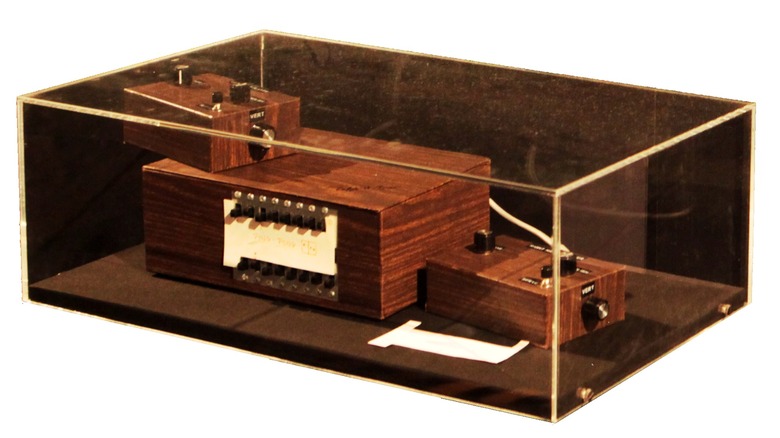
Today, the video game industry is a massive beast encompassing everything from games on your phone to the latest PlayStation 5 titles. But it didn't start out that way. In fact, when video games first arose, some considered it a passing fad. While the first consumer game console appeared on store shelves in 1972, it owes its existence to another device created five years earlier in 1967 called TV Game Unit #7, aka the Brown Box.
The Brown Box was developed by Ralph Baer and his colleagues as a prototype to test multiplayer, multiprogram gaming in an effort to license the technology. As you can see, the name is apt, as the wooden boxy device was as rudimentary as it gets, but that hardly mattered because it worked. While it was only a prototype, the Brown Box innovated by including two controls, and the system could play more than one game.
Programming it required flipping switches, while program cards were used to inform the switches what to display. In terms of games, they were fairly simple versions of ping-pong, checkers, golf, and there was even a lightgun game. Five years after inventing the Brown Box, Magnavox purchased it and produced the Magnavox Odyssey in 1972, kicking off the first generation of video game consoles.
The ARPANET
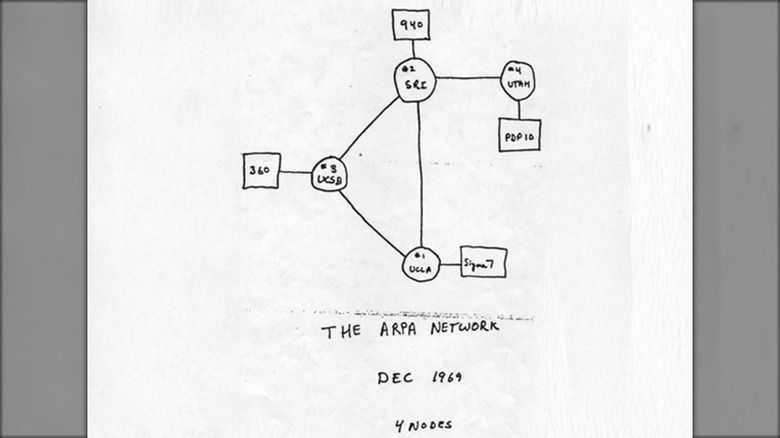
When the World Wide Web arrived in 1989, regular people connected to others around the globe, opening the doorway to modern internet commerce, data sharing, video streaming, multiplayer gaming, and so much more. However, the internet predates that by a lot, and it started with ARPANET.
The Advanced Research Projects Agency (ARPA), the precursor to DARPA (the "D" stands for defense), created the Advanced Research Projects Agency Network (ARPANET) to establish communication between multiple computers. The first connected computers came in 1969, mapped out somewhat crudely in the above image. Initially, the ARPANET connected only universities and government computers, but it expanded over time.
Communications technology advanced to the point that it became possible to share messages, better known as email and internet relay chat (IRC), and other capabilities arose in the 1970s. Ultimately, the ARPANET ceased to exist in 1990, but for decades it was the only way to easily connect one computer to another across a great distance, and it gave birth to the internet we know and use today.
UNIX
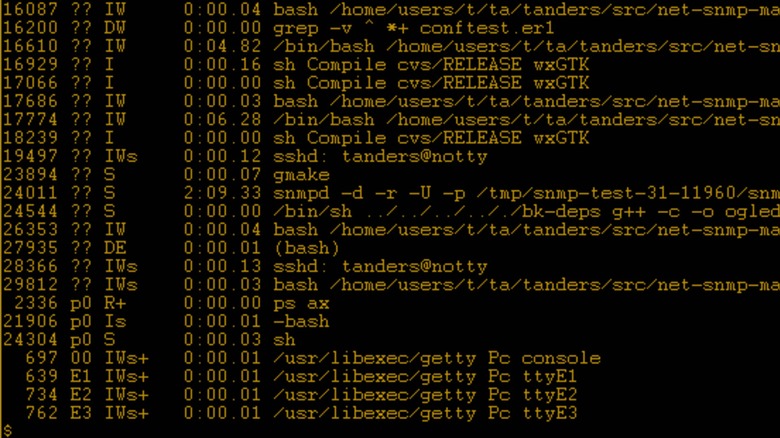
While most people use Windows as their operating system (OS) on desktop and laptop PCs, it's hardly the only one available. There are tons of different operating systems, many of which people use daily without much thought. If you use an Android phone, that's an OS, while folks using iPhones use another called iOS. However, they all owe a debt to the one that arrived in 1969. UNIX was the first OS designed to run on any and all computers, and it became the foundation of the internet.
Created at AT&T's Bell Labs for use internally, it didn't take long for the company to release UNIX to outside companies and people. From there, it found use across numerous industries, and it became one of the most important OSs around, largely due to its open design. Its inventors, Dennis Ritchie and Ken Thompson, were welcomed into the National Inventors Hall of Fame in 2019 for their work.
Modern programming owes a lot to UNIX, and you can trace everything from macOS, iOS, Android, and Linux straight back to it. While impressive, Windows, as we know it today, wouldn't exist without UNIX influences, though Windows isn't a UNIX-based system and only used some of its coding along the way. Regardless, UNIX's impact on modern computing makes it one of the most important inventions to come out of the 1960s.