

Every Military Jet Ever Included In Star Trek's Michael Dorn Aircraft Collection

If you're a fan of "Star Trek," odds are you know all about Michael Dorn. He joined the franchise when "Star Trek: The Next Generation" kicked off in 1987, and has since appeared in more episodes and individual series than anyone else. Since appearing in Season 3 of "Star Trek: Picard," Dorn has appeared as Worf in 284 episodes, not to mention every one of the "Next Generation" films, so he's well known to the fandom. However, what many fans might not know about Dorn is that he's a pilot and has an impressive collection of aircraft.
In November 2022, Dorn sat with Flying Magazine to discuss his love of all things aviation, and he talked about the many aircraft he's had in his collection, which includes military jets. Civilians can and do purchase military aircraft, which are then referred to as Warbirds, and Dorn has had many over the years. While he's yet to add his dream plane, the Lockheed F-104 Starfighter, to his collection, he has at times owned and operated a CASA Saeta HA200, a Lockheed T-33 Shooting Star, a North American F-86C Sabre, and a North American Sabreliner 40A.
That's just his military aircraft — Dorn has a collection of civilian planes as well. He's not just a collector and admirer of planes; he is a trained and licensed pilot. He learned to fly during a writers' strike, which afforded him the time needed to get his license. Since then, he's been an avid collector and pilot, and these are all of the military jets he's owned at one time or another.
CASA Saeta HA200
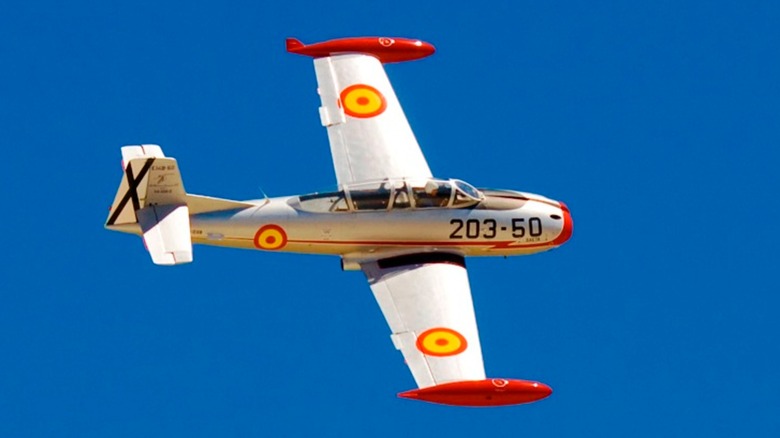
After Dorn got his pilot's license it didn't take long for him to begin acquiring airplanes, though initially, they were civilian Cessnas. He even flew with the Blue Angels, and the first military jet he added to his collection was a CASA. The CASA Hispano Aviación HA-200 Saeta is a small, tandem-seat, twin-engine aircraft that helped Dorn learn to manage flying a jet, and it only made him more enamored with military aircraft. The CASA is a jet trainer, and it's the first Spanish aircraft to use jets for propulsion.
They first appeared in 1962, so the CASA goes back quite a ways, training cadets of the Spanish Air Force for several decades. One variant was used as a ground-attack aircraft, which was exported to other nations, including Egypt. Some CASAs saw combat during the Polisario insurrections in Morocco, so the jets have some history. In terms of power, they're fitted with two Turbomeca Marboré II F3 turbojet engines capable of producing a combined 2,114 lbs. of thrust.
This gives the jet a maximum speed of 429 mph, and the aircraft has a range of 932 miles. Its service ceiling is just under 42,700 feet, and the jet itself is relatively small. Its wingspan is 34 feet, 2 inches; it's 29 feet, 5 inches long, and is 9 feet, 4 inches tall. It's unclear which variant Dorn purchased for his collection, but he spoke about it in an interview with Airport Journals, saying, "It was a tiny, twin-engine jet, but it got me acclimated to jet operations — how jets work and the speed and thinking way ahead."
Lockheed T-33 Shooting Star
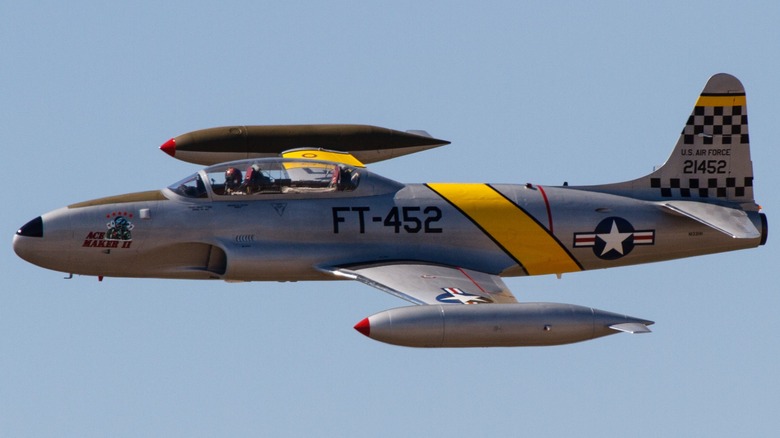
After learning the basics of jet operation in his CASA, Dorn then purchased a T-33 Shooting Star, which is the same trainer the U.S. Air Force previously used to train its pilots. Speaking of his purchase, Dorn told Airport Journals, "It was a good experience because the T-33 is built like a tank. You can bounce it off the runway and make hard landings. It's also an old airplane, so the response on the jet engine is very slow." Dorn's instructors were all former Air Force pilots, so it makes sense that he followed in their footsteps.
The Lockheed T-33 Shooting Star entered service in 1948, first for the Air Force, but then it made its way to the U.S. Navy and several foreign customers. By the end of its production run, a total of 5,691 T-33s of various variants were built, though it was most often used as a training jet. While the U.S. didn't employ the T-33 as a combat aircraft, other nations did. It was also used as a reconnaissance jet, and some were outfitted with two .50 caliber machine guns in the aircraft's nose.
The T-33 was powered by a single Allison J33-A-35 turbojet engine, which gave it the power needed to fly up to 600 mph. Its cruise speed was 455 mph, so it typically flew around there, and the aircraft boasted an impressive range of 1,275 miles. Dorn held his T-33 in his collection for three years, and after trying out a Mitsubishi MU-2, which he didn't purchase, he moved on to the same jet the Air Force did.
North American F-86C Sabre
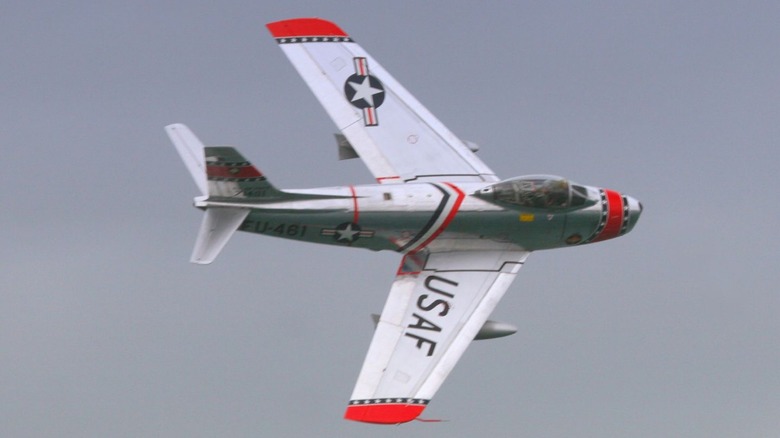
Dorn enjoyed his F-86 Sabre, which he described as "a dream to fly," adding, "You really have to work at screwing it up." The F-86 was a significant upgrade over Dorn's previous military jets, as it was a single-seat fighter jet that was heavily used in combat operations. The F-86 Sabre ruled the skies in the Korean War, taking on Soviet MiG-15s in dogfights across "MiG Alley." The F-86 was the U.S.' first swept-wing fighter, and it proved its worth in numerous engagements.
The fighter has a kill ratio of 1.3:1, though some sources put the number closer to 10:1. The F-86 Sabre was powered by a single General Electric J47 engine capable of providing 5,200 lbs. of thrust. This gave the F-86 a top speed of 685 mph, or Mach 0.89. In terms of armaments, the F-86 fought in the skies over Korea with six .50 caliber machine guns, making it particularly deadly. Dorn's aircraft was the North American F-86C Sabre, and he flew to "Star Trek" conventions in the jet, so he got a lot of use out of his Sabre.
While he was flying it over the Mojave Desert, the engine quit on him due to a lack of fuel, which he didn't realize was due to a broken gauge. He managed to bring the aircraft down safely at Air Force Plant 42 near Palmdale, California, and landed safely. When the emergency crew arrived to ensure everything was okay, Dorn was immediately recognized as Worf, which worked in his favor, as he wasn't legally allowed to land on a military base despite the emergency.
North American Sabreliner 40A
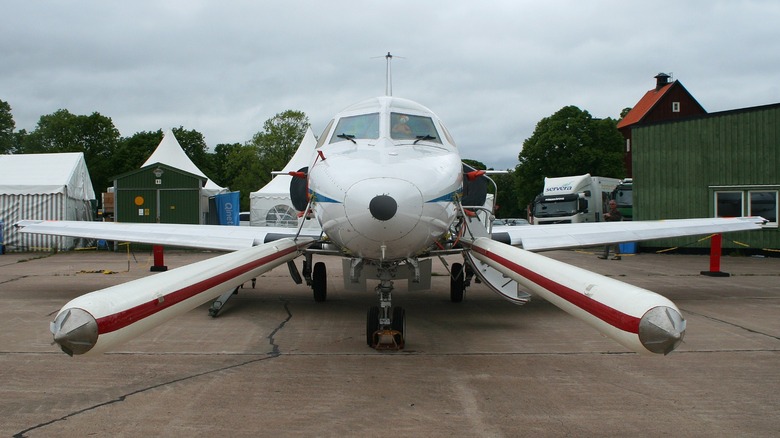
After flying his F-86C Sabre for four years, Dorn sold it in 1998 and acquired a North American Sabreliner 40A, which is the last military jet added to his collection as of this writing. He told Airport Journals, "I thought I was done with military flying. It's kind of complicated, and you have to email the FAA to tell them where you're going to go. It's a little bit of a hassle. ... I just wanted to be able to jump into my airplane and fly." That didn't exactly happen, as the Sabreliner is a military jet.
Unlike his previous military aircraft, the Sabreliner isn't a fighter, nor is it an attack aircraft. Instead, it's primarily used as a trainer by the military, though it has corporate applications as a business jet. The military began flying the Sabreliner in 1962, and it remains in operation for the U.S. Air Force, U.S. Navy, and the U.S. Marine Corps. The biggest difference the plane offered to Dorn was that it required a crew of two, so he'd go up in the air with a copilot, which wasn't his favorite thing to do.
Dorn explained that it was a bad choice to purchase the plane because "you're at the mercy of your copilots. ... I was bored out of my skull. You take off, and you have your arms crossed for two hours." That was the last military aircraft Dorn added to his collection, but he explained to Flying Magazine that the legendary, howling Lockheed F-104 Starfighter is his dream jet, and "The 104 will be my final airplane, because it really goes fast."