

What Happens If You Sharpen A Knife Or Tool Blade At The Wrong Angle?
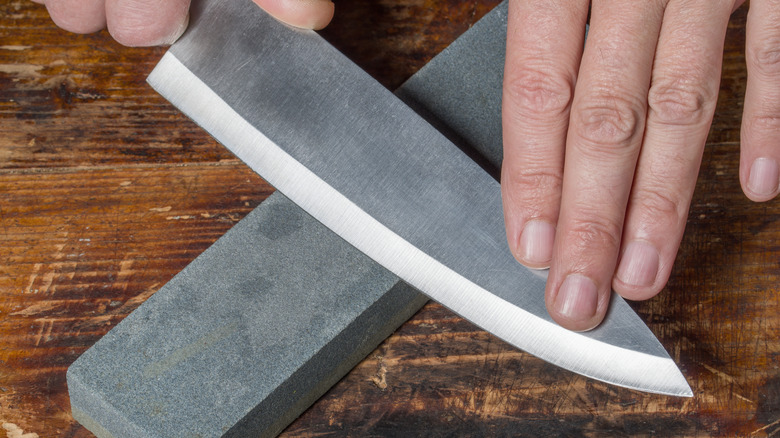
A big part of owning any kind of bladed implement, whether it's a kitchen knife, work knife, Swiss Army knife, or multi-tool like a Leatherman, is keeping it properly sharpened. Knives naturally wear down over time, their cutting edges becoming dull and chipped, so they need to be sharpened with a rotary tool or whetstone in order to maintain their strength and ability to cleanly slice through materials. However, sharpening a blade isn't as simple as holding it against a sander for a couple of seconds and calling it a day.
Keeping blades properly sharpened is delicate work, requiring not just a steady hand, but an eye for angles. Every blade has an optimal angle at which it's meant to be sharpened, usually dictated by its manufacturer. So long as you stick to that optimal angle, you'll get a nice, sharp blade without hindering the tool's overall longevity. However, if your sharpening angle is too steep or shallow, you risk warping the blade's shape. Not only can this greatly diminish its cutting ability, leaving it too brittle or too thick, but over time, this can severely diminish the tool's structural integrity, causing it to wear out faster than it normally would.
Improper angles can lead to blade warping and damage
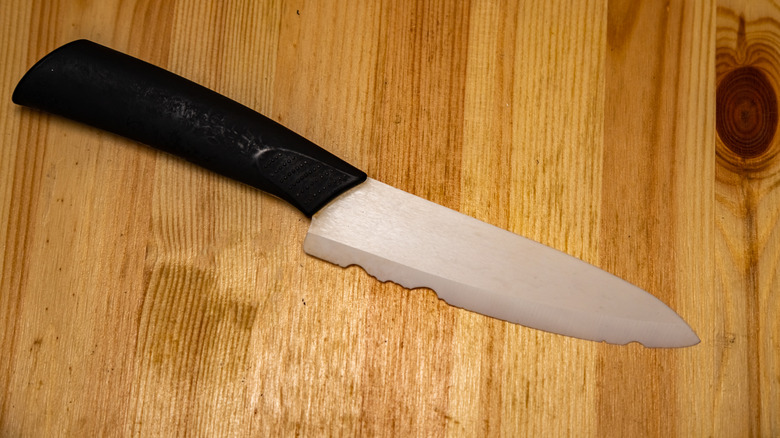
If your knife or bladed tool came with an instruction manual, you should consult it before performing any kind of sharpening work, as it should have a manufacturer's note about the optimal sharpening angle. Whatever the manual says, you should strive to stick to it, as going too far in either other direction can have damaging knock-on effects.
If your sharpening angle is too wide and steep, then you're not actually sharpening the blade, just making it thinner. A proper sharpening is supposed to "part" the side into edges, which is what gives it its cutting ability. Without a parted edge, the blade can't actually cut anything, merely pressing into and crushing materials and leading to much messier separations. That thin side also can't support the weight of the metal behind it, which means it will chip or fold over relatively quickly.
Inversely, if your angle is too shallow, you risk filing the edge down into nothing. It may technically have the part necessary to be considered an edge, but it'll be so thin and wispy, that it'll fold over the moment you try to press it into anything. Additionally, a shallow angle causes shaved metal to pile up behind the blade, creating uneven shapes that make the blade drag and hitch when cutting.