

Is The Toyota Land Cruiser Body-On-Frame Or Unibody? (And Does It Really Matter?)
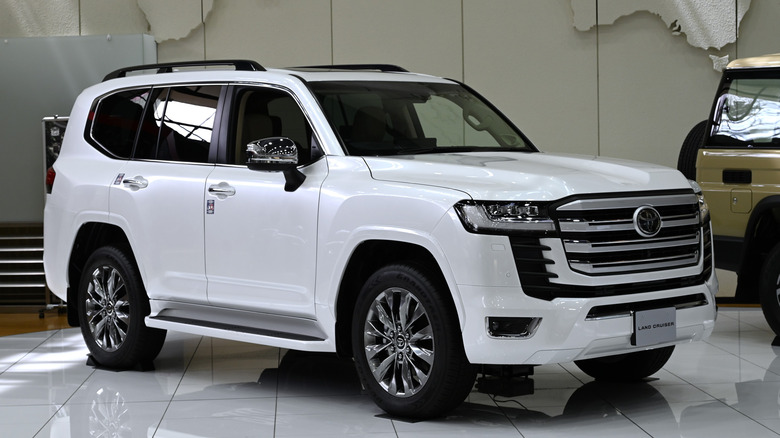
If there's one SUV almost universally associated with ruggedness, it's the Toyota Land Cruiser. That quality has defined the truck since its inception, in no small part thanks to its body-on-frame construction. And yes, the Land Cruiser remains a body-on-frame truck, even in the luxurious Lexus LX guise, the only way to get a true Land Cruiser in the United States. While Toyota does sell a Land Cruiser in the U.S., the American-market Land Cruiser is actually the smaller Land Cruiser Prado, and has been since 2024. That said, the Prado is also body-on-frame, so much of what we'll discuss applies here, too.
Why is body-on-frame construction so integral to the Land Cruiser, though? Would a Land Cruiser still be the same vehicle if it were unibody instead? The first question is fairly complicated, but the latter isn't: No. It's even in the name: "Land Cruiser" evokes a vehicle that can go anywhere, and Toyota has marketed it as such since the 1950s. Body-on-frame and unibody vehicles each have pros and cons, but the Land Cruiser needs those body-on-frame pros to excel at what it was designed to do.
The Land Cruiser is known for, among others, being very reliable, easily modifiable, and excellent in all terrain conditions. Sure, it isn't perfect, but Toyota has also compensated for many of its weaknesses over the years as well. Let's examine it more closely and define why its construction is so integral to its identity.
A history of rugged dependability

The Toyota Land Cruiser is somewhat unique in the truck world in that its design philosophy hasn't changed much over its many generations dating back over 75 years. It's basically the SUV variant of the Ford F-Series, another example of body-on-frame done for a reason: utility. And, like the F-Series, the Land Cruiser has never forsaken that vision, even though modern variants dwarf older examples in terms of cost, luxury features, and sheer size and weight. That truck DNA still lives there, providing a solid foundation for its identity.
Now, Toyota has been criticized by researchers and enthusiasts alike for its relative stagnation, and one might argue the Land Cruiser is particularly emblematic of this. After all, the 70-series Land Cruiser, which is still in production, has changed little since Toyota introduced it in 1984. That stagnation, however, makes it a proven platform: enthusiasts still celebrate 40- through to 80-series Land Cruisers as exemplars of quality and off-road prowess, with examples selling deep into five-figure territory despite having hundreds of thousands of miles on decades-old chassis. You know what you're getting into when you buy a Land Rover 70, then.
None of that is accidental, though. The Land Cruiser was originally designed to emulate the Willys MB — a simple SUV capable of going anywhere and doing anything. That has colored all variants of the Land Cruiser since, with Toyota continuing to market the full-size Land Cruiser and smaller Prado as as modern vehicles with old-school, durable underpinnings.
Why the body-on-frame enhances the Land Cruiser

A body-on-frame construction offers several advantages that suit the Land Cruiser well. For one, as mentioned before, it's simple and rugged. The Land Cruiser is essentially a frame with a body sat on top of it, with each able to flex independently (to a point, anyway). This lets the frame move slightly when off-roading and supports strengthening modifications. Let's say, for instance, you need a stiffer chassis for towing. Just weld in some reinforcing brackets in the back. Bigger axles, increased suspension travel, larger engines — it all becomes easier with a body-on-frame.
Moreover, because you're not stressing the car's body, you can modify it without ruining the vehicle's structural integrity. You can remove the doors or roof or swap body panels with no problems; it's far more flexible than a unibody in that regard. The downside is that unibodies are far better at being cars than body-on-frame vehicles. They handle better, have a lower center of gravity, and weigh less. But reviews of the Lexus LX rarely complain about ride quality, just the lack of cargo space and third-row passenger comfort due to the frame intruding on the interior — both common problems facing today's luxury body-on-frame SUVs.
But let's not kid ourselves; the Land Cruiser is a full-size truck, and the smaller American variant isn't specialized for on-road work, either. It'll never handle like a compact crossover, but that's hardly the point. You don't buy a Land Cruiser because it handles nice on pavement. You buy it because it can go anywhere. A unibody would jeopardize that ability, alienating its own market.