

Can You Use Bleach In A Pressure Washer? Here's What You Need To Know
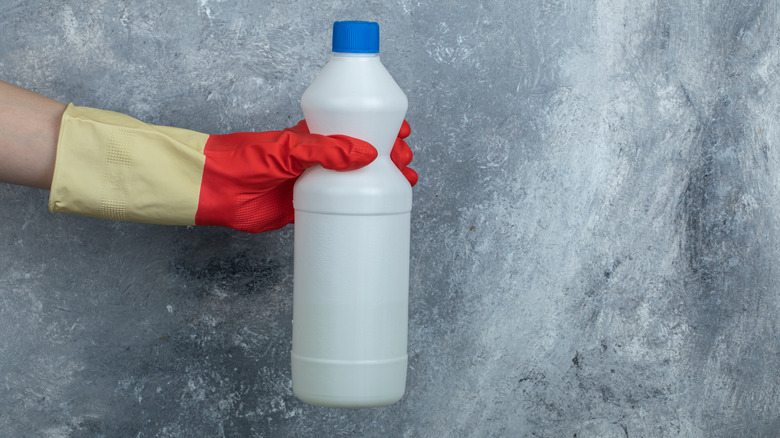
We may receive a commission on purchases made from links.
The typical reason you get out the pressure washer is because you want to clean something outside that's stuck too firmly on to manage with just scrubbing. While pressure washer streams are powerful, though, they may still be insufficient when it comes to dealing with particularly stubborn outdoor messes, like stuck-on mold and moss. If you were trying to clean out mold inside your home, you may consider employing consumer-grade liquid bleach. By that logic, running bleach through your pressure washer would seem like an optimal solution. However, this isn't quite the case, and in fact, it'd be one of the biggest mistakes you could make with a pressure washer.
Bleach is well-known as one of the most caustic substances you can buy at the supermarket, and its harsh properties have a nasty habit of not discriminating between targets. If you attempt to fill your pressure washer's solution tank with a bleach mixture the same way you would cleaning solution, you'll almost certainly destroy your washer's internal components. It is technically possible to perform spot cleans with bleach and a pressure washer by employing some additional equipment, but given bleach's aforementioned caustic nature, you might want to think carefully before you try that.
It's not safe to run bleach directly through a pressure washer
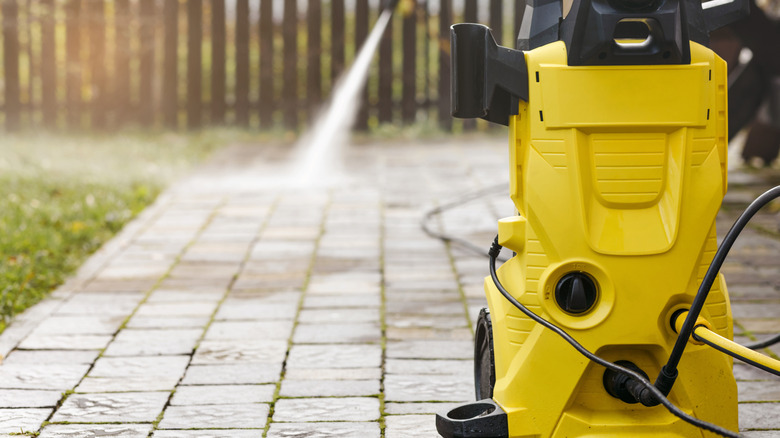
Pressure washers may be fairly rugged as far as home cleaning equipment goes, but they're not invulnerable, and certainly not against the threat of chemical reactions. If you attempted to use liquid bleach in the same way you'd use pressure washer detergent, you could force your washer to endure multiple forms of damage, culminating in its complete failure.
Just about every component of a pressure washer could be potentially damaged by bleach exposure. For example, if your water tank or solution tank is made of plastic, the bleach will begin breaking it down, thinning it out and causing it to become brittle. Eventually, cracks will start to form in its surface, followed by full-on holes, which is terrible for both the obvious reason and because holes in any part of a pressure washer will diminish the pressure.
In addition to the plastic tank, bleach can also damage the rubber and metal internal components of your washer. In the former case, rubber hoses, such as those that connect components together, will become similarly brittle and fragile to plastic components. In the latter case, metal components in the pumping mechanism like seals and O-rings will be corroded and develop pits, which will lead to the pump failing. It's a similar negative effect to what would happen if you tried to put bleach in a diesel engine.
Bleach can be used to clean separately, but it still presents risks
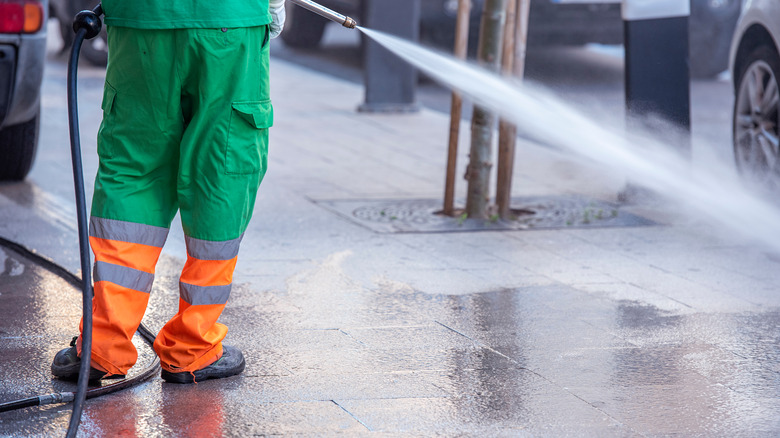
If you're determined to use bleach to clean something outside, there are a couple of ways you can skirt the potential damage to your pressure washer. The first option is to use a downstream injector, a component for a pressure washer that adds solutions at the end of the water flow rather than at the start in the tank. This will keep the bleach away from the washer's sensitive components.
Alternatively, you can use a standalone pressure pump sprayer to apply a bleach solution separately, then wash it off with your pressure washer. You can get one at your local Home Depot for around $30.
While these tricks will allow you to use bleach with your pressure washer, you should still approach the matter very cautiously. Before using bleach in any kind of large-scale cleaning capacity, you should be wearing protective gear, including gloves, goggles, long pants and sleeves, and boots. Additionally, you should never use pure bleach, as it would be far too intense. Bleach should be diluted with water at a ratio of 0.25 to 1, or a quarter gallon of bleach to one gallon of water.
Finally, bleach should only be used on certain types of surfaces, including concrete, asphalt, brickwork, pools, and other similar types of surfaces that can safely resist the corrosive effect. It would work for cleaning the concrete floor of a workshop, for example. Bleach should not be used on surfaces like wood or metal, and especially not near vegetation like outdoor plants.