

How The Cost Of Changing Your Oil Has Changed Since The 1960s
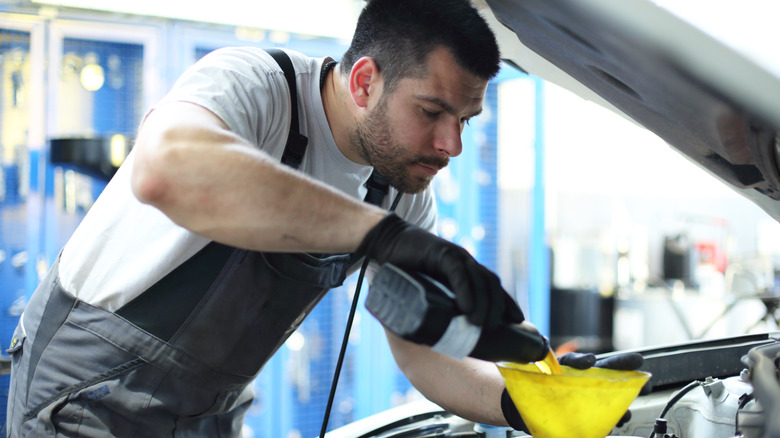
Oil change prices vary depending on where you go, the type of vehicle you drive, and any optional additions you may choose. Customers can broadly expect to pay up to around $70 for a standard change, including the filter, and up to around $130 with synthetic. It's enough to make you wonder why oil changes are $100 or more now. In the 1960s, these costs were just a fraction of what they are today.
As reported by J&S Auto Repair- Warwick, "In 1960, the cost of 5 quarts of oil for an oil change was only $2.25!" GM Parts Center adds that a little later in this era, in 1964, a quart of oil was $0.34. Adjusted for inflation, this works out at approximately $3.12 and contrasts quite profoundly with prices from earlier and later that century. In 1934, those figures stood at $0.07 and $1.50, respectively. These numbers are adjusted for inflation according to 2022 pricing, when that same quart was around $4.97 (about $5.90 in 2026).
Motorists could change the oil in their car themselves, otherwise there would be a labor cost to pay the mechanic's shop. The United States Bureau of Labor Statistics reports that, in 1964, hourly wages for body repairmen ranged from $3.50 to $4+, and that class A automotive mechanics made from $2.50 to more than $3.50 (depending on U.S. region). Other factors that have influenced rising oil change prices include fluctuations in the price of motor oil itself. Cheaply made disposable auto filters kept this component quite inexpensive: A study from Michigan State University, hosted by HathiTrust, notes that, for farmers, an oil filter refill cost a U.S.-wide average of $1.99 in March 1960, rising to $2.10 in 1962 and to $2.18 in 1964.
The changing costs and needs of different eras' vehicles
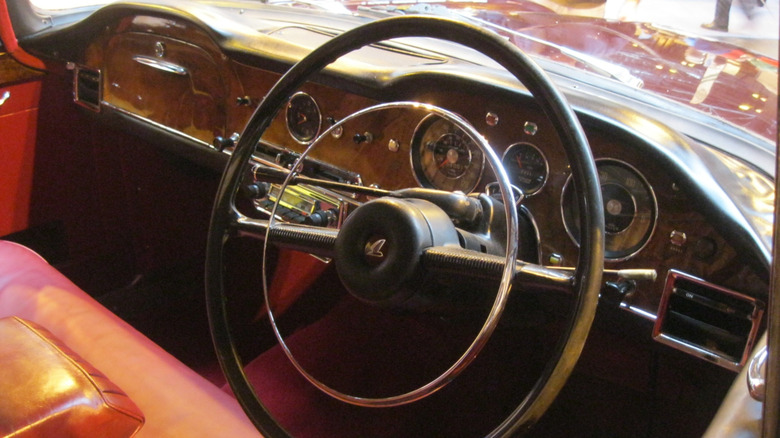
Unless you're a dedicated classic car enthusiast, the car you're driving now is probably very different to the ones that motorists drove in the 1960s. Developments in aerodynamics and materials have taken place, and the substances that power them have evolved over the decades. In the realm of motor oil, one of the biggest developments has been synthetic oil. The potential of synthetic oils was just starting to be recognized in the 1960s, but it was far from being fully plumbed.
Some vehicles of the 1960s used up oil faster than today's more efficient models, and that oil itself was lower quality without some of the additives that have been introduced to maintain its quality for longer. This was the era when the 3,000-mile rule of thumb took hold, but today, you don't generally need to change your oil nearly that often.
The price of an oil change, needless to say, can be directly impacted by the cost of oil itself. This has been through intense fluctuation since the 1960s and, in tandem with inflation, has changed a lot over time. For instance, in2013dollars reports that, "according to the U.S. Bureau of Labor Statistics, prices for motor oil, coolant, and fluids are 637.37% higher in 2026 versus 1977 (a $127.47 difference in value)." Spending power and inflation have a huge impact on cost comparisons too, as do a variety of other changes that took place in the industry.
What that oil change cash could buy you, then and now
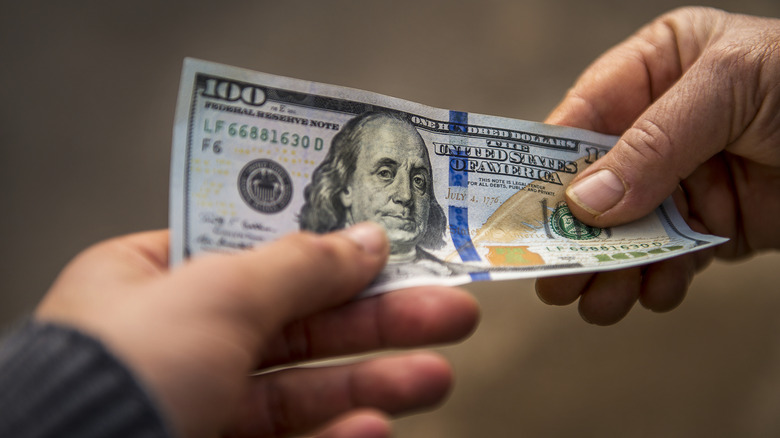
Purchasing power is a vital consideration in contextualizing these numbers. Let's consider the federal minimum wage, which, according to the Federal Reserve Bank of St. Louis, slowly rose from $1 in 1960 to $1.60 in December 1969. As of July 2026, it stands at $7.25, but again, these figures don't necessarily translate to an overall increase in spending power.
In January 2014, the American Enterprise Institute illustrated the change in purchasing power by comparing how long factory workers needed to work to afford a basket of 11 household appliances. It estimated that a typical factory worker in 1959 would have had to work almost six months, whereas a contemporary factory worker needed to work about a month. According to in2013dollars, the dollar's value has fallen to just 9% of where it stood in 1960, meaning that "$100 in 1960 is equivalent in purchasing power to about $1,128.10 today." While today's wages and prices are much higher, inflation has had a huge impact: $1 in the 1960s, for instance, equates to around $11.40 about 60 years later.
We should also remember that while the basic process of changing a car's oil hasn't changed much since the 1960s, many factors in the industry landscape have changed, and these will affect the price. Contributing factors include the cost of new refinement and treatment regulations, as well as changing demand since oil changes are required less often on modern cars.