

Here's How Often You Should Be Changing Gear Oil
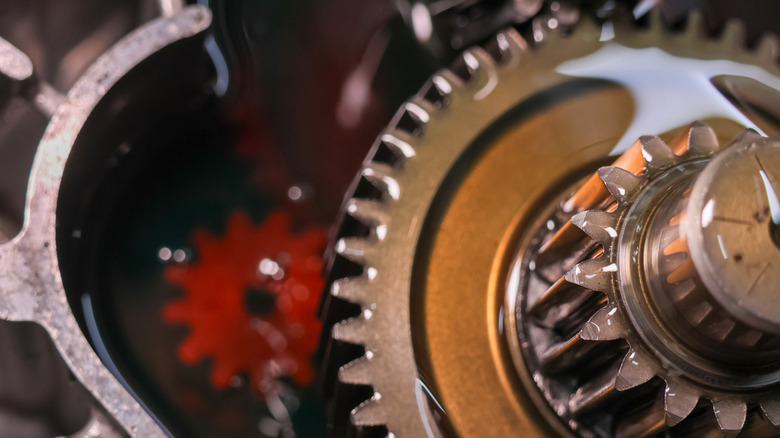
You know how the human body contains all sorts of different fluids that each do different things? So too do cars. You have your standard engine oil, which comes in conventional, synthetic, or a blend of the two; brake fluid, coolant, and more. Just about anywhere that needs liquid cooling or has metal-on-metal contact, you'll find a corresponding fluid. One such lubricant, responsible for one of the most violent parts of your car outside of the combustion chamber, is gear oil. Gear oil is responsible for lubricating a number of different components, namely manual transmissions, axles, and differentials — anywhere with gears, basically, hence the name.
How often should you change it? Like any other fluid, that depends on its application and how hard you drive the car. There's no single universal rule that says to change it every X amount of miles, though a good place to look would be your owner's manual. But a good rule of thumb is, if you drive normally and don't tow a lot, you could stretch it to around 50,000 miles. Cut that in half if you're not careful with your car, similar to changing automatic transmission fluid.
Bear in mind that different cars need different types of gear oil as well, with some cars needing multiple types of gear oil by themselves. For example, GL5 gear oil eats away at brass because of its additives, so you need to use GL4 if you have brass synchros in your transmission, whereas GL5 might be fine for the axles. Different viscosities exist as well, such as 75W-140, 85W-90, etc. What does all this mean? Let's break it down.
Types of gear oil and their applications
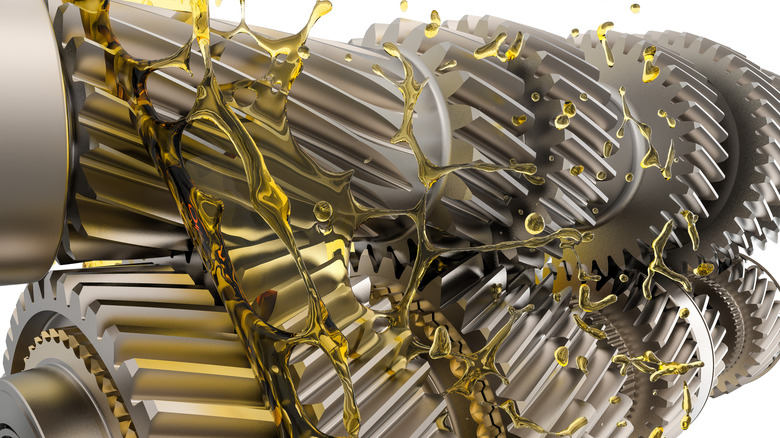
The main takeaway here is to do your homework and check your owner's manual to be absolutely certain you're putting the right gear oil in the right component, because different oils have different properties that could damage certain parts. Certain formulae like hypoid gear oils are designed to withstand higher pressures, meaning they have additives and consistencies that let them stick to metal surfaces easier under heavy loads. This provides a sacrificial layer of oil on whatever it touches, particularly good for higher-performance axle applications. Likewise, full-synthetic gear oil helps with these applications as well.
Conversely, lower-pressure rated GL4 contains less additives that make it more suitable to lower-pressure applications, such as vintage manual transmissions and standard car axles. These applications produce less strain on the working parts, provided you're not slam-shifting the car all the time, so their service interval is likely similar to higher-performance GL5 in high-pressure loads because the wear rate is fairly uniform. You can theoretically put GL5 in a GL4 or vice versa, but do so at your own risk; the additives (or lack thereof) in these oils may damage certain metal components.
Other types of gear oil exist as well, with the most well-known subcategory being differential oil, or simply diff oil. This is the oil that lubricates the axle differential — that big pumpkin-looking thing on your axle. There's a bunch of gears in there that would grind against each other without being saturated in this specialized oil. Like all the other gear oils your car has, this should be changed roughly 30,000 to 50,000 miles or so, depending on your vehicle type and driving style.
What happens if you miss your service interval?
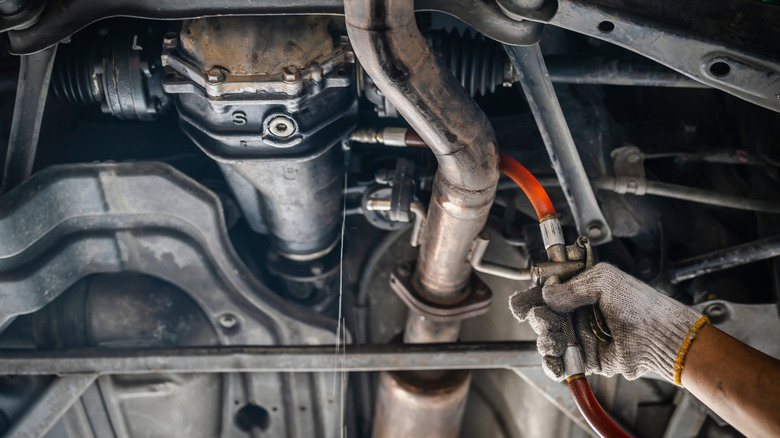
It really depends on how hard you're driving and how late you are, but there's a few things to watch out for if your gear oil is going bad. First of all, gear oil absolutely reeks, as any mechanic can attest to, so if you have a sulphur and phosphorous-like odor emanating from your car all the time, you should probably check your axle boots and diff seals.
Aside from the smell, though, the big thing to listen for is a grinding noise. Remember the key word here is "gear" oil. What happens when you crunch two gears together without any lubrication? They grind and produce a lot of heat. Gears don't like grinding, so a manual transmission might pop out of gear all of a sudden, you might feel vibration or shuddering when turning, or you'll hear an incessant scraping noise from an axle.
To better visualize what happens if your gear oil goes bad, picture a car turning. The outside wheels travel a longer distance because it's a bigger circle, right? That's the job of a differential — it allows your wheels to turn in the same direction at different speeds. If the oil goes off, then turning sharply like that will upset those gears and cause a grinding sound. The same principle applies with manual transmissions as well — any time you're putting stress on the gears will produce grinding sounds without adequate lubrication. That's an excellent way to turn a $100 service into a $2,000-plus transmission rebuild, so be sure to change your gear oil on time.