

These Tech Brands Are 2026's Biggest Losers When It Comes To Repairability
The U.S. Public Interest Research Group (PIRG) Education Fund has been publishing its annual Failing the Fix scorecard since 2022. The report assigns a repairability score to some of the most popular phone and laptop manufacturers, using data from a French law passed in 2021, known as the repairability index. According to PIRG, this year's scorecard also includes data gathered under the European Union's new European Product Registry for Energy Labelling (EPREL) rules.
The EPREL rules mean that certain electronics products sold in Europe have to adhere to minimum requirements like resistance to drops, batteries that meet at least 800 charge cycles, transparent information on disassembly and repair of the devices, supplying parts for seven years, longer software support, and providing repair shops access to software and firmware.
These rules currently apply to smartphones, tablets, and cordless phones. For PIRG's 2026 scorecard, the data informed updates its scores for smartphones. Data from France was also used for laptops.
The group also deducted points for companies that belong to trade groups or organization that lobby against right to repair policies, and awarded points to any company that has supported right to repair legislature. This is an important metric, as right to repair laws in the U.S. have been a war of attrition, with high profile lawsuits playing out of years, like the one with John Deere over various repair restrictions on its heavy equipment — a lawsuit it ultimately lost, to the tune of $99 million in repair funds to farmers.
Apple, Samsung, and Lenovo are the biggest losers
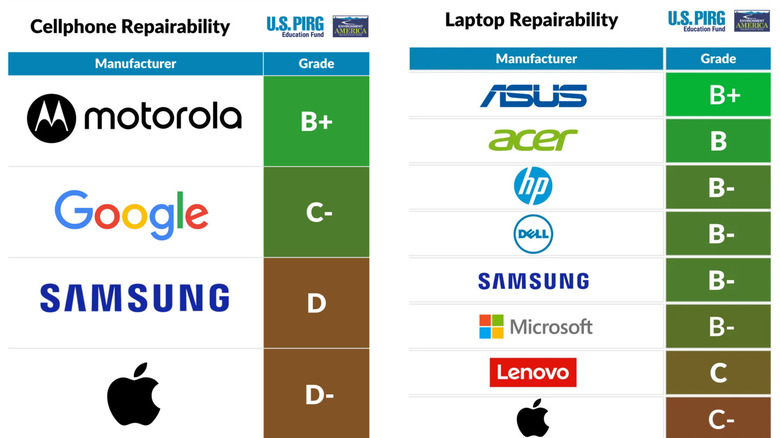
Apple and Samsung are two of the smartphone industry's biggest players, and both were at the bottom of the scorecard for smartphones: Samsung with a D, and Apple with an even worse D-. Apple's iPhones and Samsung's Galaxy devices are both notoriously difficult to repair. Both continue to rely heavily on adhesives, and Apple has a penchant for using a variety of screws, some of which are proprietary, as well as a history of parts pairing.
Apple still restricts a large number of aftermarket parts, restricts Face ID replacements, and its Activation Lock anti-theft system is tied to several parts, which effectively locks them out of being harvested for repair. Despite the low scores, both Apple and Samsung have made some concessions for independent and self repair.
As of the iPhone 16 line and iOS 18, Apple's built-in Repair Assistant allows for used Apple parts to be calibrated on-device and used for repairs. The more recent iPhone Air and iPhone 17 Pro also made notable improvements for basic repairs by using electrically releasing adhesive, standard screw types, and allowing access to Apple parts and repair documentation.
Samsung launched its own self-repair program in 2022, and has continued to expand on its catalog of parts and services. Recent devices like the Galaxy A57 and Galaxy S25 Ultra have been praised as some of the most repairable Galaxy devices in years.
As for laptops, Lenovo scored a C, and Apple received a C-. PIRG noted that it has not seen any meaningful improvement in laptop repairability from last year.
Software support, and the need for a universal repair score
Software support for devices remains a significant bottleneck for repairs, and jeopardizes longevity by giving devices an artificial expiration date, even when its hardware life could continue functioning. When devices outlive their software support timeline, they effectively fall off of a cliff, no longer receiving OS or security updates, and become relegated to the growing e-waste pile. To put this into perspective, the death of Windows 10 is expected to render 400 million PCs useless, with no upgrade path to Windows 11.
Lawmakers have (slowly) recognized software support as an area that's just as important as hardware, and have made slow shifts in policy in an attempt to curb planned obsolescence and software abandonment. While things are moving slow in the U.S., the European Union's Ecodesign requirements for smartphones and tablets took effect last year, and imposed a minimum of five years of OS and security updates on devices sold in Europe. Google and Samsung have already committed to supporting their premium devices for seven years, but cheaper Android phones don't always get the same treatment. Apple historically has provided software updates for its iPhones and Mac computers for six to seven years.
PIRG notes that states and lawmakers in the U.S. should work towards a universal and identifiable repair score for devices, akin to fuel economy stickers on cars or energy labels on appliances. This would arm consumers with valuable repair information and insight into the overall life of the device before they commit to a purchase.