

Can You Put A Twin Turbo On A 4-Cylinder Engine?
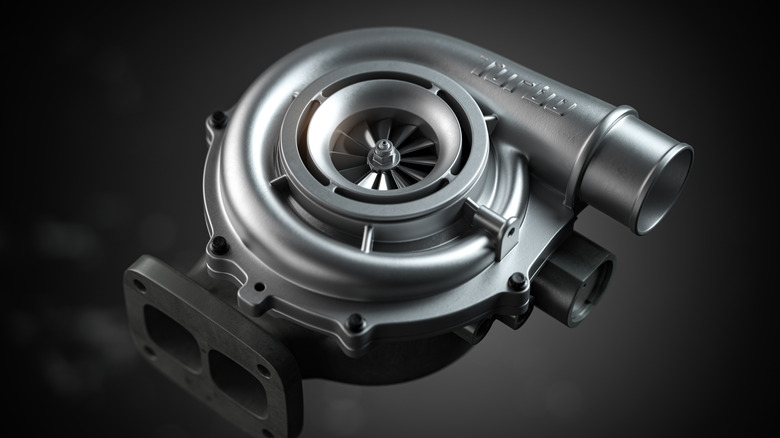
Turbochargers are incredibly useful devices for extracting power and efficiency from small-displacement engines. And since the heady days of the 1980s, these gadgets have evolved to become reliable, compact, and relatively commonplace. A lot of cars you see feature turbochargers these days, owing to the fact that you don't need all that much displacement to produce the same amount of power. In other words, a turbocharger makes a smaller V6 equally as capable as a larger V8.
Most turbocharged engines with two cylinder banks — V6s, V8s, and so on — feature twin-turbo setups, whereas most single-bank engines and anything with less than six cylinders have a single turbocharger. But there are exceptions to that rule, including a number of diesel inline fours and even a boxer four with twin turbos. Why is it so rare, though? One hint is that it has nothing to do with the number of cylinder banks; the RB26DETT and 2JZ-GTE are both inline sixes with factory twin turbos, and the Mazda RX-7's 13B also came with twin turbos, and that's a Wankel rotary.
The reality is a combination of two factors: complexity and airflow. Basically, modern turbos move air quite well over a large RPM band. Diesel engines, however, typically run at lower RPMs, so the turbo might not kick in fast enough. So you use a smaller turbo to boost the larger one in a compound setup, hence the twin turbo on these engines. As for the complexity, that's shown off in full with Subaru's twin-turbo boxer engine. Let's explore both in depth and discuss why this setup hasn't been pursued further.
The relationship between turbochargers and airflow
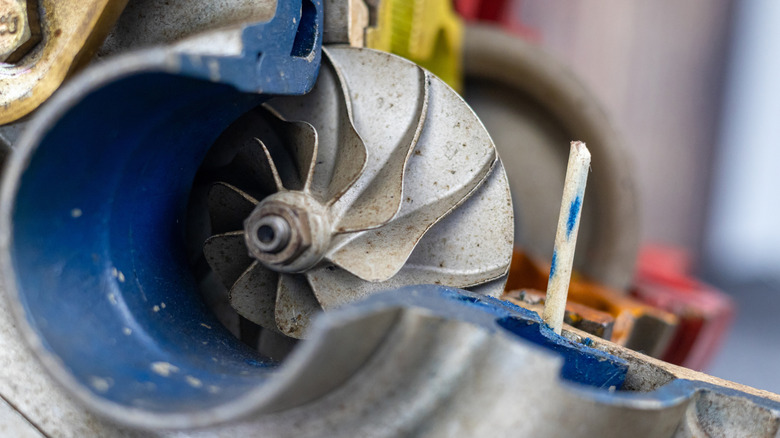
To understand why twin turbos don't mix well with modern four-cylinder engines, we need to look at how a turbocharger works. A turbocharger's effectiveness depends on how much airflow it receives from the car's exhaust. Choosing the correct size turbo is dependent on the total mass airflow of the exhaust — basically, more airflow means a bigger turbo, and less airflow needs a smaller turbo to maximize the benefits of a turbocharged engine.
Certain turbocharger setups can manipulate this airflow in different ways; all a turbocharger is, really, is an air compressor powered by the engine's exhaust. So why not have a smaller turbocharger work when the RPMs are low, so you're not moving as much air through the exhaust, and a bigger turbo take over when the RPMs get higher? Bingo, that's called a sequential twin-turbo setup. Conversely, you could have two turbos each feeding off of separate manifolds, one for two cylinders in a four-cylinder setup, and that's your parallel twin-turbo.
The problem here comes from the airflow needed to make such a setup work. Two smaller turbos are great when you can move enough air to offset the mechanical complexity of the system. But an inline four, particularly a smaller displacement unit, benefits just as much from a single turbo because such an engine would struggle to produce the airflow needed to efficiently drive two turbochargers.
In short, a single-turbo inline-four is less complicated, and with today's specialized technology, lag is hardly as big of an issue as it was 30 years ago. So what's the point of running a twin-turbo in one when all it does is add additional parts, labor, and cost?
Exceptions to the rule
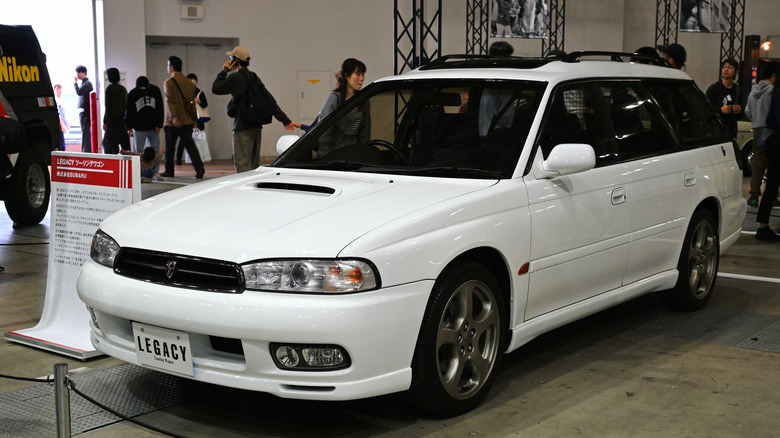
Again, there's no unwritten rule that says one cannot put a twin-turbo on an inline-four, just that it requires a specialized setup. So let's take a look at two specific examples: Ford's BiTurbo diesel and Subaru's twin-turbo boxer.
The BiTurbo is a 2.0L diesel marketed by Ford Europe in vehicles like the Ranger, specifically to international markets like Europe and Asia. It's a sequential turbocharger setup, meaning it features a smaller turbo that feeds the engine at lower RPMs, followed by a bigger turbo for higher revs. This gives the engine a fairly high performance window, as evidenced by Ford marketing it in the Ranger Raptor. The engine itself wasn't particularly bad, though it did suffer from having a wet timing belt, which likely played a part in Ford's discontinuing of the BiTurbo in 2026.
Subaru's take on the setup, meanwhile, utilized its famed boxer engine layout. However, almost all boxer engines these days use a single turbo, so why did Subaru opt for a twin-turbo four-cylinder that one time in 1993? Well, the problem was that this predates a lot of more modern anti-lag systems, like electric or variable-geometry turbos, being commonplace, so all Subaru did was move the lag from one spot to the other with its sequential turbo setup. Or two spots, rather — the smaller turbo had a lag spike, then the bigger turbo had its own lag spike. Moreover, it was complex, finicky, and didn't offer compelling enough benefits over a single turbo that could do the job just as well. Funnily enough, the same principles still apply today, which is why it's so rare to see such a setup.