

Why Are Attack Helicopters Called 'Gunships'?
The idea of a vehicle that could achieve vertical flight — also known as a helicopter — has been around much longer than you might think. The Chinese created a kite with a rotary wing that produced lift around 400 CE. We have Leonardo da Vinci's famous 15th-century drawings of such a machine, powered by the use of a what da Vinci called a spiral airscrew. Down through the ages, toys of all kinds — some using bird feathers to mimic rotors — successfully achieved vertical flight.
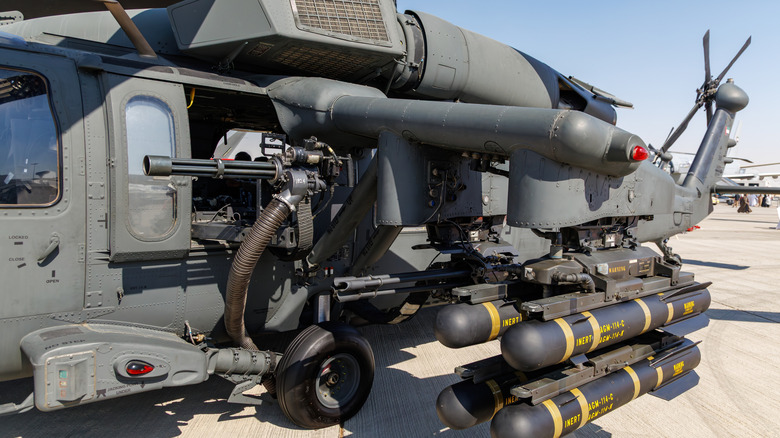
The first helicopter gunships didn't come to fruition until the Army needed more from its punchless Bell UH-1 Iroquois Hueys during the Vietnam War in the 1960s. The Army added additional layers of armor plating, some side-mounted machine guns, and rocket launchers for good measure, effectively turning it into an airship with guns. Although they're a far cry from the MH-60 Black Hawk gunships used today, they were still effective. Interestingly, the term "gunship" itself has a long and convoluted history in military parlance.
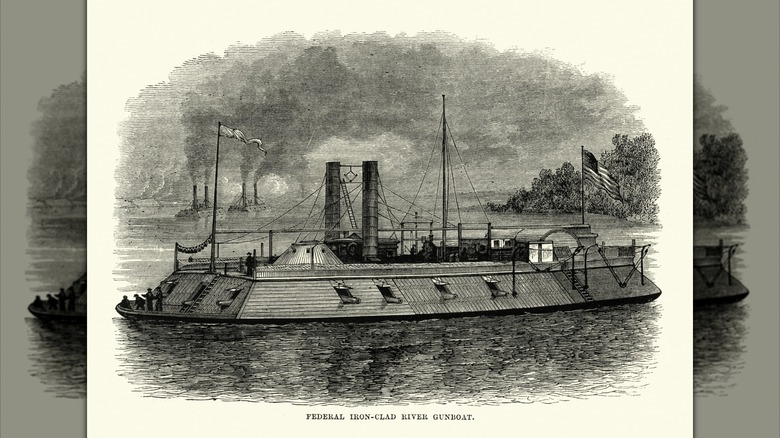
During the Civil War, four decades before the Wright Brothers took to the skies at Kitty Hawk in 1903, both the Union and Confederate navies used heavily armed, steam-powered ironclad ships to patrol rivers, protect supply lines, and attack enemy forts situated on the coast. These types of ships were referred to as gunboats, or gunships, the very same term that would later be adopted to describe heavily armed military aircraft.
Ships with guns have been around for a long time
If you look in a dictionary, you'll find that a "gunship" can be one of a few things. Yes, it can be a helicopter armed to the teeth with side-firing guns or cannons used to provide close air support, but it can also be an armed fixed-wing airplane, such as the AC-47 (originally the FC-47), nicknamed "Puff the Magic Dragon," the first aircraft designated as a gunship. Bell's UH-1 Huey — one of the most iconic military helicopters — hit Vietnam in 1963, and by the end of the war over a decade later, 7,000 had been put into use.
Helicopters weren't used during WWI, and they were only introduced into service at the very end of WWII. None were gunships, however. The Vietnam War, however, became known as The Helicopter War because it was the first time whirlybirds were used to such an extent. Although the war stretched out over two decades - from 1954 to 1975 — the United States didn't officially enter the fray until 1964. Early birds like the Hueys, which lacked armor and weapons, were primarily used to shuttle troops and equipment into hard-to-reach places, as well as to medically evacuate (medevac) wounded soldiers.
Interestingly, the first person brave enough to climb aboard a "helicopter" was French engineer and bicycle maker Paul Cornu. On November 13, 1907, Cornu hopped into a twin-rotor machine powered by a diminutive 24-horsepower engine and lifted roughly five feet off the ground. Cornu's contraption held him aloft for all of 20 seconds, but it still counted. From there, the global race was on to develop a practical machine, with many successes and failures along the way.