

11 Of The Best Projectors You Can Buy For Your Home Theater
We may receive a commission on purchases made from links.
A good projector can go a long way in upgrading your home theater setup. Great projector quality, massive displays, and support for all major image formats go a long way in breathing new life into the movies, TV shows, sports events, concerts, and video games that you run on your system. Pair a solid projector with a great screen and a robust audio system, and you'll be hosting movie nights every weekend in no time!
That being said, finding a good projector is easier said than done. Projectors from top brands are far from affordable, and budget-friendly alternatives may not be up to your quality standards. Make sure that you do your research to find a high-quality projector that fits within your budget. A bunch of companies have thrown their name in the hat, developing state-of-the-art projectors that are worth taking a look at if you're in the market for a projector for your home theater system.
Valerion VisionMaster Max
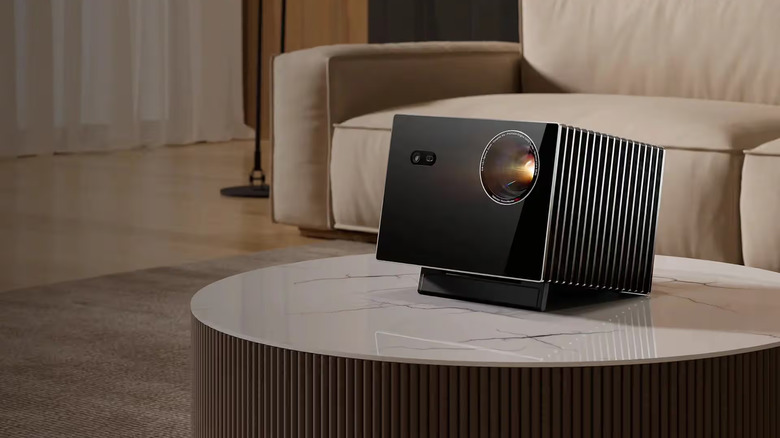
The Valerion VisionMaster Max is a great projector to choose ... especially if you don't have a budget cap. After all, a price tag of $3,699 makes it a wildly expensive projector. The VisionMaster Max is capable of projecting 4K images, courtesy of the eXpanded Pixel Resolution (XPR) fast-switch pixel shifting technology that was introduced by Texas Instruments (TI). As a result, the projector is capable of reaching extreme brightness levels while also doing justice to deep blacks, the latter being especially important for Dolby Vision and HDR10+ content. It employs triple laser technology to unlock a massive range of colors, ensuring that the picture output is vibrant, detailed, and a joy to behold.
If you hate the rainbow effect that plagues most projectors, then you'll be glad to know that the Valerion VisionMaster Max includes an Anti-RBE (Rainbow Effect) mode. While this will make your projector noisier, most people are willing to pay that price to minimize distractions while watching movies or playing games. Speaking of the latter, this projector supports 4K at 60Hz, along with 1080p at both 120Hz and 240Hz. This way, you can minimize latency when gaming on the VisionMaster Max. For people who prioritize the audio side of this, support for Dolby Atmos and DTS:X passthrough is also welcome. You'll make the most of your home surround sound system when connected to this projector, which is highly recommended since the speakers on this device are nothing to write home about.
Awol Vision Aetherion Max
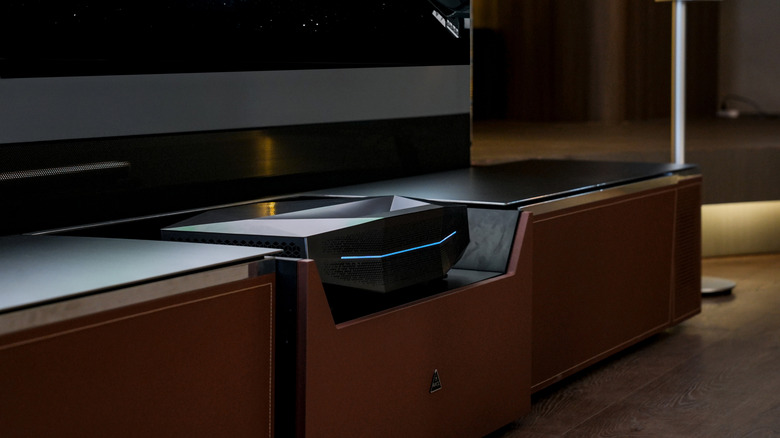
An ultra-short throw projector that usually retails for $4,499 but is currently on sale — costing $3,784 at the time of writing — the Awol Vision Aetherion Max is another premium projector you can consider. In many ways, it's similar to the VisionMaster Max — and no, we're not just saying this based on the price alone. A 4K image output that's enabled by TI's XPR fast-switch pixel-shifting technology? Check. Triple laser tech to unlock a wide color gamut? Check. An anti-RBE mode that increases the projector's noise output? Check.
In fact, there are some areas where the Vision Aetherion Max even exceeds the capabilities of the VisionMaster Max. For starters, you can enjoy 4K visuals at 120Hz or 1080p at 240Hz, making this projector far superior for gaming purposes. A brightness rating of 3,300 ISO lumens means that you don't have to worry about any dim imagery — provided you haven't made a mistake when installing your home theater system by letting in too much light — while the 6,000:1 native contrast ratio means that the deep blacks seen in HDR10+ and Dolby Vision will look quite rich.
For people who want a touch of convenience with their projector system, the built-in support for Google TV will make it very easy to stream the content of your choice. There's also a 3D mode that you can experiment with, although keep in mind that crosstalk is a major problem if you activate this feature. If image ghosting is not easy for you to overlook, give this mode a wide berth.
Xgimi Horizon 20 Max
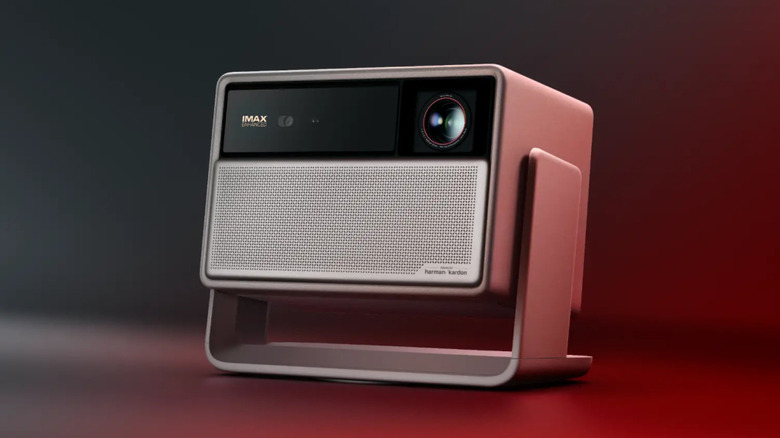
At $2,699, the Xgimi Horizon 20 Max is an expensive device, which is why the discounted price of $2,249 at the time of writing will be a welcome sight for anyone in the market for a good projector. Not only is the Xgimi Horizon 20 Max portable, but it's also bright, with a measured rating of whopping 4,850 lumens. A home theater room with a bit of light leakage isn't ideal, but the Horizon 20 Max should make up for it with its bright image. A 20,000:1 viewing contrast ratio means that any deep blacks will look great, although they do take on a grayish hue from time to time.
Given the Horizon 20 Max's portable nature, you'll be glad to know that this projector comes with a powerful, room-filling 12-watt Harman Kardon audio system that supports all major audio formats — namely, Dolby Audio, Dolby Digital, Dolby Digital Plus, DTS-Virtual:X, and DTS-HD. People used to the convenience of streaming services will appreciate the integrated Google TV OS, while gamers will enjoy low-latency gaming courtesy of its support for 4K at 120Hz and 1080p at 240Hz.
That being said, this projector isn't perfect by any means. The fans get loud when the projector is on, and the rainbow effect is noticeable without any proper fixes. If you want to use this projector as a portable display, get ready to fiddle with the annoying setup menus all the time as you try to perfect its image. Even after that, a single bump can throw the projector's image out of whack, forcing you to be very careful when moving it.
Hisense M2 Pro
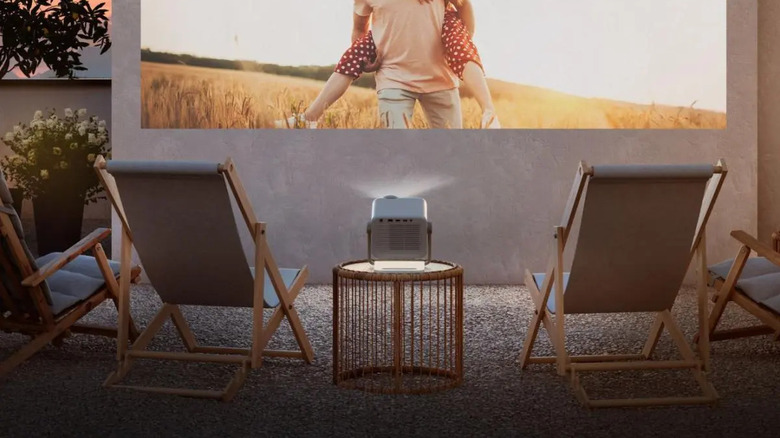
The Hisense M2 Pro aims to punch above its weight for its $1,297.99 price tag, and it's definitely a device for your home theater system worth buying. Similar to the Horizon 20 Max, the M2 Pro is a portable projector, although the 1,300 ANSI lumen brightness rating is significantly lower than its counterpart. However, an argument can be made that Xgimi went overboard in this department, especially since the Hisense M2 Pro performs admirably even if there's a bit of light leakage in your home theater room. It projects a 4K image ranging from 65 to 200 inches, and the built-in stand makes propping it up easy. The projector's stellar image quality comes from XPR fast-switch pixel-shifting technology, while triple-laser tech lets it do justice to a wide range of colors.
The projector also comes with an optical zoom that lets you increase image size without a perceived loss in quality. As a bonus, the M2 Pro will also inform you when you venture into the digital zoom territory, making it easy to avoid the same while setting up the projector. Casual gamers can stick to 4K at 60Hz, while people serious about avoiding any lag during multiplayer gaming sessions can enjoy 120Hz or 240Hz refresh rates at 1080p. The proprietary Vidaa OS used by Hisense makes an appearance here, although the list of apps it supports isn't as extensive as Google. Thankfully, you can always use a separate streaming stick if this becomes a problem. Rainbow artifacting isn't uncommon on this device either, so make sure you set up the image properly to avoid this distortion.
Sony Bravia Projector 9
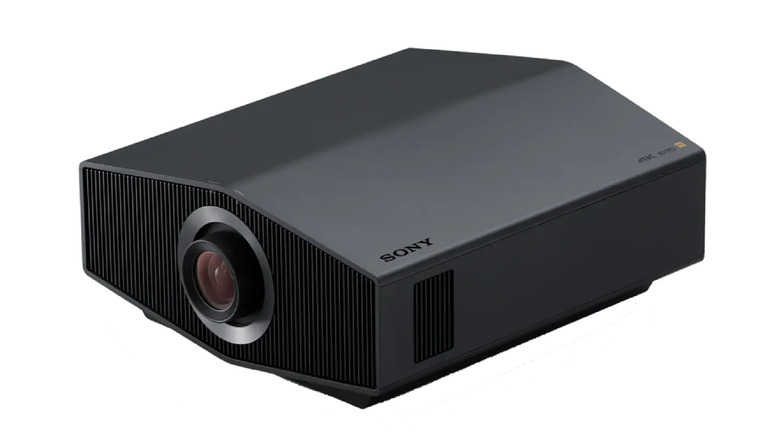
Before we start talking at length about the Sony Bravia Projector 9's suite of features, it's important to address the elephant in the room. The $35,999.99 price tag is absolutely ridiculous, and you should only consider this projector if you don't have a budget. If you decide to empty your bank account for this device, Sony may wow you with some of the best image processing tech you can find in a projector. XR Clear Image processing adds three-dimensional depth to any projected image and unlocks an impressive level of 4K upscaling. This works in tandem with Reality Creation image processing tech to make visuals look crisp and detailed.
The Live Color Enhancer feature also ensures that this projector's output is saturated to a T, leading to a vibrant image that is a joy to look at. There's also a Dynamic HDR Enhancer system for revamped tone mapping that improves brighter images without sacrificing the look of darker regions. Still, for such a ridiculously expensive projector, it could've done better when it came to black levels, even if the XR Deep Black feature does a decent job in this department. Unfortunately, decent won't cut it for such an expensive projector, especially since it also lacks support for Dolby Vision, HDR10+, or 3D content.
Epson QB1000
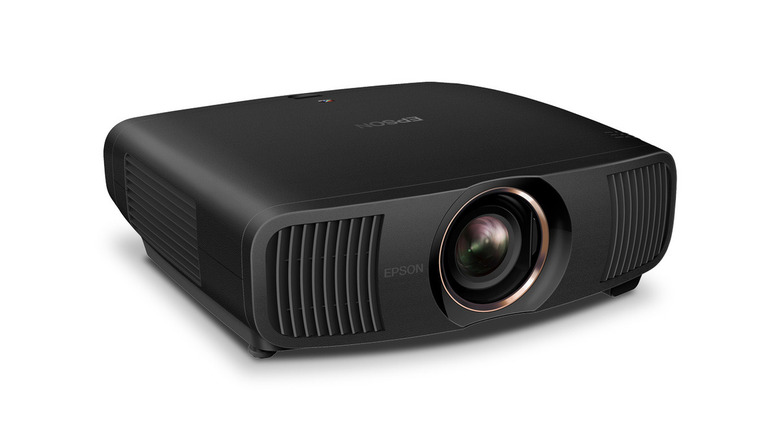
After the ridiculous price tag of the Bravia Projector 9, seeing the Epson QB1000 retail for $6,699.99 seems almost reasonable in comparison. For this price, you'll get a projector powered by Epson's 3LCD projection engine, which uses three LCD chips for red, green, and blue colors that eliminate the rainbow effect. This works in tandem with a multi-array laser diode to project beautiful colors that cover a wide range and do justice to the 3,300 ISO lumens of brightness that are emitted by this projector. Epson also employs UltraBlack (UB) technology — a compensatory filter that minimizes stray light sources, allows for dynamic tone-mapping to improve contrast levels, and enhances the density of pure blacks to help them stand out. While this device fails to completely remove the grayish-blue hues that plague most projectors, it is far from a dealbreaker.
With two 40Gbps HDMI 2.1 ports, ALLM (Auto Low-Latency Mode), and a 120Hz refresh rate at 4K resolution, the Epson QB1000 is appealing for gamers who want to be totally immersed as they make the most of their home theater setup. On top of all this, the projector also runs quietly — a boon for people who don't want to hear fans blaring as they consume the content of their choice. There are two major caveats to keep in mind, however. Firstly, this projector lacks support for Dolby Vision or 3D, which isn't ideal for such a wildly expensive product. Secondly, if you're using a woven projector screen, then the QB1000 has a tendency to exhibit a distracting moiré effect that isn't ideal for immersion purposes.
JVC DLA-RS1200
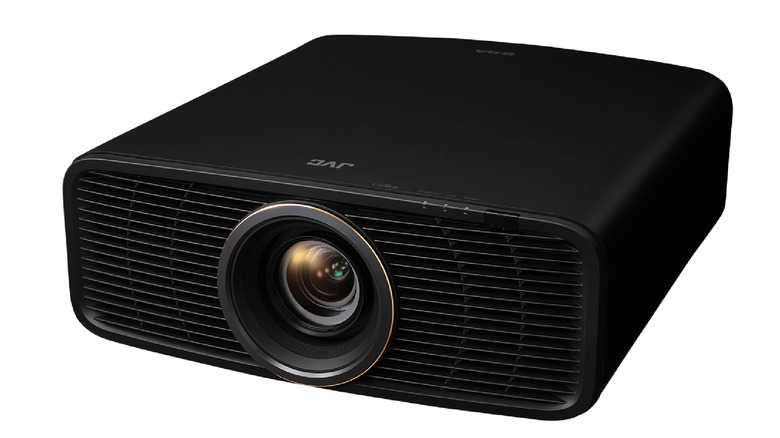
A great native 4K projector that costs $6,999.95, the JVC DLA-RS1200 manages to deliver in terms of image brightness and satisfying black levels courtesy of its 2,000-lumen brightness rating and a 40,000:1 contrast ratio. Regardless of whether you're watching SDR or HDR content, the DLA-RS1200 does justice to both image formats. Frame Adapt HDR tone mapping technology is also worth noting, analyzing every frame and dynamically adjusting the brightness accordingly. Along with this, Deep Black Tone Control does justice to deep blacks and adds more detail to shadows. These combine to help the DLA-RS1200 deliver amazing picture quality that will make your favorite movies and TV shows look breathtaking.
Unfortunately, gamers should look elsewhere for their projector needs. The 34-millisecond input lag isn't alleviated by any additional modes like ALLM, while the projector itself lacks any 120Hz mode whatsoever. There's no Dolby Vision or 3D either, which isn't great for people who want their expensive state-of-the-art projector loaded with all these features. Finally, to unlock the full capabilities of the DLA-RS1200, you'll need to fiddle around with the settings quite a bit. Relying on the default configuration won't maximize its capabilities.
BenQ W2720i
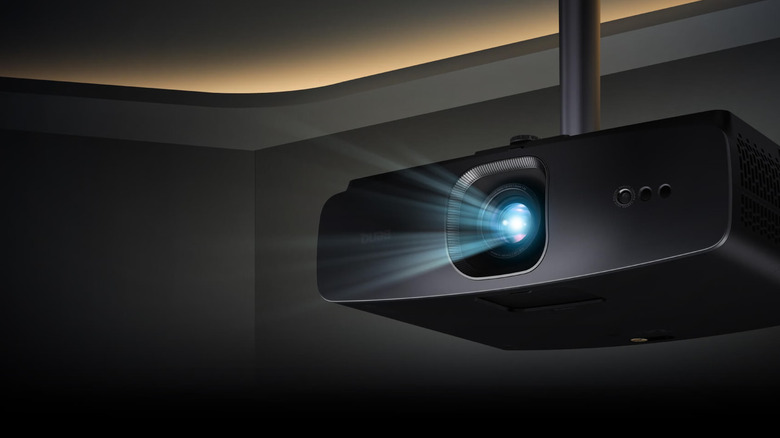
The BenQ W2720i is a viable option for people in the market for a reliable projector. The excellent picture quality of this projector is achieved via Digital Light Processing (DLP), which works along with XPR tech. The W2720i uses LEDs to project images with a brightness rating of 2,500 lumens and a ridiculously high contrast ratio of 2,000,000:1. With support for 4K at 120Hz and 1080p at both 120Hz and 240Hz — the latter minimizing input latency to just 7 milliseconds — this projector is a decent gaming device. There aren't any specific game modes, but this is a minor gripe in the grand scheme of things.
The Android TV OS used in this device is surprisingly robust, which is perfect if you want a smart projector to replace your TV. Connectivity options are very malleable, with this projector sporting three HDMI ports on the back. One of these is a proper 48Gbps HDMI 2.1 port, and another supports an eARC connection. On top of this, there are two Type-A ports, support for an optical connection, a 3.5mm audio output, and a USB Mini Type-B port as well. Given all these perks, it's easy to see why this projector is a great value-for-money offering at $2,499 price, further reduced at the time of writing to $1,799.
Hisense L9Q
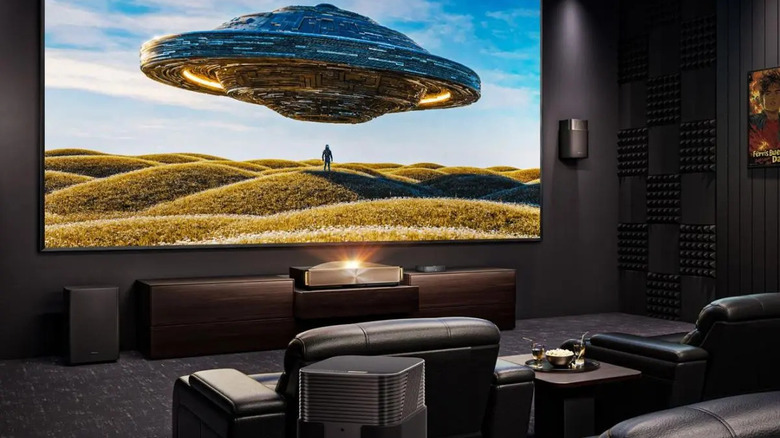
At $6,499.99 — $5,999.99 at the time of writing — there's no denying that the Hisense L9Q is quite expensive. Thankfully, it does a commendable job of delivering in this price range. 5,000 lumens of brightness is a highlight, as is the support for all major image formats like Dolby Vision, HDR10+, and IMAX Enhanced. Gamers will love the two 48Gbps HDMI 2.1 ports that support 4K resolutions at 120Hz. If you want input lag to be totally minimized, you can enjoy a refresh rate of 240Hz as long as you don't mind a 1080p resolution. With TriChroma laser technology, the projector can reproduce a whopping 110% of the BT.2020 color space.
Another area where the Hisense L9Q impresses is sound. Packing a feature-rich, 10-channel 6.2.2 audio system designed by Devialet, the sound emanating from this speaker is so rich that it can genuinely give soundbars a run for their money. That being said, there are some problem points with the L9Q worth noting. The dreaded rainbow effect rears its ugly head yet again, as do grayish blacks that may distract you at times.
LG CineBeam S
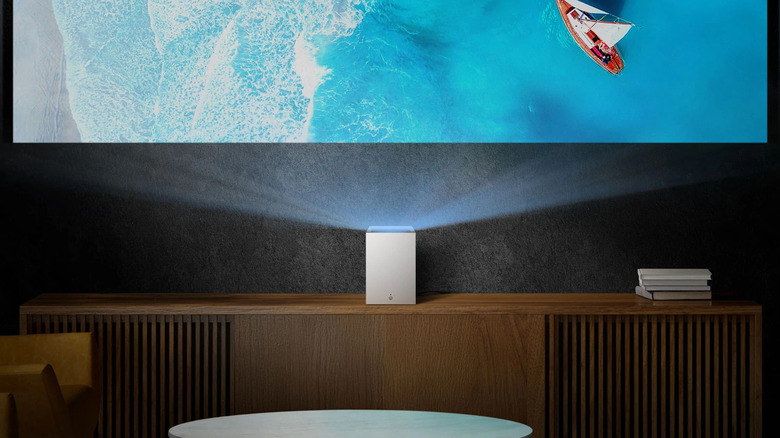
If you want an ultra short-throw projector that can project a 100-inch screen with ease, then the LG CineBeam S is a great option to keep in mind. At $1,299.99, it boasts a price similar to the Hisense M2 Pro. However, at the time of writing, it's the cheapest projector on this list with a price tag of $1,149.99. The XPR pixel-shifting technology makes for a crisp 4K image, while the RGB triple-laser light source helps the colors of this projector stand out. LG's webOS is also a welcome inclusion for those who want their projector to double as a convenient streaming device, even if the interface isn't all that smooth.
There are some areas where LG has made some cutbacks with this projector. The lack of support for 3D isn't ideal, but people can still live without it. Brightness is abysmally low, with a paltry max output of 500 lumens. It also runs pretty loudly, but these are compromises people are willing to make for a relatively budget-friendly speaker. Portability is a huge positive for this projector — not only is the CineBeam S compact and light enough at 4.2 pounds, but it also features several convenient setup tools. Auto Screen Adjustment fixes screen alignment and focus for the most part and only requires some minor fine-tuning on your end for near-perfect image projection. It's unreasonable to assume that you'll find a white wall or a projector screen wherever you take the Cinebeam S, which is why Wall Color Adjustment mode is such a useful inclusion.
BenQ X3100i
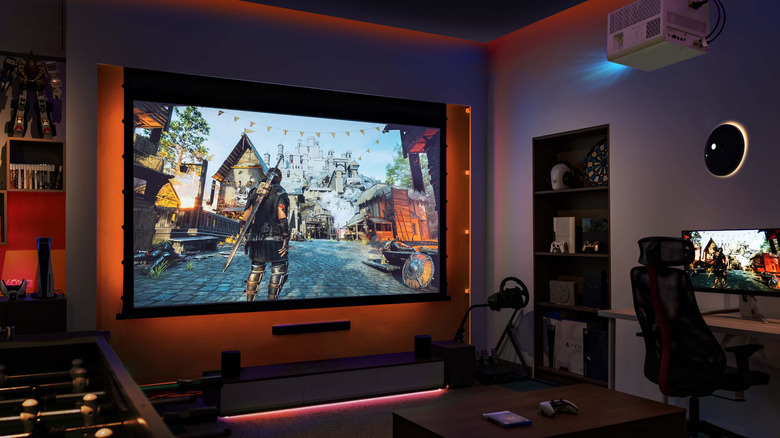
Home theaters aren't just useful for immersion in cinematic movies and dramatic TV shows. These setups are perfect for unlocking a memorable gaming experience, which is why certain projectors exist that are tailor-made for this hobby. The BenQ X3100i is one such projector that proudly wears its gaming capabilities on its sleeve.
For starters, it boasts four unique gaming modes depending on the title you're playing. RPG mode unlocks a more cinematic experience, with a focus on deeper bass. SPG mode improves colors and makes vocal output as clear as can be. FPS mode improves audio clarity and makes sure that any projected blacks are deep and detailed. Finally, RCG Mode ensures that the motion and sounds of your racing games feel all the more realistic. Depending on whether you've plugged in a Sony, Nintendo, or Microsoft console, BenQ's Auto Game Mode recognizes the console in question and applies the setting you'd chosen for your previous gameplay session. You can also enable an FPS Crosshair for greater aiming accuracy. Finally, with BenQ SettingXchange, you can access settings used by other pro users for specific games for an even greater degree of personalization!
Given its gaming focus, one puzzling thing about the X3100i is its inclusion of HDMI 2.0 ports. This means that a 120Hz refresh rate is only achievable at 1080p, which is far from ideal for a gaming projector. While picture quality is bright and clear, the Android TV OS integration is mediocre at best. Rainbow artifacting also plagues this projector, which isn't ideal for anyone who wants to be totally immersed when playing games on this device.
Methodology
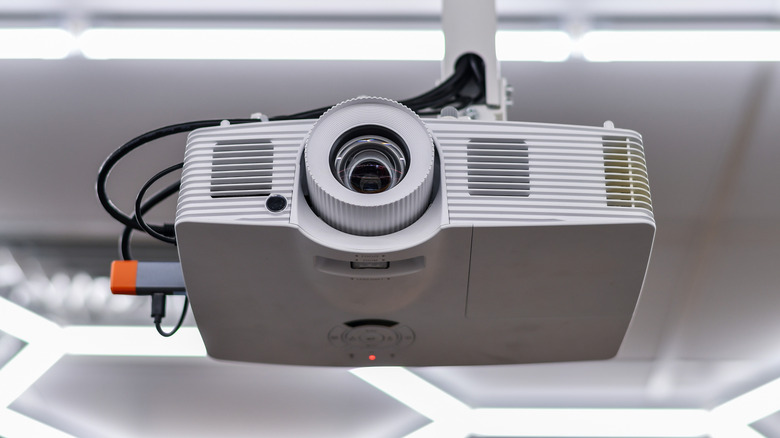
To ensure high-quality projector recommendations, all the devices on this list have great reviews — a 4 out of 5, 8 out of 10, or 80 out of 100 and higher — across three or more review outlets. These notable publications include What Hi-Fi?, PCMag, TechRadar, Trusted Reviews, Android Authority, Pocket-lint, Projector Reviews, AVForums, Expert Reviews, Sound & Vision, Mashable, CNET, Projector Central, Engadget, and XDA.