

How Long Does A Power Steering Pump Last & Are Replacements Still Available?
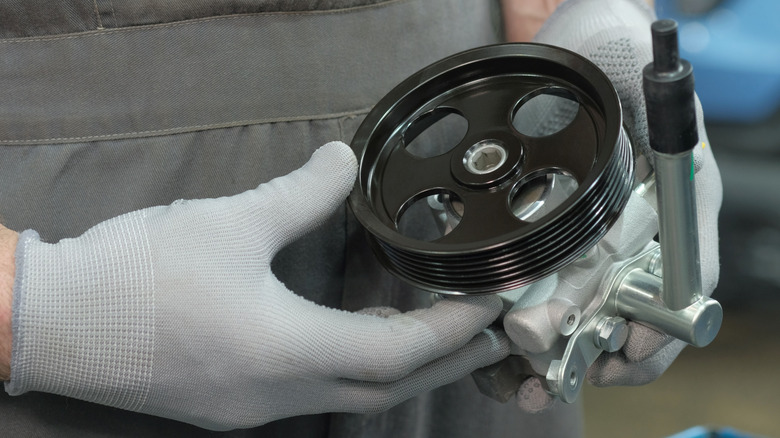
Regardless of form or function, a car must accomplish three basic tasks: accelerate, stop, and turn. The first is accomplished by your engine, the next your brakes, and the third by the front tires, but how do you actually turn them? It seems intuitive at first, but you don't turn the steering wheel and the tires just magically turn themselves. There must be some hard connection from point A to B — most commonly in older cars, a steering rack. It gets a little more complicated, with things like rack-and-pinion steering entering the chat — yes, there's a difference between those systems as well.
Let's go back to basics, though. How do you get the tires to turn easily? At first, it was just heaving with your arms; older cars typically didn't have power steering. But as cars got bigger and tires got wider and grippier, you needed something to overcome the forces exerted on the ground. Tires don't like turning when you're stationary; you have to force it. That's why power steering exists, and the power steering pump is, appropriately, what powers it all.
The power steering pump does what it says — it pumps the hydraulic fluid that assists you in turning. Given their relative ubiquity in older cars, replacement parts are still easy to come by, which you'll need every 100,000 miles or so for the pump itself, and around four years for the fluid. Your mileage may vary depending on make/model, of course, but that's your general guideline. Let's talk about how they work and how you can extend your pump's service life.
Identifying your power steering pump and if it's gone bad
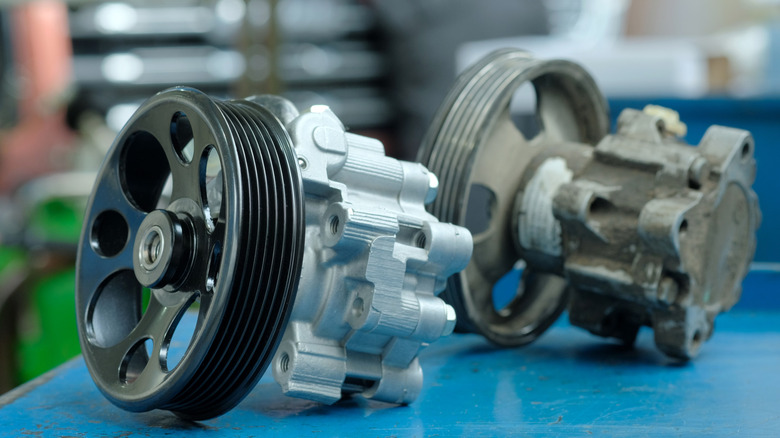
For simplicity's sake, let's think of the power steering pump as three independent components. You have the pump itself, power steering fluid, and the belt that drives it. All of these parts have separate service intervals, with the latter being particularly subjective; some cars have an individual accessory belt for different stuff, whereas others have a big long serpentine belt that drives everything. The short answer is to check your service manual and record your maintenance logs to preserve it all.
To better understand how to preserve it, first we must understand what it actually does. A power steering pump operates on the principle of hydraulic pressure. The pump pressurizes a set of lines running down to the steering system, making the effort relatively consistent regardless of how fast you're going. They exist because the torque required to turn stationary tires is much greater than rolling ones, which is also why it's really difficult to steer a car with the engine off.
That increased effort is your primary sign that something's wrong with the power steering pump. Assuming you checked the fluid in your reservoir and the pump itself is failing, you'll start to notice inconsistent steering effort depending on speed, loud humming or whining noises coming from the engine bay, and a pulsation when you turn in. Moreover, low power steering fluid means you're losing hydraulic pressure, which results in an increased turning effort across the board.
How to prolong the life of your power steering equipment
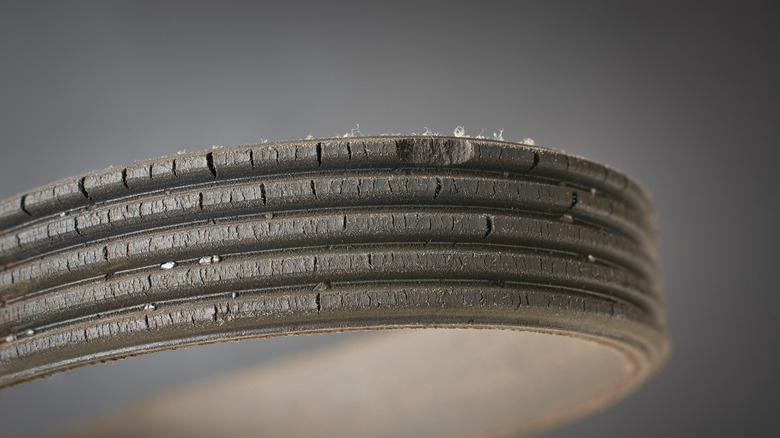
Nothing is immune to the effects of degradation, belts and fluids included. That's why these components are designed to be replaced in regular service intervals, with specifics detailed in your car's service manual. Larger components like the pump itself are also relatively easy to find, depending on your car. While most modern cars have electric power steering — meaning no hydraulic lines — that doesn't apply to everything. For example, the Subaru Impreza WRX had hydraulic power steering as late as 2021, with shops recommending periodic power steering fluid checks with each regular oil change.
While there's no strict way to prolong the life of individual components beyond rust protection — which is another discussion itself — you can certainly keep the parts from degrading more rapidly than anticipated. For one, be sure to change the filter and fluid on time, which prevent metal shavings from entering the pump itself. Also note that the fluid level is only accurate when the car is at operating temperature with the fluid warmed up; generally cars have independent hot and cold level markers, so don't overfill the system by accident because you think the fluid is low.
If you feel something wrong with the steering, your first solution is to do a full fluid flush and check the pump for damage. The pump itself can last the life of the car if you don't drive hard and keep up with the maintenance, so eliminate the fluid as a variable before changing the pump entirely.