

This Classic JDM Sedan Pushed More HP In 1990 Than A Modern Ford Maverick
The Japanese Domestic Market (JDM for short) automotive realm is a veritable treasure trove of quirky, powerful, and deeply interesting creations. You get everything from kei trucks and vans that look like crates on wheels to Ferrari-challenging supercars like the Honda NSX, all spread between several major manufacturers looking to one-up each other.
Despite their variety, Japanese cars are heavily regulated, with restrictions on vehicle and engine dimensions, power output, and more — at least on paper. One of the more infamous examples was the 280 ps, or 276 horsepower, gentlemen's agreement of 1989, in which all the major marques agreed to cap horsepower at that figure. It was more a safety concern than anything, implemented to prevent the sort of horsepower arms race seen in '60s America. Some of the most legendary JDM engines came out during this time, including Nissan's RB26DETT and Honda's C30A, and the 1JZ-GTE in the 1990 Toyota Chaser.
Yes, Toyota really did produce a car with more power than a Maverick in 1990 — 26 more horsepower, to be exact. A top-tier Maverick Lobo produces 250 hp, which isn't bad considering it's a fairly small truck. But imagine taking that much power — as much as the '90s Nissan Skyline GT-Rs — and putting it in something akin to an early '90s Toyota Camry. In other words, this was a potent car.
The Toyota Chaser: A Supra in a business suit
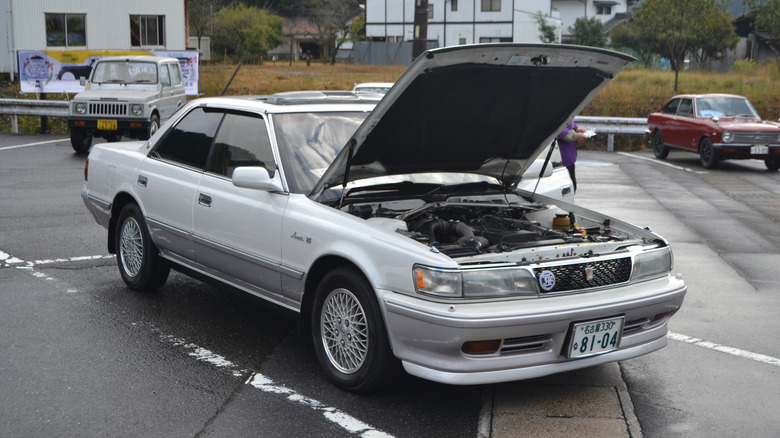
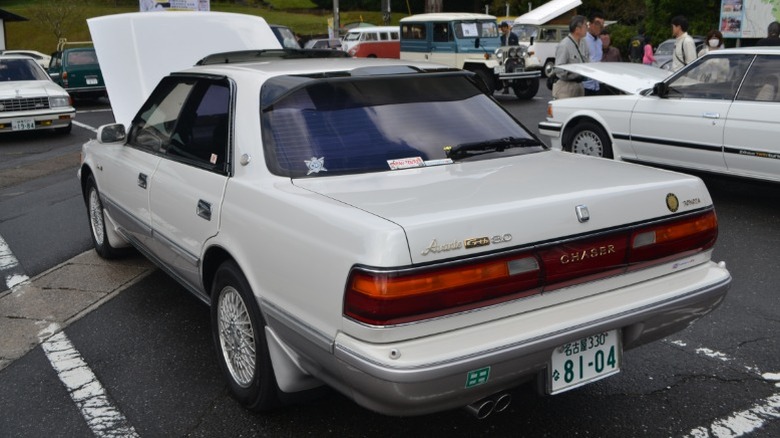
The Toyota Chaser isn't strictly one vehicle; rather, it's one of three sister cars, with the other two being the Mark II and Cresta. It's somewhat complicated, but think of it this way: Toyota had three different dealership chains, and each sold its own model. They're all fundamentally the same car, just with different logos and cosmetic variations, with the Chaser being from the Toyota Auto Store. Like its siblings, the Chaser was a luxurious, understated car, although, as its name implied, it was marketed as the sportier variant, like a Japanese equivalent to the Pontiac G8 versus the sister Chevrolet Caprice. Toyota built six generations of the Chaser before discontinuing it in June 2001.
The fourth generation debuted in August 1988. It was contemporary and more subdued than its flashier predecessors, but still retained the boxy look of its forebears, a design language predating the rounded-off JDM legends of the mid-1990s. It's perhaps not the most inspiring look, but it's what lay under the hood that really impressed.
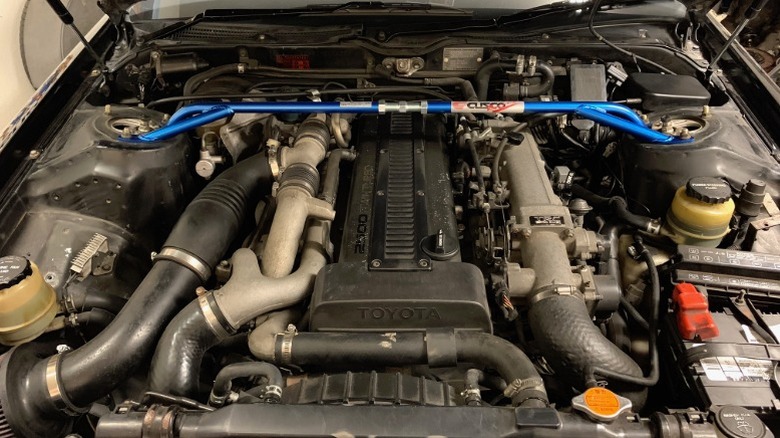
It was, quite literally, a Supra sedan. When it debuted, the top-trim level was a 208-hp GT Twin Turbo, but Toyota quickly supplanted that in August 1990, introducing the 276-hp 1JZ-GTE to the engine bay. It was the same powertrain you could find in the A70 Supra and Soarer coupes, among others. While most will know the engine's successor, the 2JZ, the 1JZ was no slouch, as evidenced by the Chaser's continued popularity in tuning circles.
How the gentlemen's agreement inadvertently birthed the legend
The 1JZ was limited to 276 hp by an informal gentlemen's agreement, so there aren't a lot of official documents about the regulations. But we can infer it was due to safety concerns, especially given rising road fatality rates in the 1980s. Cars got faster and more powerful, and road infrastructure had to change to keep up with cars and reduce fatalities. But Japan also got its automakers to implement ways to keep speeds down.
Take, for example, the infamous speed chime present in many vintage JDM cars. It would go off at around 100 km/h, pr 62 mph. Most cars also featured an electronically limited top speed of 180 km/h, or around 112 mph, among other measures. If you're looking to import your own classic JDM machine, these are some caveats to be aware of.
However, imagine you're a Japanese manufacturer in the '80s or '90s looking to build the hottest sports car possible. You can't chase horsepower figures, so what do you do? Build cars not for outright power, but make sure the engines can handle extra power. Take those engines and put them in race-winning machines in the vein of classic NASCAR. Add a bit of extra spice with special edition versions, such as the Skyline V-Spec. The result of this approach, intended or not, is a thriving aftermarket for these powertrains that have pushed power figures well above stock and cemented the legacy of cars like the Chaser in the process.