

5 Fighter Jets That Are Quicker Than The F-22
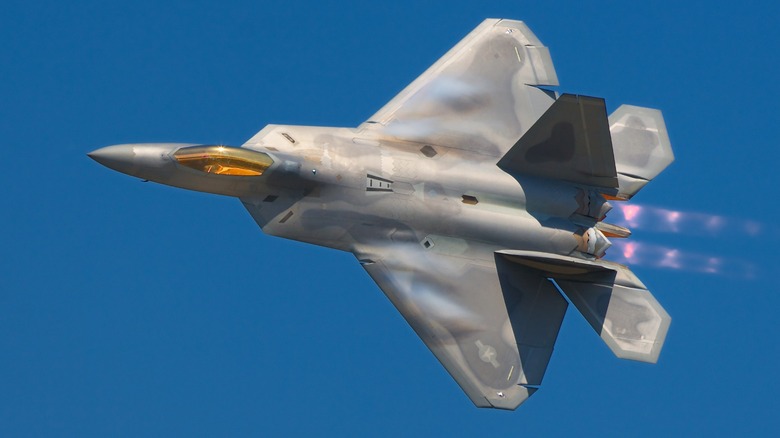
When Lockheed Martin and Boeing developed the F-22 Raptor for the U.S. Air Force, it ushered in a new generation of fighter jets. As the lead aircraft in the 6th generation, the F-22 became the benchmark that all subsequent aircraft had to meet or exceed, placing the bar high for the U.S. and other nations around the world. Unfortunately, they cost so much that the Air Force capped its F-22 fleet at fewer than 200 aircraft, but despite this, the F-22 is one of the service's most advanced and capable fighters.
The F-22 is outfitted with two Pratt & Whitney F119-PW-100 turbofan engines that produce a combined 70,000 lbs. of thrust, giving it a top speed of Mach 1.95 (1,500 mph) at altitude. The F-22 also features supercruise, giving it the ability to exceed Mach 1 without firing up its afterburners, so it typically flies at Mach 1.5 (1,151 mph) using this feature. That makes the F-22 an incredibly fast fighter, but it's not the fastest one around, as there are several with top speeds that outclass the inaugural 6th-generation aircraft.
Fighter jets from other nations, including those that are considerably older than the F-22, can exceed its maximum speed. Most come from Russia, though U.S. aircraft like the F-15E Strike Eagle and F-14 Tomcat fly faster than the F-22. Still, while they're fast, it's interesting to compare the U.S. fighter to those made by other countries. These five foreign-made fighter jets are all faster than the F-22, and they were all designed and built overseas.
Israel Aircraft Industries Kfir
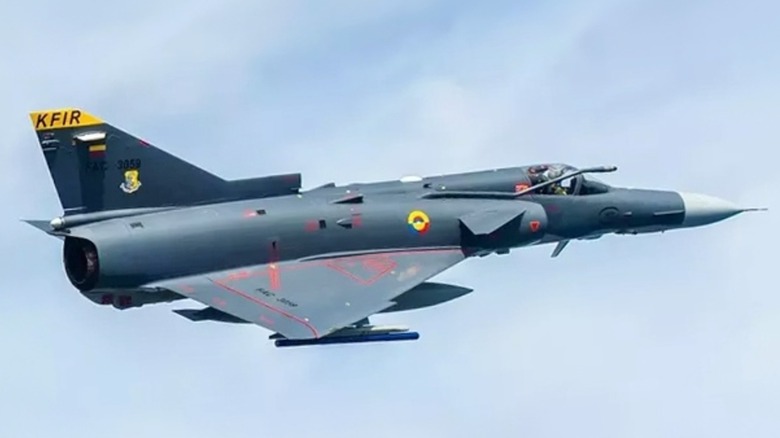
While Israel operates plenty of vehicles procured from allies, the nation has its own defense industry producing all manner of tanks, combat vehicles, and fighter jets. The Israel Aircraft Industries (IAI) Kfir is an Israeli fighter jet based on the design of the French-made Dassault Mirage 5. IAI installed its own avionics systems and produced its own version of the General Electric J79 turbojet engine under license from the American company.
The result is the IAI Kfir, a fast 4th-generation fighter jet that entered service in the Israeli Air Force in 1975. While only around 220 have been built, it remains in operation in Colombia, as the above image features one of the Colombian Aerospace Force's Kfirs. The Kfir is Israel's first Mach 2-capable aircraft, and thanks to its aforementioned engine, which was the same one that powered the F-4 Phantom II, its 15,000 lbs. of thrust push the Kfir to a maximum speed of Mach 2 (1,516 mph) at altitude.
Israel produced the Kfir, which means "Lion Cub" in Hebrew, because of a French trade embargo. The limit on trade pushed Israel to make something of its own, and the end result was an incredibly powerful, fast, and agile fighter jet that still operates more than 50 years after its introduction. It's not something that could pose much of a threat to something like an F-22, but the Kfir nonetheless remains one of Israel's best-made aircraft of the 20th century.
Mikoyan MiG-29 Fulcrum
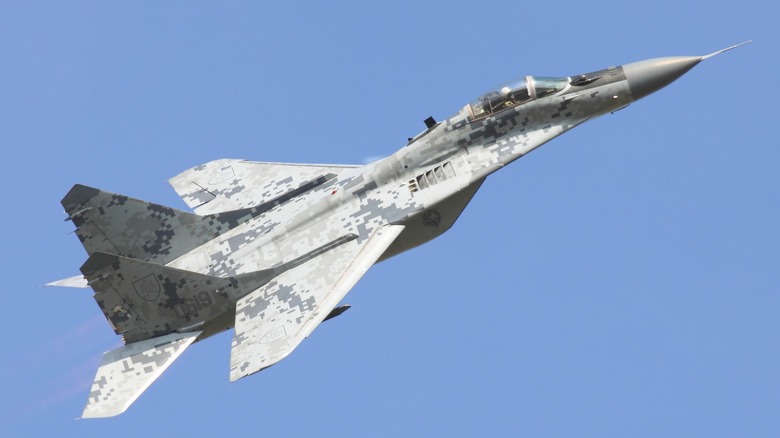
The Soviet Union's MiG-29 Fulcrum is an air superiority fighter that began operating for the Soviet Air Forces in 1983. When it was introduced, the MiG-29 was meant to counter the F-15 Eagle and F-16 Fighting Falcon, which was a common practice throughout the Cold War. One side would produce a superior fighter, and before long, the other side created something to counter it. When it arrived, the F-15 was already nearly a decade old, while the MiG-29 was outfitted with newer and more robust components, presenting a challenge to the West.
Like many Soviet-made aircraft, the MiG-29 remains in operation decades after its introduction. As of this writing, the MiG-29 is flown by dozens of countries and is ranked fifth of the worldwide top 10 active aircraft types, with 788 active MiG-29s in service according to World Air Forces 2025, an annual publication by Flight Global that tracks the world's military aircraft. That's largely because the MiG-29 is a well-designed fighter that's been upgraded and modernized over the years, much like the F-15 and F-16 it was designed to counter.
For power, the MiG-29 utilized two Isotov RD-33 turbofan engines capable of producing a combined thrust of 36,600 lbs. This gives the MiG-29 a maximum speed of Mach 1.98 (1,520 mph) at altitude. As a result, the 4th-generation fighter jet a slight speed advantage over the F-22, but given the vast differences in technology, stealth, and maneuverability, it's unlikely that a MiG-29 would come out on top in a dogfight against the 6th-generation fighter.
Mikoyan-Gurevich MiG-23 Flogger
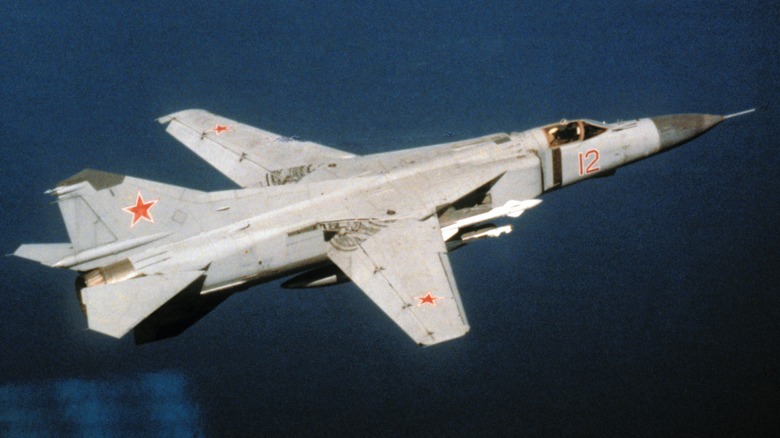
The MiG-23 Flogger is a 3rd-generation fighter developed in the 1960s, so you'd think that it couldn't exceed the speed of a 6th-generation aircraft. Despite its age, having been introduced in 1970, the MiG-23 is a well-engineered fighter flown by the Soviet Air Force as well as several export partners. While it's no longer in service with any major air forces, Angola, Ethiopia, Kazakhstan, Libya, the Democratic People's Republic of North Korea, Sudan, Syria, and Zimbabwe still fly them according to World Air Forces 2025.
When it was introduced in 1970, the MiG-23 was a powerful fighter outfitted with a single Tumansky turbojet engine capable of producing 17,635 lbs. of thrust to 25,350 lbs. with afterburner. This gave it a maximum speed of Mach 2.02 (1,550 mph) at altitude, making it a little faster than the F-22. Additionally, the MiG-23 boasted a combat range of 740 miles and could reach an altitude ceiling of 59,000 feet.
The USSR put a lot of time and money into the MiG-23, having produced over 5,000 of various types, including many that were designed for export. While fast, if an F-22 went up against a MiG-23, it's highly unlikely that the Soviet-built aircraft would survive the encounter. Still, with its powerful radar and speed advantage, one might be able to escape from a dogfight against the 6th-generation fighter. That said, the best radar systems of the 20th century would first need to "see" the stealthy F-22, which is incredibly unlikely.
Sukhoi Su-27 Flanker
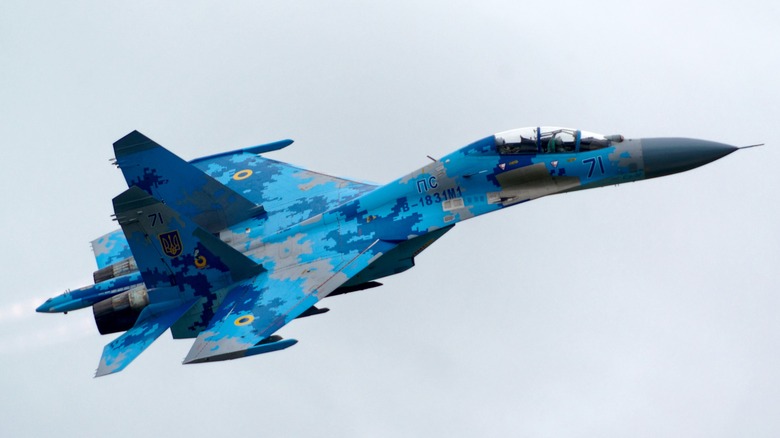
Another Soviet-designed fighter capable of incredible speed is the Sukhoi Su-27 Flanker. The USSR developed the Su-27 as a counter to the United States' 4th-generation fighters like the F-14 Tomcat and F-15 Eagle, and, like those aircraft, speed was a consideration in its design. Meant primarily for air superiority missions, the Su-27 entered service in 1986, though only around 400 were ever produced before the end of the Cold War.
Much of the aircraft's strength stems from its supermaneuvrability, as it is one of the few fighter jets capable of pulling off the Cobra Maneuver. Outside of aerial acrobatics, the Su-27 is a high-performance fighter capable of pulling 9+ G with a rate of climb of nearly 1,000 feet per second. Despite its low production numbers, many Su-27s continue to operate for the Russian Aerospace Forces and other nations, including Ukraine. For power, the Su-27 features two Lyulka AL-31F Series 2 afterburning turbofan engines.
These provide a combined 55,280 lbs. of thrust, giving the Su-27 a maximum speed of Mach 2.025 (1,553 mph). While only slightly faster than the F-22, the Su-27 has a speed advantage over the much newer fighter. While an F-22 has yet to take on an Su-27 in combat, Ukraine claimed to have used one to shoot down a Russian Su-35 in July 2026. The Su-35 is a technologically superior 4.5-generation fighter jet that's slower than its 20th-century predecessor, showing how speed can aid in combat operations against a much newer aircraft.
Mikoyan-Gurevich MiG-25 Foxbat
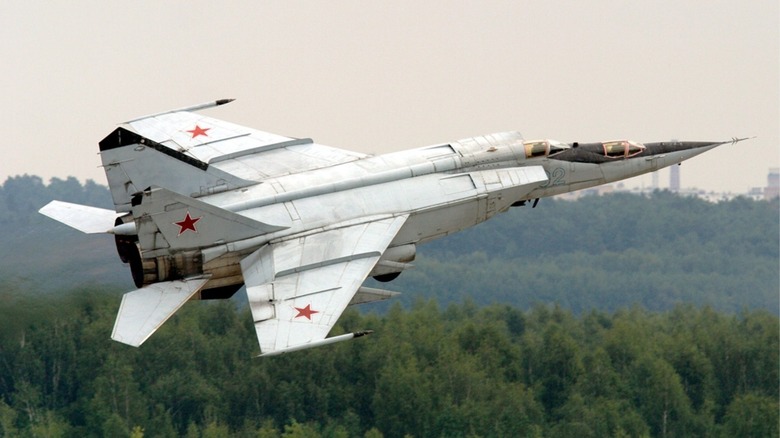
The MiG-25 Foxbat is another Soviet aircraft that entered service for the Soviet Air Defense Forces in 1970. While it has long since retired from the Russian Aerospace Forces, it continues to operate for a handful of nations, including Libya and Syria. When Soviet designers and engineers sat down to create the MiG-25, speed was at the forefront of their minds because the aircraft is capable of moving incredibly fast.
The fighter employs two Tumansky R-15B-300 turbojet engines capable of producing a combined 45,000 lbs. of thrust. This gives the MiG-25 a top speed of Mach 2.8 (1,850 mph), which is far faster than many fighter jets ever fly. That said, Lt. Viktor Ivanovich Belenko, a Soviet defector who flew his MiG-25 to the West, explained in his debriefings that the actual speed limit for the fighter was Mach 3.2 (2,190 mph), but doing this put the engines at serious risk, as they overheated when pushed to Mach 2.8.
As a result, the Soviet Union capped the MiG-25's top speed at the lower Mach number to ensure it operated for as long as possible. Even flying at the lower speed, the MiG-25 has a significant advantage over the F-22, as well as its contemporary fighters during its heyday. The MiG-25 is one of the fastest production aircraft ever produced, sitting behind much speedier planes like the SR-71 Blackbird. Still, while slower than that famed spy plane, it remains the fastest fighter-interceptor ever made.