

4 Parts Of Your Car You Probably Shouldn't Use Power Tools On
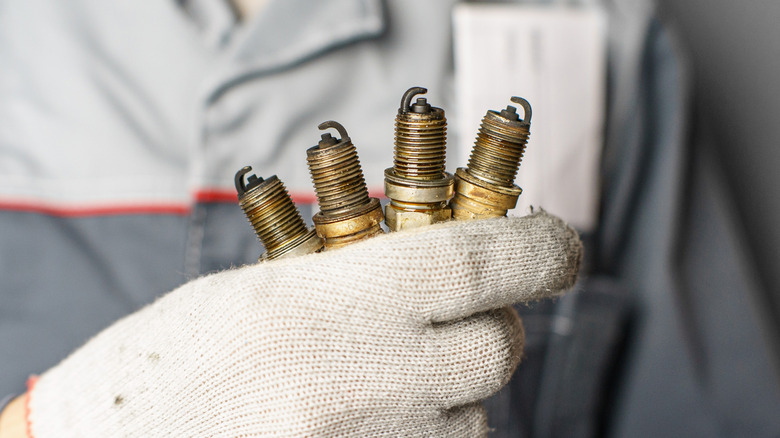
Whether you're an experienced mechanic or someone just dipping their toes into automotive work, it's apparent that you'll need a host of tools to work on all modern vehicles. In many cases, power tools will be your best friend, removing seized nuts and bolts and subsequently reattaching them to the proper torque in the blink of an eye. Mechanics widely trust multiple power tool brands with such work, too. With that said, those especially new to the world of car repair should know that there are some instances where a hand tool, as slow and underpowered as it may be, is the superior option.
Ultimately, the need for a solid hand tool over a power tool during automotive work comes down to the nature of what you're working on. While much of a car is metal, including the fasteners, there are some components that are made of more brittle, delicate materials. Power tools can pack too much of a punch, cracking plastic elements or stripping specifically-designed metal ones. With that, what started out as a small job could become something far more involved and expensive. Additionally, while sometimes parts can theoretically be installed using power tools, a power tool could damage the replacement piece without proper care and steadiness.
All of that is to say that the old adage "slow and steady wins the race" very much applies in auto repair scenarios. Here are a few examples of hand tool-preferred parts.
Oil pan
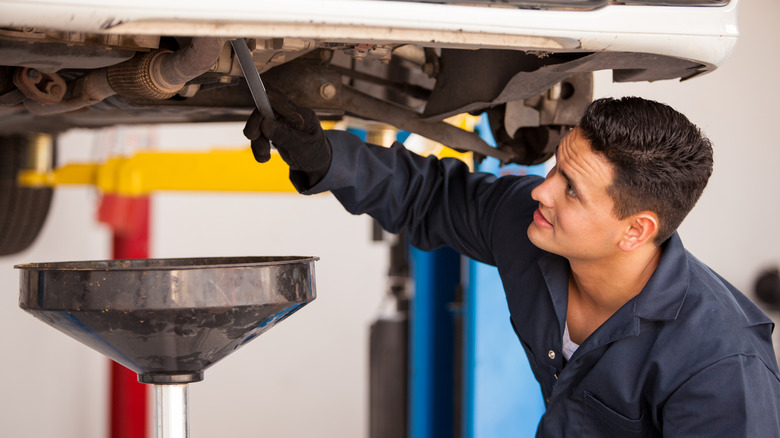
Oil changes are simple on most vehicles and don't typically require much by way of tools. The oil cap should unscrew by hand, and the oil filter can generally come off the same way. Once you get under the vehicle, however, you'll need a tool to remove the oil plug. If you have the clearance for it, a powered wrench or driver could seem perfect for removing and reattaching it. The reality is, though, using a tool with such power and speed could come with dire consequences and turn this rather entry-level job into a more professional ordeal.
First and foremost, there are the risks to the oil pan. While sturdy, these components are a bit delicate compared to others on the vehicle. Too much power could strip the threads it has to connect with the plug or, worse yet, crack the pan. This means oil leakage and the need for a replacement, which is significantly more costly and time-consuming than a simple oil change. The plug could also be stripped as well, so it too could require replacement. Additionally, power tools could make it harder on you next time should you overtighten. If you don't have a drill handy for the next oil change, you could end up fighting an over-torqued plug. Thus, to avoid this one of the many potential oil change mistakes, leave the power tools alone. You're much better off using a socket wrench or, should the plug prove tight, a breaker bar to get the plug moving.
Spark plugs
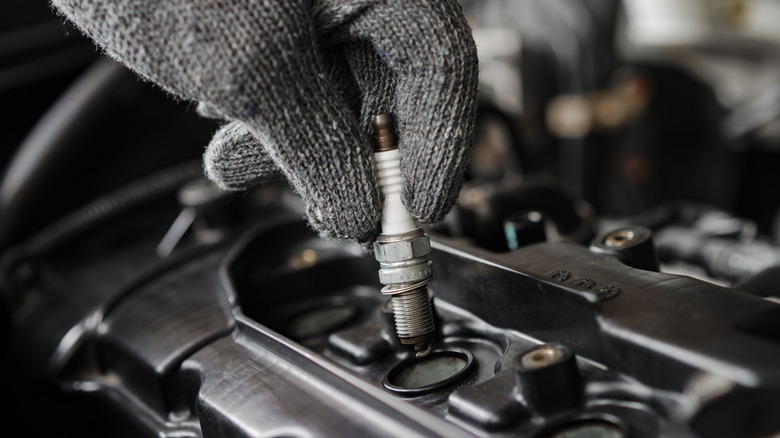
When you start seeing signs that your spark plugs have gone bad, it's in your best interest to replace them. If you don't take your vehicle to a mechanic for this job, you could do it yourself with the right tools. The best way to go is using a socket wrench and a designated spark plug socket to remove the old one and tighten the new one after setting it by hand. This tool combination offers you the right blend of leverage and grip on the plugs to quickly take the old one out and tighten its replacement sufficiently. As tempting as it may seem as a time-saver, this is yet another job where a power tool could do more harm than good.
On the whole, spark plug replacement is a delicate job. They need to be tightened to the vehicle manufacturer-recommended level in order to function efficiently. Therefore, if you blast away with a torque wrench or impact driver, you risk damaging the spark plug you sought to install. Power tool levels of torque could strip the threads, install it crooked or otherwise incorrectly if it's not initially set right, or, in a worst-case scenario, cause engine damage. Improperly tightened spark plugs can fail sooner than they would otherwise, with engine misfires and other negatives as a consequence. For removal and installation alike, a good socket wrench and spark plug socket are more than enough.
Strut shaft nut
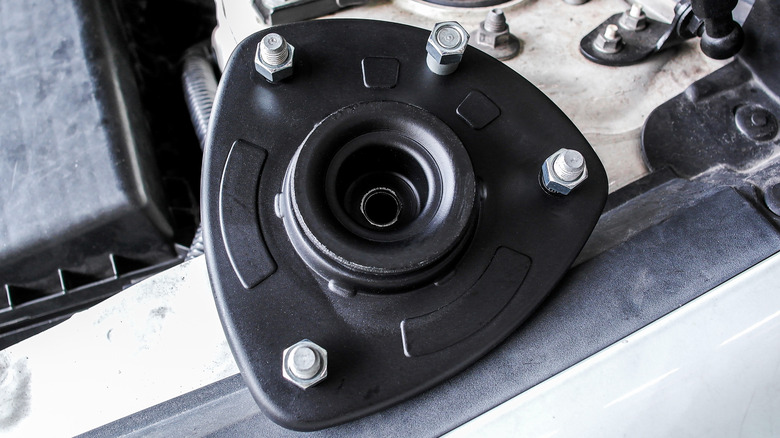
Struts, not to be confused with shocks, are incredibly important to a safe, comfortable ride in any vehicle that has them. They're vital to an operational suspension system, keep a vehicle at the correct height, and play a hand in absorbing road bumps. That's to say they take a beating, with replacement becoming essential at some point. If you want to tackle this rather involved repair job yourself, just know that bringing power tools like an impact wrench into the equation isn't a great idea. As tough as struts are, portions of their installation demand a steady hand and just the right amount of power to avoid ruining them.
To put it lightly, using a power tool to replace struts, especially once you get to the strut shaft nut, is far from a good idea. A tool like the aforementioned impact driver will move the strut shaft nut, though it will most likely also move the internal shaft along with it, which is the problem. This can lead to a cascade of issues, from the breaking of the seals around the internal shaft, causing a sharp drop in pressure within, to creating an oil leak. All of this amounts to a strut that won't perform as it should in terms of shock absorption, making it a danger to drive with. To avoid such a blunder, it's best to just take your time and remove the nut by hand with the compatible socket size, a socket wrench, and a breaker bar if needed.
Anything plastic
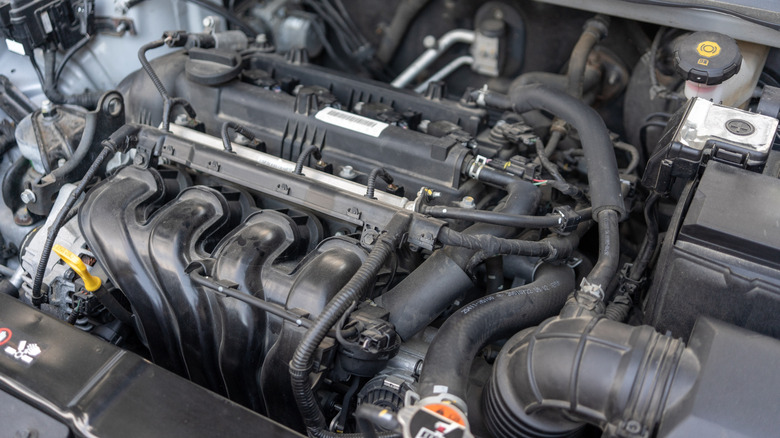
Modern vehicles are largely composed of metal, and that means there are lots of places where power tools are safe to use. Simultaneously, cars, trucks, and the like now feature an increasing number of plastic elements, from shells inside the cabin to entire air intake manifolds. Sometimes, these parts are held together using metal bolts, or in ways that make it seem as though power tools could aid in their removal or reinstallation. On the whole, though, anything plastic on a vehicle should be worked on with hand tools only.
The big concern here is the brittleness of plastic and its susceptibility to cracking under excessive force. If you're working on a part of your car that's plastic and you use a power tool to reapply a fastener, for example, there's a good chance you can overtighten and split the area surrounding the fastener and beyond. This could mean a lacking connection between the fastener and part, or the greater destruction of the part in question. With that, you'll have to source a replacement, especially if it's something made of plastic that your vehicle can't properly run without. All of that's to say that a steady use of hand tools is always preferred when dealing with plastic, eliminating the concern of overpowering the material altogether.