

Why Garbage Disposals Are Rare In Europe, But So Common In America
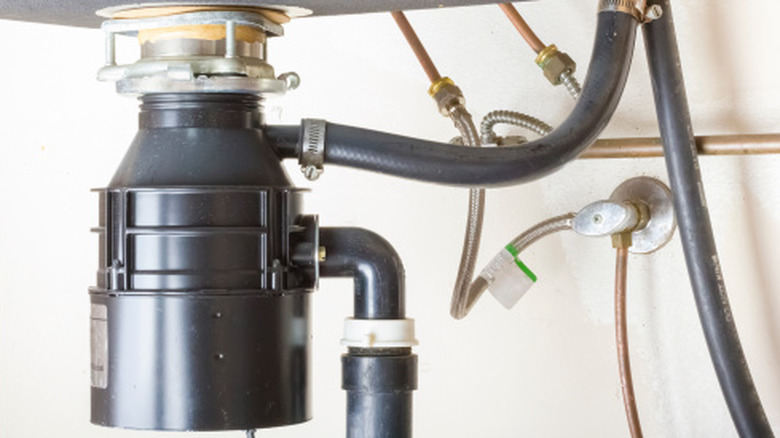
The latest Census figures for 2026 put the population of the United States at almost 343 million, with the global population now above 8 billion. By comparison, the number of people in the U.S. in 1950 sat around 150 million – less than half of what it is today. The U.S. during those early post-World War II years saw the baby boom, the proliferation of mass production, and massive suburban growth, resulting in home remodeling and kitchen modernization – all of which helped bolster an economy that had been stagnant during the war.
The garbage disposal (aka sink macerator, food waste grinder, garburator, electric pig, etc.) was invented in 1927 by American architect John W. Hammes. He patented the device in 1935 and started the InSinkErator Manufacturing Company in his hometown of Racine, Wisconsin, in 1938. In fact, the label still exists, one of 10 appliance brands owned by Whirlpool.
While only 52 disposals were made in the first year, more than 65 million are now installed in roughly half the homes in America today (though they have a shorter lifespan than you might realize). But the same can't be said for Europe where garbage disposals are banned in many countries, making it difficult to find meaningful statistics. In fact, disposals seem as rare in Europe as home air-conditioning. Additionally, waste disposal methods differ greatly from country to country there; some use landfills, while others incinerate, recycle, or compost. Two main factors drive the differences between the U.S. and Europe: the cultural outlook on waste in general and the ages of the regions' infrastructures.
Think twice before using your garbage disposal

Cities and homes in Europe are considerably older than those in the U.S., and so is the plumbing. Older pipes are smaller in diameter, making it hard to handle bulky organic waste without causing significant problems. Homes are typically smaller, too, which restricts kitchen size and makes every inch of space vitally important. And culturally speaking, Europeans typically frown upon American meal portion sizes and associated food waste.
Not all European countries deal with waste in the same way. For instance, Austria, Germany, and the Netherlands incinerate their trash instead of using landfills, which need huge swaths of land that some countries simply don't have. However, many southern European countries still rely on landfills, which can be plagued by foul odors and contribute to methane emissions. In fact, the U.S. Environmental Protection Agency says food waste is responsible for 58% of landfills' emissions and equates the country's food waste to the greenhouse gas emissions of over 50 million gasoline-powered engines.
Scotland prohibited disposals sending food waste to public sewers in 2016, with Northern Ireland banning it for businesses the following year. In 2025, Spain enacted the "Tasa de Basuras" in cities with over 5,000 residents. This municipal tax makes egregious polluters — residents and businesses alike — pay more for everything associated with urban waste. That same year, the U.K. rolled out its Simpler Recycling initiative, banning businesses from disposing food waste into sewer systems.