

4 Handy Ways To Use The WD-40 Precision Pen Around The Garage
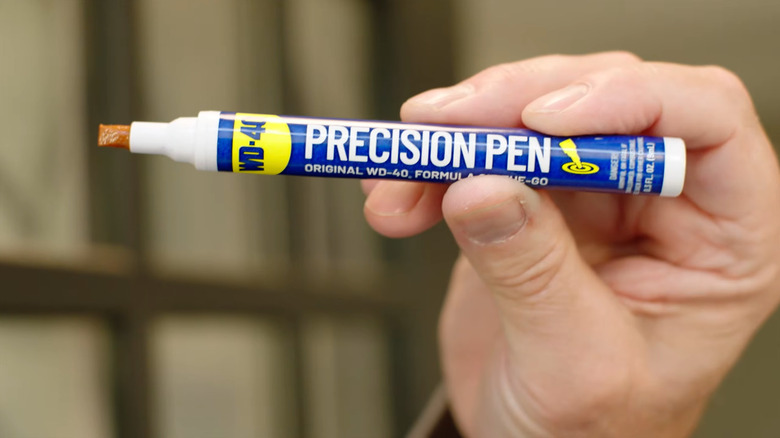
Walk into almost any garage and you're likely to find a WD-40 product somewhere. The multi-purpose solution is a hit around the house for its diverse lubricating, cleaning, loosening, and moisture-displacing properties. For those who aren't fans of the aerosol spray version, the company introduced another option: the WD-40 Precision Pen.
Anyone who has ever used the traditional product knows that the spray can be volatile and leave behind an oily residue that needs to be cleaned before it becomes a permanent mark or attracts dust — and let's just say this part is never fun when it comes to handling WD-40.
Smaller and easier to carry in your back pocket, the WD-40 Precision Pen is designed to reduce overspray, making each application accurate and localized to the area where the fiber tip touches. It isn't only for neat freaks, though, since there are actual uses for it around the garage where it makes much more sense to grab the pen than the traditional version.
Deal with those squeaky cabinet hinges
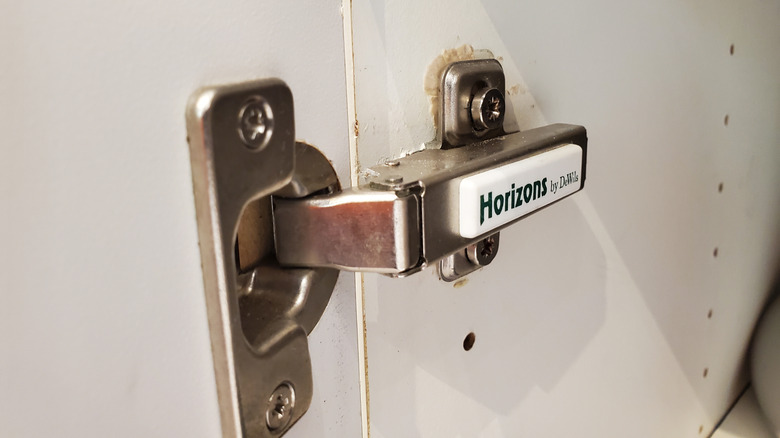
Unless you're someone who spends a lot of time in your garage and opens up cabinets frequently, a squeaky hinge might go undetected (or forgotten) for some time. Even so, they still need love too, especially if the temperature and/or garage become humid and you don't want rust to develop. While using WD-40 is a hack most homeowners know, what about those hard-to-reach places?
Depending on your garage layout and how full it is, these hinges might not always be easily accessible. Maybe it's high above your head, or there's a vehicle in the way that obstructs you from fully opening the cabinet. The WD-40 Precision Pen works best for this type of scenario, since you only need to push the pen's tip into the required area, press for a few drops, then release — and the job is done. Not only should the annoying squeaks subside, but it'll also prevent rust from forming on the hinges without leaving a pool of WD-40 dripping down the cabinet.
Lubricate your hand tools
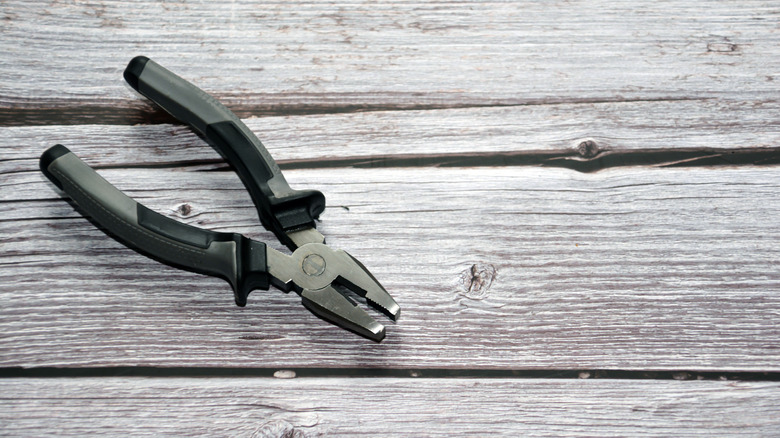
You never realize how expensive hand tools are to replace until you have to do it. This is why it's better to preserve them for as long as possible, maximizing the amount of use you get from them. Part of this includes maintaining and cleaning tools.
Of course, some of the biggest issues with hand tools are the accumulation of grime and rust, which can lead to stiffness and even breakage in the long run. As a preventive measure, WD-40 is a lubricant that can remove rust and break down grease and grime buildup. The reason the Precision Pen makes sense here is that it can be dabbed on the exact area you need it for. If WD-40 is only necessary for a joint or part, there's no need to lather up the entire tool, including the handle, and leave it slippery for the next time you need to use it.
Protect your car's battery terminals
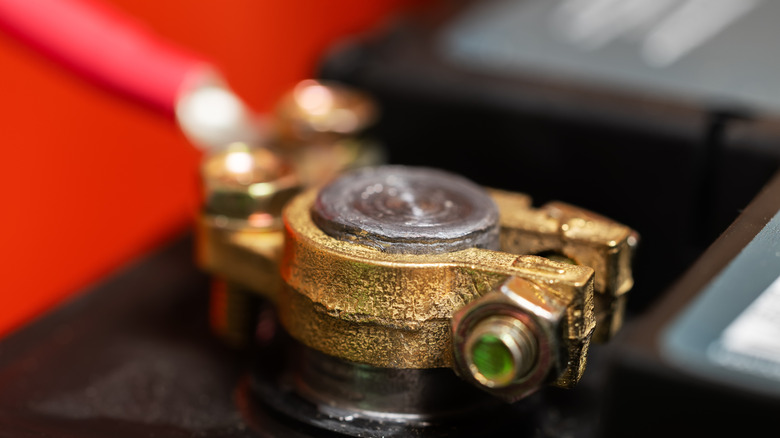
When it comes to a car battery, the average car owner often relies on the dashboard warning lights or their next car service to indicate if something is wrong. Out of sight, out of mind, right? That said, it isn't always the battery that's the issue; you also need to consider your car's battery terminals. Due to humidity, moisture, or simply the passage of time, these terminals could become corroded and negatively affect the connection.
The good news is there's a preventive measure that every car owner can take to maintain the integrity of their battery terminals. In fact, it's a WD-40 trick that could help save money on repairs or even a new battery overall. On its website, WD-40 mentioned using the Precision Pen on battery terminals, stating that "a small amount of WD-40 applied with precision can help protect connections."
Loosen stiff padlocks
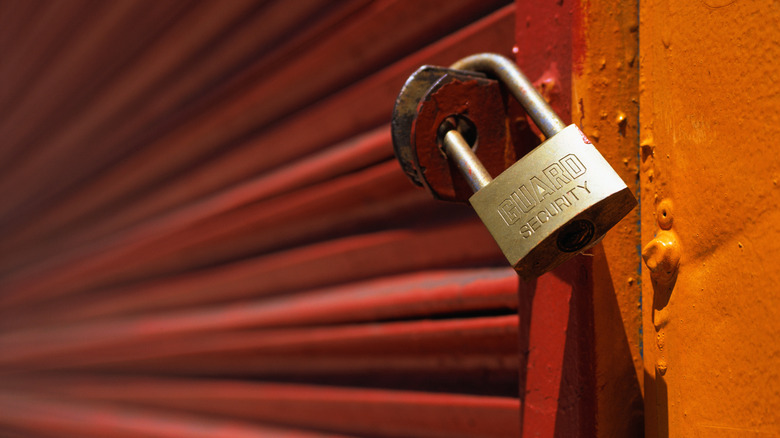
One of the greatest mysteries in life is why we gather so many padlocks in our lifetime. Every garage has at least a dozen of them that were intended for use once upon a time or have been replaced by another one. While not necessary right now, you may need to revisit old faithful, only to discover that the key is stuck and won't turn, or that the shackle won't separate from the lock body. Even worse, if it's a padlock that you're currently using and can't open it now.
The potential suspects here are rust and dirt. Unless the rust has completely destroyed the padlock, you should be able to loosen it by using the WD-40 Precision Pen and applying a controlled drop to the troublesome area(s) — in this case, the keyhole and/or around where the shackle connects to the lock body. After this, apply a little pressure to the key and turn it slowly back and forth. This should loosen the key and/or the lock mechanism.