

4 Tech Brands That Used To Make Cameras – But Don't Anymore
When people gathered around the water cooler 25 years ago to discuss the latest tech, it meant something a bit different than it does today. Technology is advancing at a faster pace today than at any other point in human history, with new trends every year. This rapid speed of advancement not only affects everyday life, but it also leads to fundamental changes in industry and business — remember when there was a Blockbuster in every town?
One commercial sector that was hit hard was the camera industry. Many companies were able to successfully make the leap from film to the digital era, but the rise of cell phone cameras in the 2010s tolled a death knell for handheld cameras. While serious photographers still tend to lug around cumbersome cameras and lenses, most of us just pull out our smartphones to snap a pic. Here are four technology companies that abandoned cameras for other, more profitable ventures.
Olympus
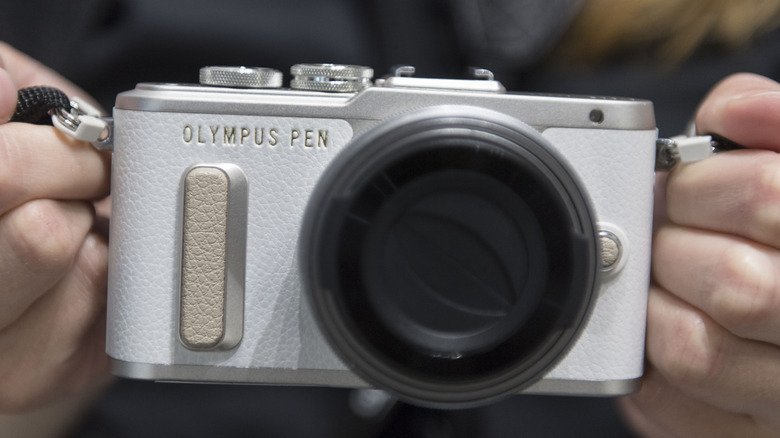
Olympus stands amongst a few other giants in the history of photography. The iconic company, which manufactured microscopes before moving into the camera business, debuted the Semi-Olympus I in 1936, followed by decades of additional film and, eventually, digital cameras. The Semi-Olympus one had the fold-out bellows we all associate with very early cameras, and it cost more than the average worker made in a month in Japan.
A few other standout products include the Olympus PEN F, which went on sale in 1963 as the world's only half-frame camera, meaning it would produce 72 photos from a roll of film that typically only offered 36 exposures. The company issued in the digital age in 1996 with the Camedia line. Later designs included waterproof and drop-resistant cameras. Everything changed in 2020 when, after three years of losses, Olympus signed an agreement to sell its camera division to Japan Industrial Partners (JIP). Today, Olympus Corporation still exists as a medical technology solutions company. Olympus was eventually absorbed into OM Digital Solutions, which sells cameras under this badge. The company focuses heavily on durable compact cameras and mirrorless cameras.
Casio

If you own a vintage Casio watch or calculator, it may surprise you that the company was also a player in the early digital camera market. In 1987, Casio Computer Co Ltd, more commonly known as simply Casio, released the VS-101, a hefty still video camera before introducing its first digital camera — the Casio QV-10 — in 1995.
The QV-10 was groundbreaking in that it was the first digital camera in the consumer world with an LCD screen. Instead of using the viewfinder, photographers could use the screen to line up their shots and get an idea of what their photos would look like without actually having to print them. Owners could also attach the camera to a TV, VCR, or computer to view their images — something we don't think twice about today but was new and innovative at the time. Casio released several other cameras, including a wristwatch camera and the unique EX-FR10 digital camera that allowed the lens to be separated from the LCD control screen, before exiting the camera market in 2018. The line was simply unprofitable, and today Casio focuses on watches, devices for the medical industry, business systems, and educational products.
Minolta
Like many other camera technology companies, Minolta was founded in Japan, by a man named Kazuo Tashima who had a rather unique vision. Rather than building its own tech, the company imported cameras from other countries, mainly Germany, and rebranded them. Its original name — Nichi-Doku Shashinki Shoten — reflects these origins, translating to Japanese-German Camera Manufacturer. In the 1930s, under the name Chiyoda, the company designed its first camera, dubbed "Minolta" for Mechanisms, Instruments, Optics, and Lenses by Tashima.
The company's history during the tumultuous 20th century includes the Minolta Vest Camera, designed to compete with Kodak's pocket camera; the first camera to use a coincidence-type rangefinder; and optics and equipment for military forces during World War II. The years following the war were difficult, but by the 1960s Minolta was producing cameras like the Hi-Matic, which John Glenn carried into space; copiers; and other technical equipment.
By the late 1990s, the company was struggling, and in 2003 it merged with Konica to form Konica Minolta. In 2006, the company exited the camera business completely and sold part of its assets to Sony. If you spot a new camera with the Minolta name, it's not made by Konica Minolta. The trademark was awarded to another company in 2015, and is now licensed by Elite Brands Inc.
Samsung
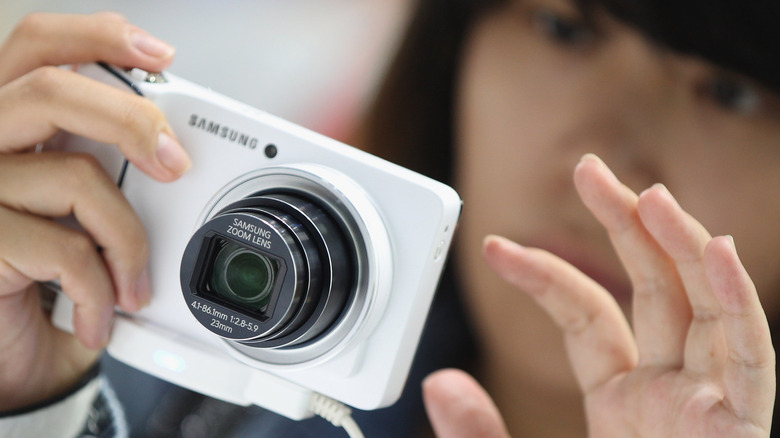
Samsung is a household name, but you may not remember that it ever sold cameras. The company currently offers a wide range of electronics, including smartphones, appliances, televisions, smart watches and rings, headphones and more. Samsung-Sanyo Electronics was founded in 1969 in South Korea, and its very first product was a black-and-white television. By the mid-70s, the company was also making refrigerators and washing machines, and it established an office in the U.S. in 1978. Samsung eventually branched out into film cameras, and in 1996 it released its first digital camera.
Samsung eventually sold both point-and-shoot and DSLR cameras, though its DSLR offerings were all rebadged Pentax models sold during its partnership with the company. In 2009, it released the ST500/ST550 with the world's first digital camera with a front selfie screen. In 2012, the Galaxy camera hit the shelves with, as you can probably guess from the name, an Android operating system with access to social media. Despite these features, this Galaxy was not a phone and couldn't make calls.
Samsung never formally announced the end of its camera line, but in 2016 an official tweet from the company implied it'd already exited the business. The company launched its Galaxy smartphone series in 2010 with the Galaxy S, which boasted a five-megapixel camera. Ultimately, smartphones dealt a final blow to Samsung's camera line, a fate shared across the tech industry.