

Never Use A Mini Chainsaw For These Jobs, Reach For These Tools Instead
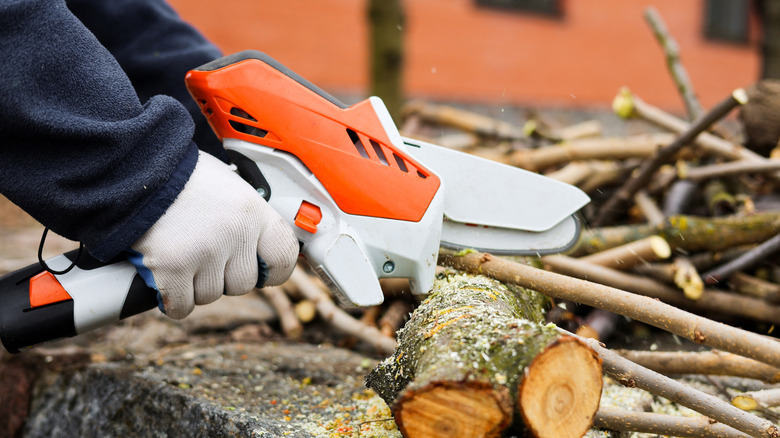
As far as powered cutting implements go, mini chainsaws are pretty nifty. You get that familiar chainsaw muscle in a compact, one-handed package, and they're readily available at retailers like Walmart for competitive prices. However, to quote some old wisdom, when all you have is a hammer, everything looks like a nail. If you have a mini chainsaw, you may experience a certain temptation to use it to cut anything and everything, and that's a temptation best ignored.
Mini chainsaws definitely have their purposes, being great for cutting and pruning mid-sized tree branches and clearing the way while camping and overlanding. If you attempt to use a mini chainsaw as some sort of universal cutting implement, though, not only will you almost definitely break it, you could end up putting your own safety at risk. Rather than trying to use a mini chainsaw for everything, you should defer to other cutting tools on a case-by-case basis, such as a full-sized chainsaw, pruning shears, pipe cutters, or other tools.
Cutting larger, thicker branches

As we mentioned, mini chainsaws are best suited for mid-sized tree branches or smaller logs, the kind of lumber that's just a bit too thick to cut through with something like a hand saw. When they're working within their wheelhouse, a mini chainsaw can cut through soft wood with little difficulty. However, there's a hard limit on what a mini chainsaw is realistically capable of. You can't use this kind of tool to cut through an entire tree.
When it comes to larger, thicker branches or logs, a mini chainsaw will swiftly find itself outmatched. Mini chainsaws lack the raw power output of their larger siblings, and so will become overloaded if forced to push beyond their limits. A few minutes of that, and the mini chainsaw's battery-powered motor could end up burning out and suffering permanent damage. Even if the motor somehow endured, the smaller chain would experience significant damage, wearing it out faster. If you're trying to remove a thick tree branch or cut up a hefty log, that's a job best left to a full-sized, full-strength chainsaw.
Cutting small, thin branches
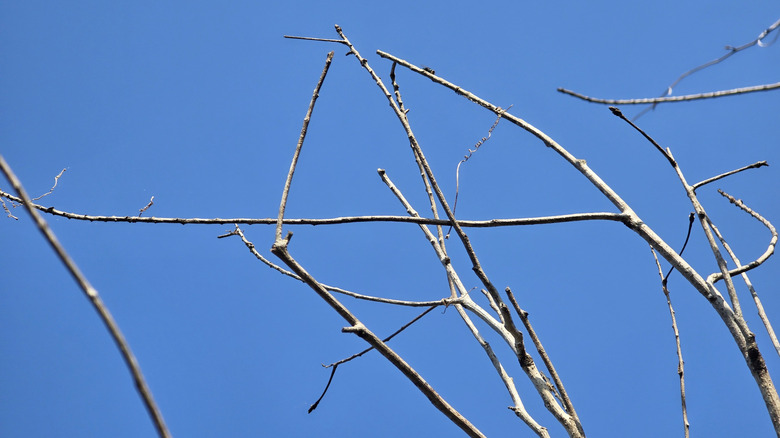
While a mini chainsaw is debatably intended for cutting smaller branches, much like how there's an upper limit on what they're capable of, so too is there a lower limit. If you're pulling out a mini chainsaw to clear out extremely small, thin branches, not only would that be a major waste of its battery power, but you could experience some unexpected safety hazards.
If the bar on your mini chainsaw is substantially larger than the wood you're trying to cut, there's a good chance you'll end up over-cutting it, which can be annoying if you're woodworking and are trying to get your cuts down to a precise size and shape. More pressing than that, if you try to use a mini chainsaw on a thin branch, the tip of the chain could end up getting caught on a thicker segment. This could result in surprisingly severe kickback, causing the whole device to buck right out of your hand. As convenient as powered tools like mini chainsaws are, for very small branches, it's best to keep things simple and employ a manual tool like a hand saw or a pair of pruning shears.
Cutting hardwoods

Something you swiftly learn when you get into the woodcutting game is that not all wood is created equal. Different types of wood have different physical properties, with the most obvious differences being between softwoods like pine, cedar, and spruce, and hardwoods like oak, walnut, and maple. A mini chainsaw can handle mid-sized cuts on most types of softwood, barring perhaps those with a high resin content like fir, but when it comes to hardwood, the job becomes more challenging.
As the name implies, hardwood is naturally thicker and more resilient than softwood. That's what makes it a great choice for building stuff that's supposed to last awhile, but it also makes it harder to cut, possibly harder than a mini chainsaw can manage. The chain on a mini chainsaw isn't built to handle the kind of punishment a hardwood inflicts, which means trying to cut with one will just wear the chain down and break it faster. That's assuming your motor doesn't stall out mid-cut, leaving your mini-chainsaw stuck halfway into a log. It is technically possible to cut hardwood with a mini chainsaw, but it's very difficult, and much like with thicker logs, the job is best left to a full-sized chainsaw instead.
Cutting PVC piping
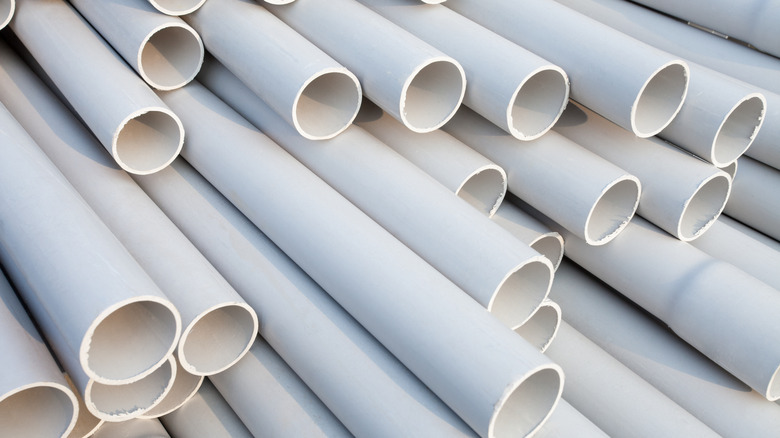
Chainsaws, mini or otherwise, may have a reputation for being the biggest and baddest among all powered cutting implements, but the truth of the matter is that they're only designed to cut through wood. They're certainly great at doing that, but when it comes to just about any other type of material, a mini chainsaw will likely have difficulty, not to mention potentially damage the material in question.
Take, for example, PVC or plastic piping. It might seem like it'd be fairly easy to cut through, and certainly, that's part of the appeal of PVC piping. However, the physical makeup of PVC doesn't agree with the construction of mini chainsaws. Plastics can get lodged in the teeth of the chain, causing it to stick and stall, spinning slower and enduring more damage than usual. If your mini chainsaw is running especially hot while it's spinning, it could even cause the sides of the pipe to start melting and warping, which will ruin them before you can use them for anything. If you're planning on cutting piping, stick to a dedicated implement like a manual or powered pipe cutter.
Cutting stone or concrete
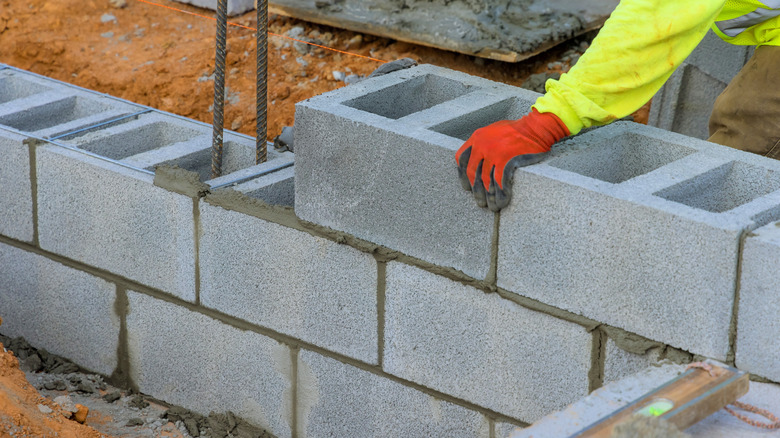
It should probably go without saying that trying to use a mini chainsaw on solid materials like stone or concrete is an obviously bad idea, but someone has almost certainly tried it. Trying to use a mini chainsaw in this manner is like the worst combination of some other scenarios we've covered here, from the non-wood materials of PVC to the thickness of hardwood.
A mini chainsaw can't handle stone or concrete, full stop. If you attempt to push a mini chainsaw into a chunk of solid stone, the best case scenario would be the chain immediately receiving damage and dulling, while the worst would be it immediately snapping and flying off. Even putting aside concerns around the chain, the motor would swiftly overload from the strain, stopping dead and burning out. Trying to push a mini chainsaw into stone will destroy the tool long before you make any noteworthy incision into the material. Only something like a diamond-tipped circular concrete saw can handle this kind of work.