

5 Tire Brands Owned By Japanese Companies
Japan is a heavyweight in the global automotive industry, and it has been for many decades now. The world's largest car brand by sales is Toyota, and rivals like Honda and Nissan also rank among the 10 biggest global automakers. It isn't just cars either; plenty of Japanese automotive component manufacturers are also big names in their respective fields. For example, according to Tire Business' 2025 rankings, four of the world's 12 largest tire manufacturers are Japanese.
These major tire makers sell tires both under their own brand names and under the names of various subsidiaries, so there's a chance you've bought tires from a Japanese company without ever realizing it. Each company also has its own OE (original equipment) deals, where the tire manufacturer works with a car manufacturer to develop and produce tires that are fitted to new cars. Working out which tire brands are owned by which corporation isn't always easy, but if you see any of these brands while you're shopping, you'll now know that they're owned by a company from the Land of the Rising Sun.
Bridgestone
As well as being the second biggest tire brand in the world by sales, Bridgestone is also one of the world's best known tire brands. It has signed OE deals with a huge range of car manufacturers, from exclusive performance marques like Ferrari and Porsche to mass-market juggernauts like GM and Toyota. The company also owns various subsidiary tire brands, including Fuzion, SureDrive, and Firestone.
Fuzion is a value-oriented brand that manufactures tires for passenger cars, minivans, and SUVs, while SureDrive is the company's entry-level budget brand. Firestone has been part of Bridgestone's portfolio since the late 1980s, when the two formerly separate tire makers merged to form one large corporation.
Bridgestone manufactures its tires in many different facilities all across the world. It has more than a dozen manufacturing facilities in the U.S. alone, some of which manufacture car and truck tires, while others produce commercial tires or advanced rubber compounds.
Despite its sprawling global presence today, Bridgestone started small back in 1931. It was founded in Kurume, an area in Japan's Fukuoka Prefecture, and it rapidly expanded over its first few decades of operation. By the mid-1950s, Bridgestone had already become Japan's biggest tire maker. The company has been publicly listed in Japan since 1961, but just over 12% of the company still remains owned by a foundation set up by Bridgestone's founder Ishibashi Shojiro. This foundation owns a large art collection and displays it at its museum in Japan, as well as giving grants to art projects and organizations around the world.
Toyo
Founded in 1945, Toyo is the smallest of the four major Japanese car tire producers. Nonetheless, it's still the 11th largest tiremaker in the world. Much like Bridgestone, it has been a publicly owned company for the majority of its existence, with its stocks first being listed on the Tokyo Stock Exchange in 1955. Today, the bulk of Toyo's shares are owned by various Japanese investment firms, companies, and individuals, with the largest single stake being owned by Mitsubishi Corporation.
Just over 20% of Toyo is owned by Mitsubishi, so it shouldn't come as a surprise to find out that Toyo's tires are fitted to new Mitsubishi vehicles. The tire maker's other OE deals include providing tires for new Nissan, Toyota, Audi, Ford, and Subaru models.
Toyo has sold tires in the U.S. since 1966, and has been partnered with Nitto Tires since 1979. Nitto is almost as old as Toyo, having first been founded in 1949, but today it operates as a subsidiary of Toyo. Nitto's tires are made at several facilities within Toyo's global manufacturing network, including at Toyo's U.S. plant in the state of Georgia.
Sumitomo
Although Sumitomo sells tires under its own name, its current roster of brands includes some names you'll likely be familiar with even if you haven't heard of the Japanese company itself. Its two biggest tire brands are Falken, which has been around since 1983, and Dunlop, which is one of the oldest tire makers in the world.
Originally, the Falken brand was launched as the high-performance brand of Ohtsu Tire, another Japanese tire maker. When Sumitomo Rubber Industries (SRI) bought Ohtsu in 2003, Falken was brought into the company's portfolio alongside it. Falken tires can currently be found as original equipment on a wide range of new cars, from Toyota to Ram and Ford. Ohtsu still sells tires in the U.S. today, with American distribution handled by the Falken Tire Corporation, which is in turn a subsidiary of SRI.
Dunlop is a much more recent addition to Sumitomo's brand lineup, having only been acquired from Goodyear in 2025. Originally, the historic company was founded in the late 1800s by tiremaking pioneer John Boyd Dunlop. Notably, Dunlop has a long history in Japan, opening its first manufacturing facility in the country back in 1909. After the brand was acquired by Sumitomo in 2025, the Japanese tire maker's North American division was renamed to Dunlop Tires North America in 2026.
Even before it completed its acquisition of Dunlop, Sumitomo was already the world's sixth largest tire brand. Just like its competitors, SRI is publicly traded. Confusingly, the largest minority stake in SRI is held by Sumitomo Electric Industries, which is a separate corporation, despite the shared name.
Yokohama
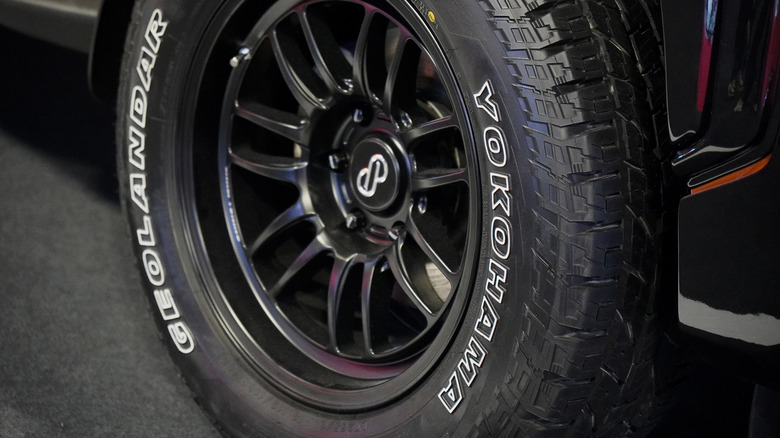
While rivals like Bridgestone and Sumitomo own an interconnected network of subsidiary brands that might appear unrelated at first glance, Yokohama does things a little differently. There are several sub-brands within the Yokohama tire family, but all of them are marketed as being part of the Yokohama brand. Advan serves as Yokohama's high performance sub-brand, Geolandar offers a range of all-terrain tires, and Avid is designed for everyday driving and commuting.
The Yokohama Rubber Company is more than a century old, having been founded in 1917. It began as a partnership between the American tire maker BFGoodrich and the Japanese Yokohama Electric Cable Manufacturing Company. Despite the destruction of its main factory in the city of Yokohama during the Second World War, the company recovered and managed to expand its operations significantly over the following decades. It entered the U.S. market in 1969.
Expansions across Asia throughout the '80s and '90s fueled its growth, and today it's the eighth largest tire maker in the world by sales. It's another brand with a long list of OE deals, from Japanese automakers like Mazda and Subaru to British boutique manufacturers like Lotus and Bentley.
IRC
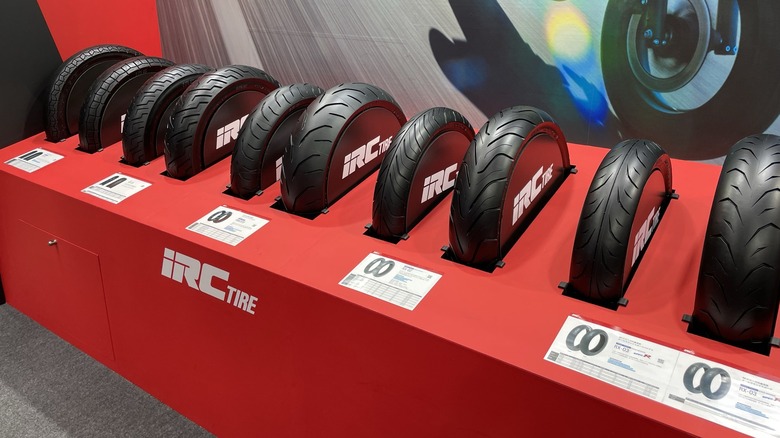
The last brand here is also the odd one out, because it's best known for making tires for two-wheel vehicles rather than four-wheel vehicles. Inoue Rubber Company, better known as IRC in America, sells a range of both road-focused and off-road motorcycle tires. In certain other markets, it's better known as a maker of bicycle tires, and it also sells wheelchair tires. The company in its current form was established in 1938, initially making bicycle tires before expanding into motorcycle tire manufacturing in the '50s.
Its first international manufacturing facility was established in Sri Lanka in 1959, and the company made further international expansions in Thailand, Indonesia, and Vietnam over the next few decades. Its parent company has been known as Inoac since 1980, and as well as expanding its tire making facilities, it has also branched out into a number of other industries. Among other things, it makes product packaging, construction materials, and welfare products. As well as manufacturing a different range of tires to all the other companies here, Inoac is also the only company here to remain privately owned today.