

Why Are European Refrigerators So Much Smaller Than American Ones?
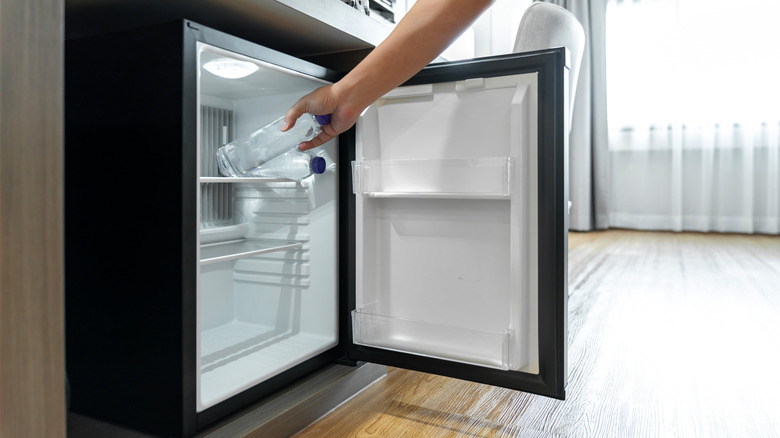
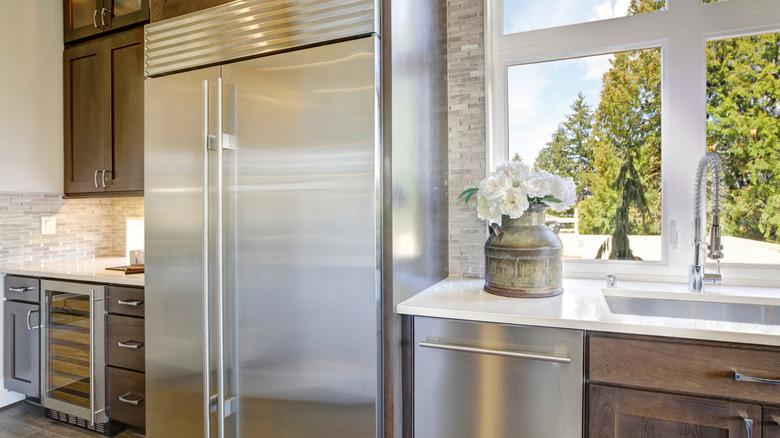
A European who visits America would be surprised by how large the fridges are there, usually spanning an entire wall, or two to four doors wide. There's even a water dispenser included in them up front, which is hardly a surprise given the size. Meanwhile, fridges in Europe are known to be much smaller, sometimes so tiny they can be tucked behind a cabinet panel.
There are multiple reasons for why this is a thing, ranging from necessity to culture. For one, Americans tend to buy groceries in much bigger quantities. Groceries themselves are designed such that they assume refrigeration — these same groceries are often left sitting on the counter in Europe. American homes, known to be much larger on average, also leave more room for the appliance.
There are numbers to back up these observations. As of 2020, European Commission data put the average household in the EU at 391 liters of cooled space, or about 13.8 cubic feet, for both fridge and freezer. There's a reason why fridges are measured in cubic feet. Meanwhile, in the US, the main refrigerator alone in households is noticeably larger. Federal survey data shows the two most common sizes running from 17.6 to 29.5 cubic feet. That doesn't even account for spares in the garage that cost a big time on the electric bill. About a third of American homes have a second fridge, and if you count those as well, it's safe to say that the typical American household stores roughly double the cold of a European one.
Americans just buy more

A fridge is only as good as the items stored in it, and Americans store a lot of them, so the fridges have to be larger to accommodate all of that. That's why some of the top brands that manufacture fridges in the US sell them in a range of large formats. More shopping means the markets themselves have to be far larger, too. In fact, USDA research on where Americans usually shop for food found that 89% of households do their primary grocery shopping at supermarkets or supercenters.
The same survey found that these households live an average of 2.2 miles from the nearest supermarket or supercenter. However, they tend to actually shop at one 3.8 miles away on average. This proves there's a preference for larger stores — they help buyers haul more, which in turn leads to demand for bigger refrigerators.
But to accommodate bigger refrigerators you need more space, too. And in the US, there's plenty of that. The figures from the OECD on living space show that outright homeowners in the US have about 3.8 rooms per household member, against two to three across most Southern European, Nordic and German-speaking countries.
In the US, buying more also has a compounding effect compared with buying in Europe, since portion sizes are much larger. Researchers at Penn and the CNRS in Paris compared single-serve supermarket foods in Philadelphia and Paris in a 2003 study and found that 14 of the 17 items they included were larger in American stores. For instance, a carton of yogurt was 82% larger in Philadelphia.
How suburbia and status turned the fridge into a statement
Beyond these factors, some reasons are cultural as well, such as American suburbia. The Guardian highlights how things went in the 1950s and 60s, when families stopped walking to local shops and started driving to the supermarket once a week instead. Additionally, summers in the US are hotter, which has led to greater demand for ice and cold drinks — stuff that needs a fridge. The ecosystem to meet these needs was already in place, like big houses to accommodate a larger appliance. At the same time, cars allowed people to carry more groceries home.
That said, a few European countries are bucking the trend — like the UK. The large American fridge is a status object, which Britain has started to adopt. A 2004 Guardian report on why more Britons are buying big American fridges found John Lewis selling two million pounds' worth of them in a single year. One executive there admitted the things cost roughly twice as much to run as a normal European-sized fridge, but that didn't stop buyers from buying them anyway. It helps to know how much electricity a refrigerator uses before committing to one that size.
Anyone wondering whether the rest of Europe is following Britain will find that it isn't. Retail sales figures from GfK, a market research firm, show that the average European fridge grew 4% over the eleven years to 2015. However, growth in America is seemingly more pronounced. EIA figures put new units there at 1.5 cubic feet larger than the ones they replace.