

What's The Difference Between Daikin And Goodman Air Conditioners?
There are some common problems with air conditioners, but choosing a new model in the first place is a different one altogether. There is a wide variety of air conditioners and HVAC systems available, after all, and it's vital to pick the model that's the best fit for your budget, your specific household, and where you live. One typical place to begin when considering any new appliance is with the biggest brands in that particular area. Two of the most significant in this case are Goodman and Daikin.
These are two of the biggest manufacturers in the U.S. air conditioner industry, and they're actually very closely connected to each other: both are owned by the same parent company, following Daikin Industries' acquisition of Goodman in 2012. A Daikin press release in March 2022 noted that the Japanese air-conditioning giant had renamed the latter Daikin Comfort Technologies North America, Inc., marking a further push into the lucrative world of Western air conditioning.
Though they are both under the same parent company, they have quite different goals and industry focuses, and so there's more to the choice between them than you may think. Broadly speaking, Goodman is often considered more of an affordable, value-oriented air conditioning supplier, while Daikin is often considered more of a premium provider. Let's take a closer look at the types of models in their ranges, as well as the different use cases for which one option might be more appropriate than the other.
Goodman air conditioner pricing, model range, and industry focus
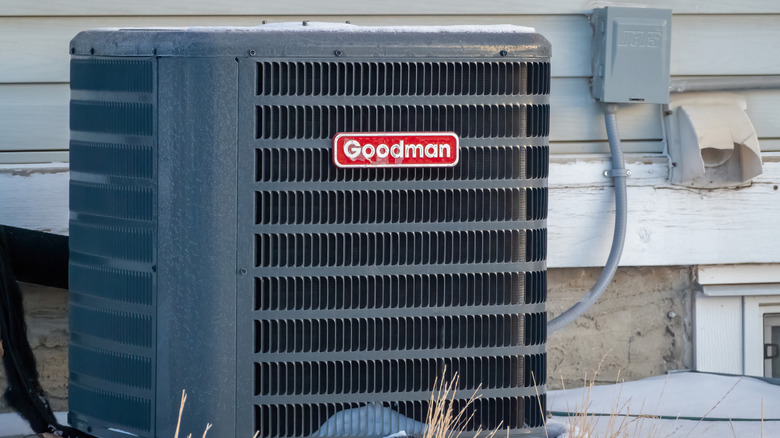
Goodman reports that founder Harold V. Goodman began Goodman Manufacturing Company, L.P. in 1982. It wouldn't be long before the company's efforts in the business would grow and diversify. Today, it's a U.S. manufacturing powerhouse, based largely in Texas. As its operations have expanded, so has the range of products it creates.
Goodman states that "since 1982, we've focused on helping millions and millions of homeowners achieve reliable, high-quality and affordable indoor comfort." Broadly speaking, this is reflected in the wider range offered by Goodman. Of the two, Goodman is widely regarded as the more budget-friendly option, with the goal of making this essential technology more affordable for a wider range of customers. Of course, this can mean that a Goodman model might lack the bells and whistles of a Daikin counterpart, and so it's for consumers to decide which they prioritize: the efficiency, simplicity, and practicality of a Goodman model, or the more sophisticated options that might be provided by a higher-end Daikin model. After all, there's no use paying for advanced features you may not need, but it doesn't make sense to buy a cheaper model that lacks a feature you might have used extensively.
Goodman's range features gas furnaces and heat pumps as well as more conventional air conditioners, and typically includes a 10-Year Parts Limited Warranty on appliances compared to Daikin's 12-Year Parts Limited Warranty. They boast generally solid efficiency. The Multi-Family R-32 Split System Air Conditioner, for example, has a SEER2 (Seasonal Energy Efficiency Ratio) rating of up to 15.2 and a customer rating of 4.9. There are some Goodman Packaged Terminal Air Conditioners/Heat Pumps that you should steer clear of, however.
Why Daikin models might be a worthy purchase instead
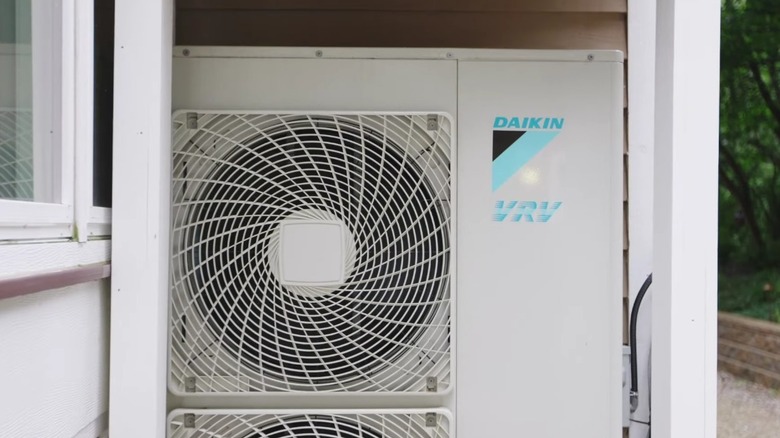
Daikin's models are designed for efficiency and connectivity. The Daikin VRV Life, for instance, offers up to 8.8 HSPF2 and up to 18 SEER2. It's also extremely versatile, designed to be tweaked to suit residential buildings that may have differing requirements for heating and cooling by offering compatibility with as many as nine different zones, as well as the option for outdoor units to connect with a single indoor one, or for the former to connect with multiple of the latter. This allows the owner to customize their system to their setup.
Interested parties can also explore other facets of Daikin's offerings, including rebates and incentives for local customers in the U.S. and Canada, allowing them to determine whether there are any bonuses or further incentives to pick up a system. Both Local Utility Rebates and Daikin Instant Rebates are potentially available. Through My Daikin System, users can register their systems, take advantage of a warranty that lasts up to 12 years, and download the Homeowner App or Daikin Comfort Control App to improve connectivity and efficiency.
In short, you could broadly say that a Goodman air conditioner is all about accessibility and solid functionality for the price, while Daikin is more about a premium, customizable, high-tech entry in the market. Of course, the specific features offered by either manufacturer will vary widely depending on the model you're considering. Regardless of the manufacturer or model, regular air conditioning servicing and maintenance is still important.