

5 Of The Most Complicated Transmissions In Automotive History
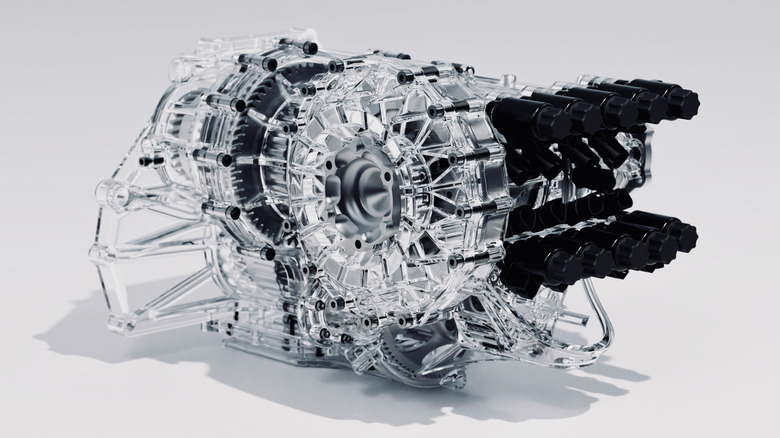
While their function may be straightforward, the inner workings of some transmissions are inherently insanely complicated. There might as well be a little wizard on the inside of the thing, using some sort of arcane magic to shift gears. Granted, that happens with transmissions a lot; a typical planetary automatic you find in most non-CVT (continuously variable transmission) cars has hundreds of moving parts. It's almost impossible to decipher how it operates if you don't have a good understanding of how such a transmission works. Meanwhile, CVTs, at least in principle, are quite simple, as are most manuals. But what about those transmissions which are one step beyond that?
We'll be discussing a lot of those here — transmissions which are just inherently complicated or bizarre, even by those high standards. To be more specific, they're transmissions which either have far more moving parts than normal, or operate in some way that isn't what you'd expect of their type. It doesn't mean that the transmissions are unreliable or overengineered in some way, just that how they do their job is overly complex.
That could be for a number of different reasons — some transmissions are like that because they have to play ball between an electric and combustion drivetrain, like Toyota's e-CVT. Others have a ton of gears for better performance or fuel economy, like Ford's 10R80 10-speed automatic. We'll focus more on the enigmatic and weird side of this, so expect to see a lot of hypercar tech alongside stuff from back when people were still figuring out how to make it all work. Let's get into it.
Ferrari 12Cilindri Manuale six-speed manual transmission
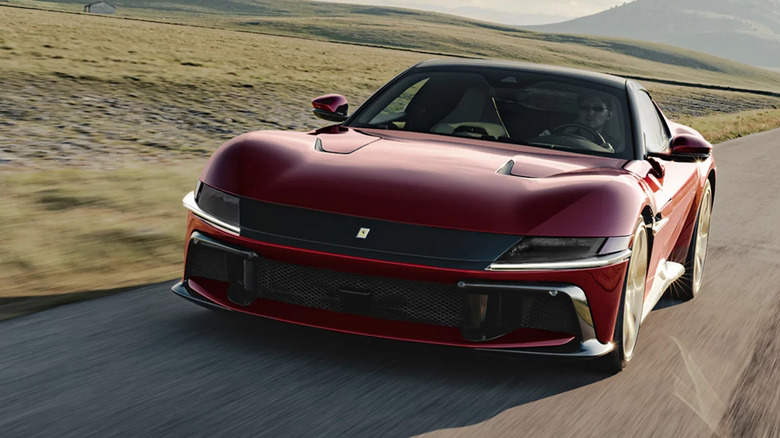
A six-speed manual is a well-understood science at this point. Granted, like any transmission, the typical manual transmission requires a little homework to understand its function. But suffice it to say, they're simple, robust, and typically last a long time. The one-sentence answer for how one works is that you have a clutch between the engine and transmission; you press on the clutch pedal to keep the engine running at idle and when you're shifting gears. That clutch is usually a manually-operated component, meaning there's a direct line between the clutch pedal and its subsystems. Well, with Ferrari's latest supercar, forget all that.
The 12Cilindri Manuale is Ferrari's way of having its cake and eating it, too. Unlike some automated clutches like Saab's Sensonic, Ferrari has an automated clutch with a physical pedal. It's technically a fly-by-wire clutch, designed to operate either as an 8-speed automatic or 6-speed manual, depending on your mood. It accomplishes this by using the clutch pedal like a toggle switch. Pressing the third pedal means the DCT's clutch pack is now controlled via computer input; you can even stall it like a regular manual.
In essence, Ferrari's vision supposedly combines the benefits of both a dual-clutch transmission (DCT) and a manual, likely capitalizing on the contemporary resurgence of the manual transmission. But instead of doing the sane thing and building a traditional manual, Ferrari instead created something so aggressively complicated that it makes their traditional DCTs look positively quaint by comparison, a feat of skill on the part of the engineers. Woe to the poor mechanics tasked with fixing these transmissions' electronic bugs in the future.
Koenigsegg's Light Speed Transmission (LST)
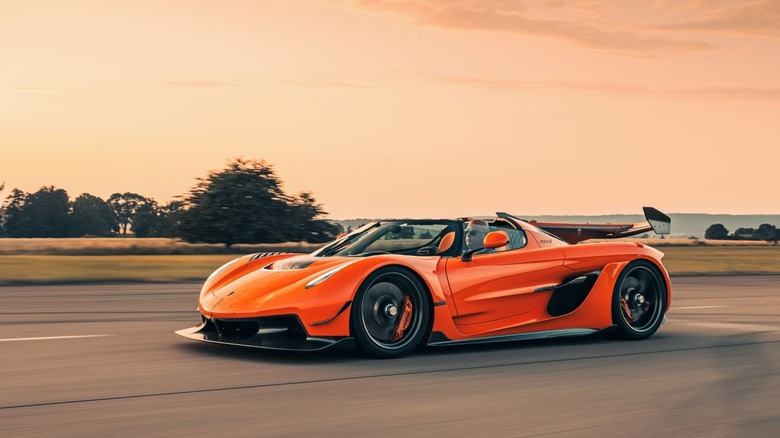
How does a company design a 9-speed automated manual transmission able to shift across multiple gears in milliseconds? Normally you would use a DCT, albeit at the cost of flexibility. While a DCT is fast at going through single gears, it can't shift down from, say, 9th to 3rd. It has to go through all the other gears first.
Not so with Koenigsegg's system, which the company has dubbed the LST, or Light Speed Transmission. It's not technically a dual-clutch transmission in the normal sense, because it has way more than two clutches. It works like a pre-selector, similar in principle to something like a Lenco drag racing transmission, which is just a bunch of little transmissions put together in sequence like Lego bricks. But instead of having multiple independent pieces, the LST takes it all and mashes it together into a compact, incredibly dense package of gears and clutches.
All this means that the Jesko, the car bearing this truly novel gearbox, can shift between any gear regardless of the number, just as quickly as any other lightning-fast modern DCT setup. The point of that is because this thing is a 9-speed, it'd have a lot of gears to cycle down to get on the power if the driver's foot gets heavy. This must also play well with the compact, lightweight nature of the Koenigsegg hypercar, necessitating these ingenious but unquestionably incredibly complicated clutch packs and gears in such a small package. Nothing else like it exists in a production car, and likely never will to any massive extent given its incredible precision.
Porsche PDK: Two transmissions in one
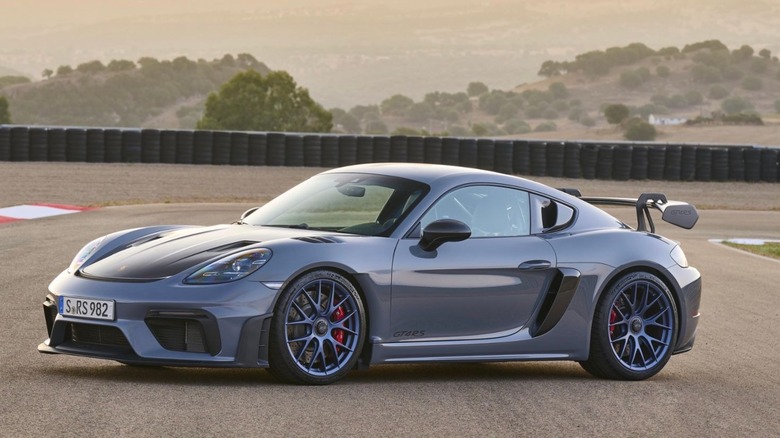
The Porsche PDK is essentially the mass-market cousin of the Koenigsegg LST, albeit without the ability to shift between multiple gears in one shot; like other automated manuals, the PDK must go through the whole process sequentially. It's actually rather simple in theory — imagine a transmission that can predict what gear you're going in, and it pre-selects that gear for you. So when you shift up or down, that shift is instant.
Porsche created this concept for the 962C Group C race car back in 1988, and it was a complicated, unreliable mess, but unquestionably a fast one. This spurred on development of what Porsche called its "Porsche-Doppelkupplungsgetriebe," German for "Porsche Double Clutch Transmission." Fast forward two decades and the company debuts it in a road car.
However, Porsche hasn't exactly been known for simplicity since 1996, as the the 911 has gone through dozens of evolutions. Luxury sports cars are inherently complex, made doubly-so by this transmission's predictive nature. It's a two-part problem: How does the transmission know what gear you desire, and how does it engage two gears at once?
The answer to the first question is sensors — a lot of sensors. Couple that with the PDK needing two sets of everything — two clutches, two driveshafts, and two gearsets. One clutch remains open with the other engaged, and it has to do all this on the fly. It's so complicated that Porsche initially considered it a disposable unit, meaning it was easier to replace the whole thing in the event of any failure.
Acura DCT8: The chimera
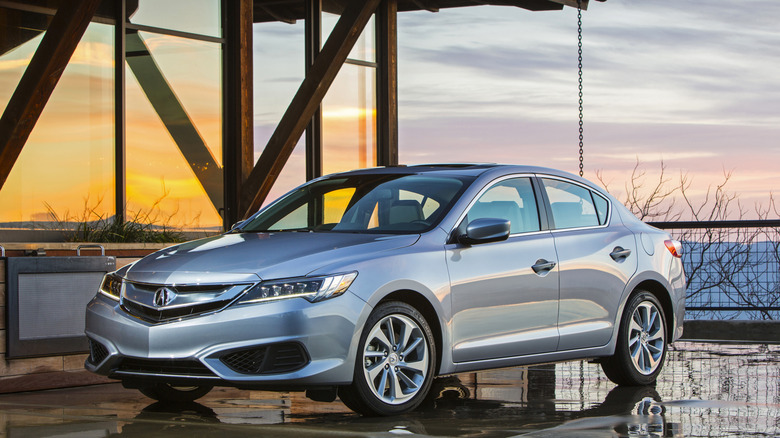
At a glance, Acura's take superficially resembles the PDK in design and function. It's a transaxle designed to pre-select gears, using electronics and sensors to figure out what gear the driver's likely to require. Granted, it's a more modern and updated variant of the familiar DCT, but aside from that, it's hardly special. Why is it on this list, then? Well, most DCTs, like Porsche's PDK, use either a dry or wet-clutch system to link the engine and drivetrain. Not Acura's DCT8, though. It's the only production DCT that uses a torque converter.
Torque converters are what you find in a traditional automatic transmission. People sometimes call them "slushboxes" because of how they felt to drive back in the day, but modern examples are both smooth and efficient thanks to a mechanical clutch inside of it. This provides a hard link between the engine and drivetrain so there's no power loss with the transmission fluid. Subtle updates like this keep the torque converter relevant in applications prioritizing smoothness.
Acura's take is to combine that smoothness with the speed of a DCT. Like the Porsche PDK, it too has two sets of everything, including gears and shafts, so it benefits from that advantage. The torque converter is primarily there because traditional DCTs are somewhat jerky, especially at low speeds, so theoretically the DCT8 is a lot easier for slow, precision work like parking. Plus the computers that help manage that aren't always perfect; having a torque converter is an interesting and effective compromise.
Ford Model T: The progenitor of multi-speed transmissions
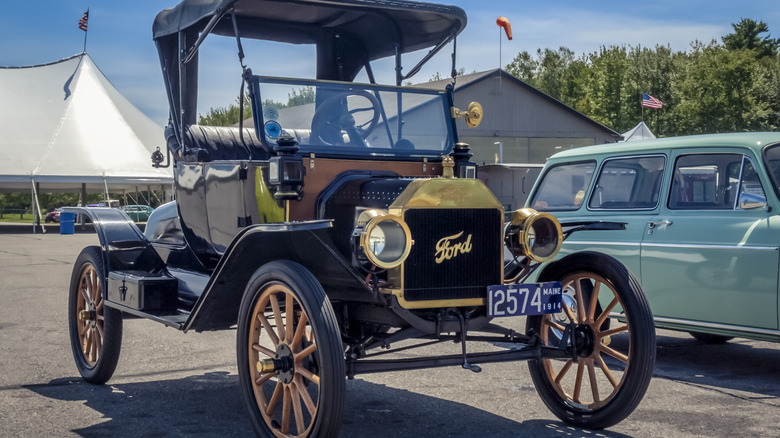
Back before DCTs, AMTs, and all the rest of it, there was exactly one mass-produced transmission, and it belonged to the Ford Model T. These were the days before anyone even had a concept of what the ideal setup of an automobile should be. Designers didn't know the pedal arrangement, where to put the shifter, handbrake, throttle, clutch pedal, any of that. And that's not even getting into the particulars of the Model T transmission itself.
While the car is simplicity itself in almost every other way, the Model T's transmission is easily one of the most complicated and (by modern standards) bizarre pieces of machinery ever fitted to a production car. It's actually not unlike an automatic transmission in that it has a set of planetary gears — a high, low, and reverse gear, specifically. Those gears are engaged by a set of cotton and/or wooden bands wrapping around the transmission itself. It was the natural evolution of other planetary transmissions that came before, generally simplifying and perfecting this early design into something which could be mass-produced and easily repaired.
The transmission wasn't just pioneering because it was the first of its kind to be produced in large quantities, either. Earlier examples dating back to the Ford Model N didn't even have a full bellhousing, meaning the innards of the transmission (and the lubrication it had) would pick up all the dirt of early American roads. Basically, this transmission needed to work out all the teething issues of those that came before, which is why it's so brilliant as well as so enigmatic and weird.