

Lotus' Emira V6 Is Pricey And Not Even The Most Powerful Model, But That Doesn't Matter
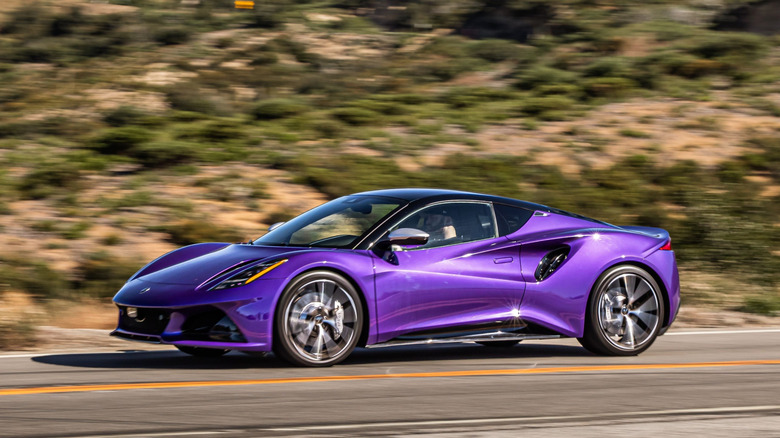
"Oh, man! Is that a Ferrari?!" I was eating tacos, sitting far enough away from the Purple Haze 2026 Lotus Emira that it would be hard to assume the car was mine. "No, it's not a Ferrari, kid," I thought about saying, but that would've been a strange introduction from a stranger who was eating alone. Besides, he wasn't asking me directly about the fantastically-colored car, at least as far as I could tell.
The child, who was somewhere in the 8-to-13 range (how old are kids these days anyway?), was walking by, holding his father's hand and eagerly asking about the slick-looking mid-engine sports car I had parked nearby. I let the conversation play out and heard his father extol the virtues of the British brand. "Nah, son. That's a Lotus. It's dope, though. Ain't it?" Momentarily, my faith in future generations was restored. Maybe they won't be relegated to wheelie-popping e-bike gangs after all.
 Travis Langness/SlashGear
The Emira was mine for the week, on loan from the folks at Lotus so that I could review the two-door sports car. But more than just driving it on my regular vehicle evaluation loops and taking notes about the ride quality, steering immediacy, and cabin build quality, I was living with it as broadly as I could. I took the Emira to the grocery store and learned just how much it could fit (or not fit) in the behind-the-engine trunk. I drove it to local car shows, visited friends, and made it mine for seven days. The only way the experience of testing this Lotus could've been made better is if I could've extended it indefinitely.
The mundane isn't so mundane
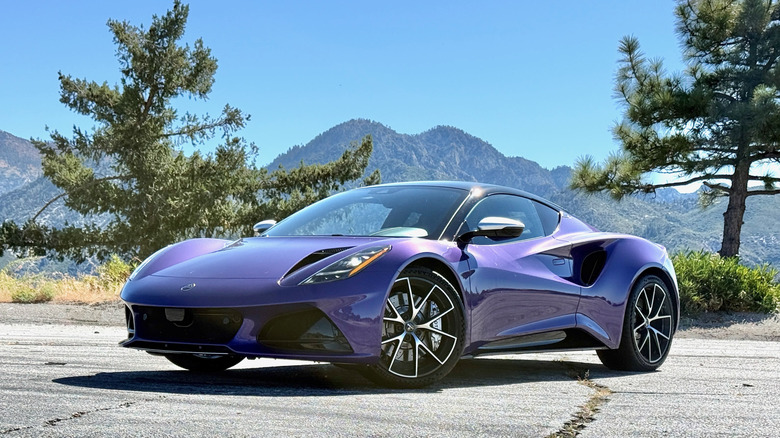
Equipped with a supercharged 3.5-liter V6, the Emira I was driving produces 400 horsepower and 310 lb-ft of torque. It makes for strong launches, exciting pulls with the pronounced supercharger whine, and excellent passing power in any scenario. I wasn't about to tell the kid that, but I was happy to talk about it at car meets later that week. And according to Lotus, the Emira will sprint from zero to 62 mph (100 kph) in 4.3 seconds, on its way to a top speed of 180 mph — not bad at all.
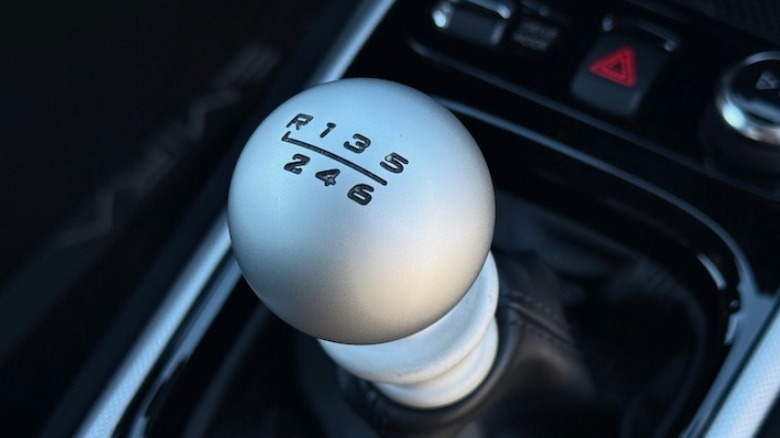
The available turbocharged four-cylinder in the Emira Turbo SE offers the same horsepower as the V6 and more torque (354 lb-ft), launching to 62 mph even faster in just 4.0 seconds. The turbo-four in the Emira 420 Sport is even more potent, with 416 hp and 369 lb-ft, trimming a tenth of a second from the 0-60 run. But the V6 is a more enjoyable powertrain for me, and the one I'd likely go with. Why? The V6 can be matched with an engaging six-speed manual transmission, while the four-cylinder is only available with a dual-clutch automatic.
 Travis Langness/SlashGear
The clutch pedal on the Emira was relatively light, the V6 offered proper power across the rev range, and it was easy to drive at slow speeds. The deficit in torque compared to the four-cylinder engine wasn't a penalty of any sort. And while the movement of the six-speed's gear lever wasn't particularly smooth, I did like the way it felt a bit actuated: almost like a rifle's action, even bordering on similar feelings to a gated manual transmission. It elevates the Emira experience, for sure.
An excuse to give it the beans
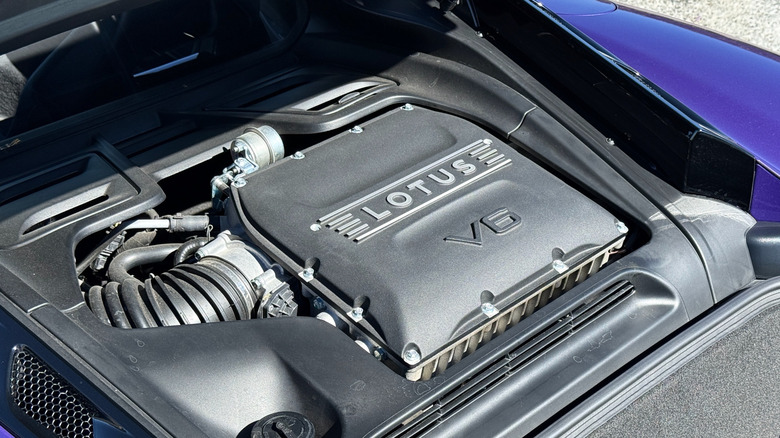
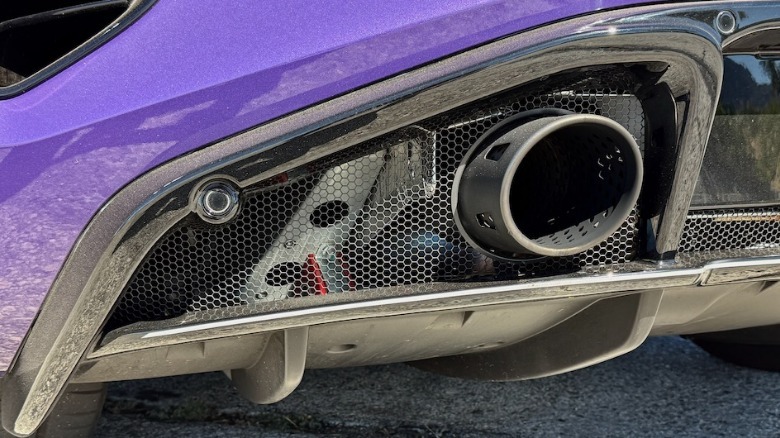
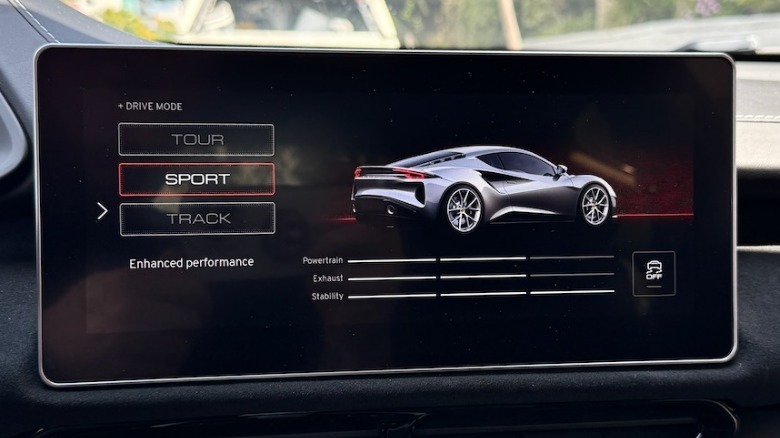
Down low in the rev range, the Emira's exhaust doesn't sound great, especially not in the standard "Tour" driving mode. It's tough for any V6 to sound good, really. Ever have one of those Rock Tumblers as a child? I did, and my mother made me use it out in the garage. Well, that's sort of what the exhaust on the Emira sounded like as I loped around town. Bouncing around, with an uninspiring growl, like stone on soft metal or plastic — especially when it was low in the rev range. When I switched over to Sport mode, though, everything livened up quite a bit.
The exhaust sounded deeper, meaner, and more purposeful. I'd lean into the throttle when a straightaway presented itself and a lovely supercharger whine appeared seemingly inches from my ears. Pair the better sounds with the excellent steering (more on that in a moment) and the satisfying sensations from the click-clack of the six-speed manual, and you've got a recipe for an intensely good back-road weekend car.
 Travis Langness/SlashGear
With these sorts of come-to-life moments, I took it everywhere I could. As is the case with many test vehicles, the folks at Lotus had a restriction on how many miles I could drive the car, but I went right up to that mileage limit by exploring local canyon roads, squeezing out every inch of driving distance out of the mid-engine performance sports car. If I bought one of these, I'd need to factor in a pretty serious gas, brake pads, and tires budget, just based on the sheer joy it would provide me.
You'll have a hard time finding better steering
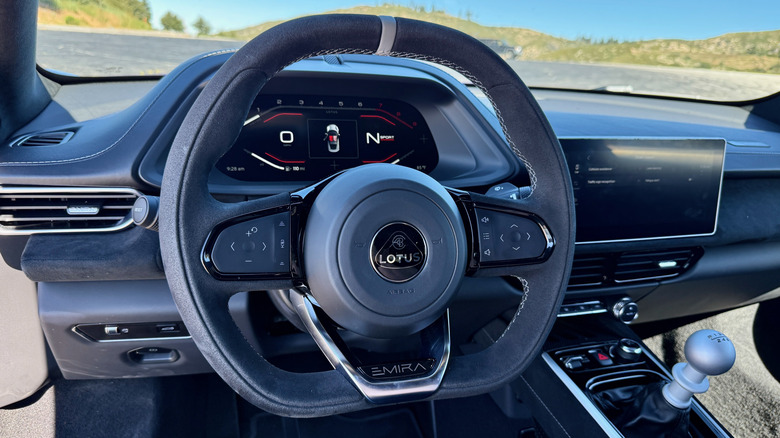
On top of being properly powered and equipped with a satisfying manual, the 2026 Emira has what I believe to be the best steering of any car on sale today. Or, at least any car I've driven. After several days commuting in the Emira, and many trips into my local mountains to double-check my math (translation: go fast and have fun), I couldn't think of any modern car that had better steering. I racked my brain, and went over all sorts of old notes and reviews for cars I'd driven in the last decade or so, especially those in the Emira's price range, but I couldn't come up with anything.
The steering is extremely well-weighted, and the wheel itself is just the right thickness and diameter. It's a joy to hold in your hands while the car is stopped, and a thrill while it's in motion. Genuinely, it's hard to understate just how good the Emira's steering is.
 Travis Langness/SlashGear
I've had recent experience with a few different Porsche coupes, as well as the standard C8 Corvette, and some relatively-recent experience with a few Italian exotics, and while all of them feel good to drive, none of them pull off what the Emira does. None of them feel like they've established as direct a connection between the steering wheel and the tires. It's the sort of steering that feels commanded by your thoughts rather than the movement in your arms, and it brings an entirely new meaning to the word "immediate".
A good ride and a pretty premium interior
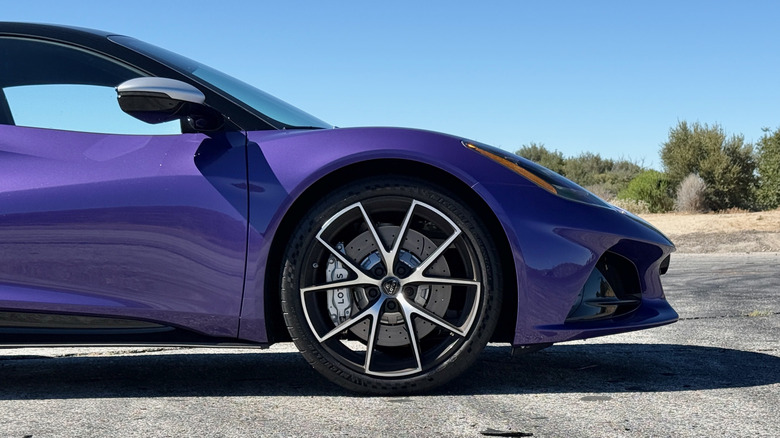
For a fast, two-door two-seater, with an engaging manual and some of the world's best steering, the Emira is pretty comfortable. The V6 SE comes with Bilstein Sport suspension, which is a bit more aggressive than the standard Turbo model's Touring suspension, but it didn't beat me up. Over busted-up roads and criminally common potholes here in Los Angeles, it transmitted the unsettling changes in terrain, but it did it without violence or pain. There were some creaks and squeaks inside the cabin that distracted me from the drive at a few points, but nothing egregious.
 Travis Langness/SlashGear
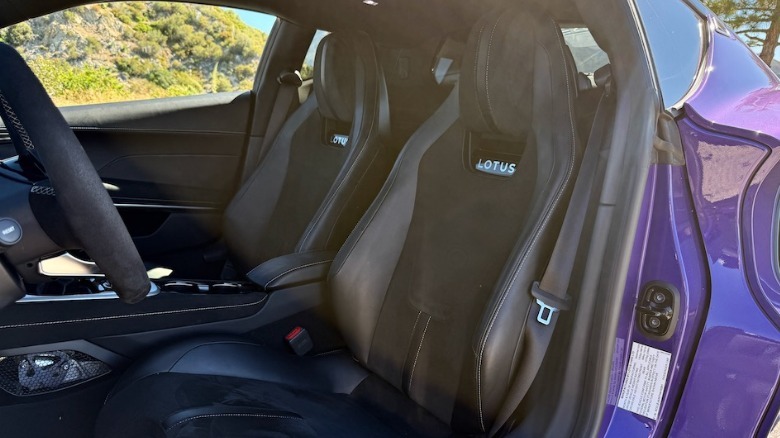
The Emira's 12-way adjustable heated seats strike an excellent balance between performance and comfort, with lots of hip and side bolstering to hold you in place around high-G corners, as well as soft-enough padding to keep you coddled on long road trips. The Alcantara upholstery is a nice touch, too. The 12.3-inch driver display and the 10.25-inch center touchscreen are both mounted low enough that they don't impede your forward view, and the touchscreen has a sort of semi-gloss finish that keeps it from getting smudged up with greasy fast-food fingertips.
 Travis Langness/SlashGear
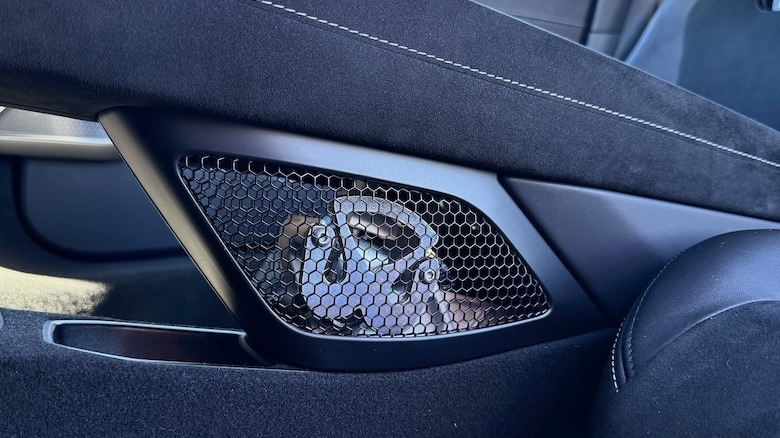
There are also lots of lovely little details to spot all around the interior. The tiny human used for the climate control diagram, for instance, is wearing a racing helmet. The six-speed manual? You can see its mechanical shifting heart through the honeycomb center console panels that match the vents hanging out over the engine bay and around the exhaust. There's also the flip-up switch over the stop-start button that gives every drive a bit of a fighter-pilot feel.
Some of the tech leaves a bit to be desired
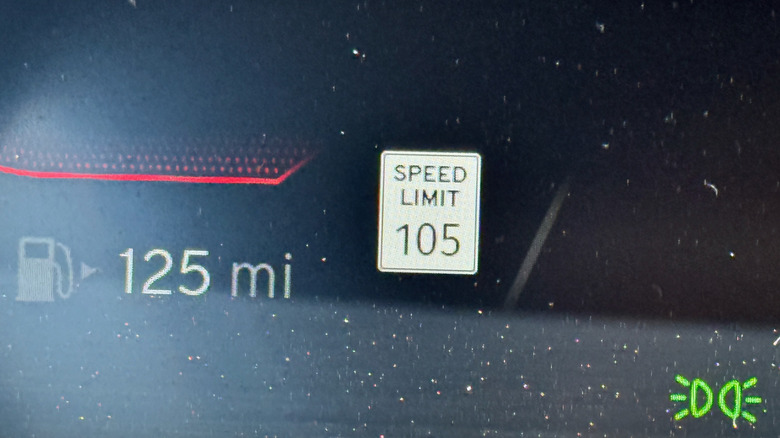
With the performance upsides of the Emira came a few tech downsides, though. For instance, every time I started the car, I had to turn off one of the driver aids: traffic sign recognition. The Lotus folks warned me about this feature before I ever drove the car, and they even walked me through the procedure to disable it. A few selections on the touchscreen, drilling down one menu and toggling some on-off switches did the trick, but if I was in a hurry and set off without disabling this feature, it meant some pretty annoying alerts from the Emira.
Instead of just alerting me every time I slightly crept over the posted speed limit (honestly, I'd be okay with that), the system misread a lot of signs. Often, this would manifest with the system warning me of a speed limit that was lower than the posted one, but comically, it also displayed a few speed limits that were much, much higher: as high as 105, for instance. Naturally, I didn't get any warnings for that one because I wasn't doing triple-digit speeds in LA traffic.
 Travis Langness/SlashGear
On top of the speed warning issue, the Emira seemed to think that my gym bag or my water bottle placed on the passenger seat were enough weight to be considered a person, so the seat-belt warnings chimed in too. I definitely couldn't load groceries on the passenger seat without fastening the seat belt. The optional stereo wasn't very impressive either, seeming underpowered even at maximum volume.
Then there's the price
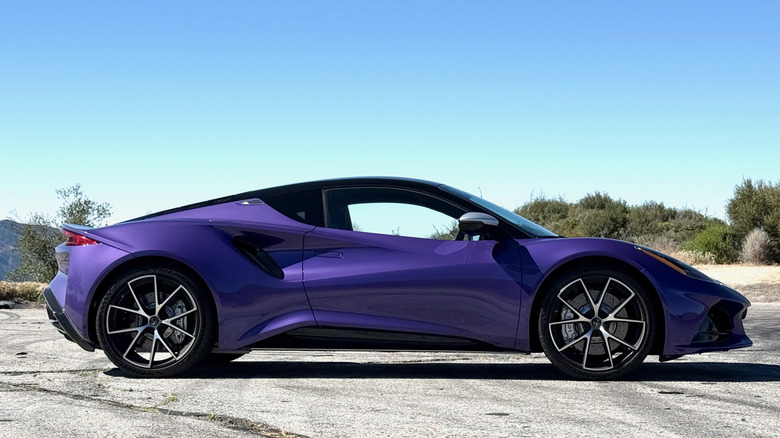
The Emira has a hefty price tag — no getting around it. The lowest trim, the Turbo SE, has an MSRP of $109,400 (including a $2,500 destination fee). It's relatively low on creature comforts, but smartphone connectivity (Apple CarPlay and Android Auto), the 10.25-inch touchscreen, and driver aids like adaptive cruise control are all standard.
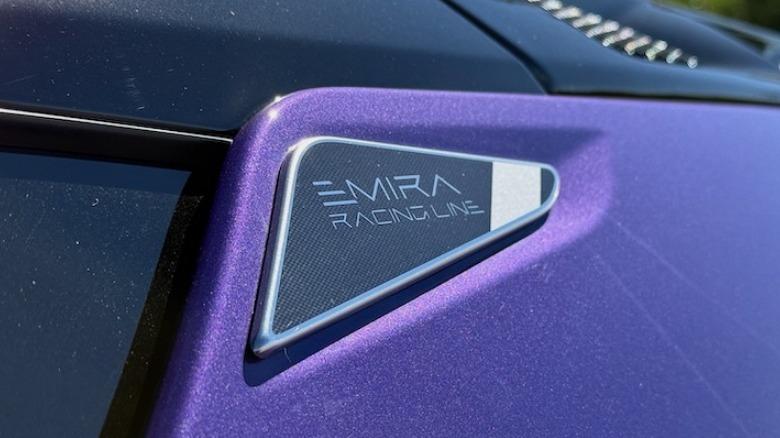
Add another $3,000 to that total, and you get the SE Racing Line, which matches the mirror caps to the car's color, upgrades the upholstery and stitching on the interior, and includes a few other aesthetic changes. The V6 SE adds another $3,000 to that total, coming paired with the sport suspension and a limited-slip differential, but the V6 SE Racing Line goes just a bit further.
 Travis Langness/SlashGear
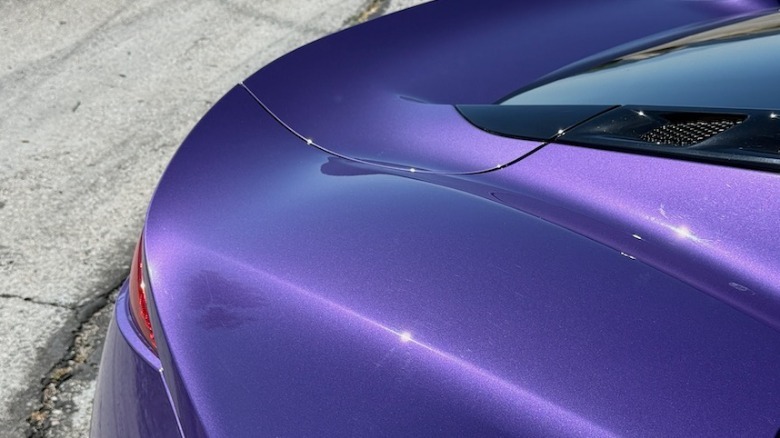
The 2026 V6 SE Racing Line version I drove had an MSRP of $125,150. Like I said, that's pricey, but a base 911 is nearly $13,000 more. And certainly, options like the $2,950 Purple Haze paint job and the KEF stereo ($1,250) could be skipped to bring that price down, but the SE Racing Line is already near the top of the lineup for the Lotus, so there aren't too many other options on this test car to send packing. The top-trim 420 Sport version of the Emira switches back to the four-cylinder engine, bringing power levels to 416 hp. At a $7,000 premium over the cost of the V6-powered SE Racing Line, though, the 420 Sport would be hard to justify in my mind. For the money, the Emira certainly packs a performance punch, but refinement aficionados may choose a German brand instead.
2026 Lotus Emira verdict
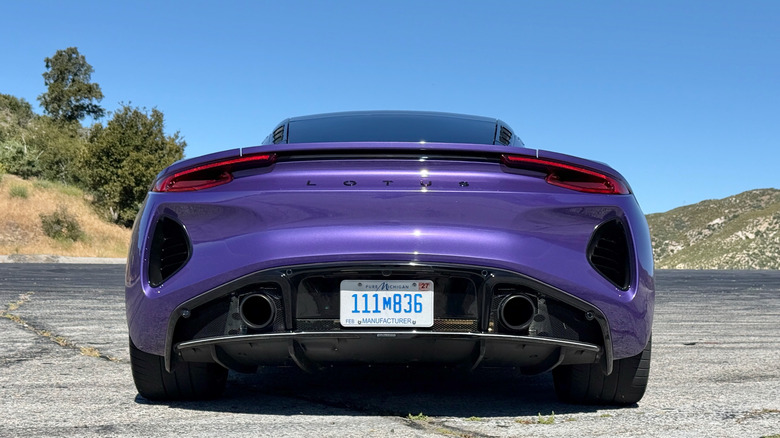
Driving around in the wickedly-purple two-seater for a week, running errands, listening to the compliments the car received along the way was no chore. The 2026 Lotus Emira got attention everywhere I drove it, and I was happy to talk to people about such a fun vehicle. It's stunning vehicle, but it's also playful. It wasn't exactly whimsy that characterized the experience, but more so it was a bit of wonder without the public ire that's typically drawn by fancy sports cars.
This was a bit like what I experienced in the Oak Green Porsche 911 a few weeks prior, but the Lotus seemed to elicit an even more engaged response from car people and non-car people alike. Everyone was hyped on it, including me. It has its flaws, like the funky tech issues, and paying for one would be no easy feat, but behind the wheel of the 2026 Emira, there is proof all around you that automotive enthusiasm still exists, and you're participating in it in a big way. Unfortunately, the supercharged V6 is going away relatively soon, and a hybrid four-cylinder is set to replace it. So get one while you can, and don't be afraid to put miles on it either.