

If You See Green, Black, Or Red Electrical Wires At Home, Here's What They Usually Mean
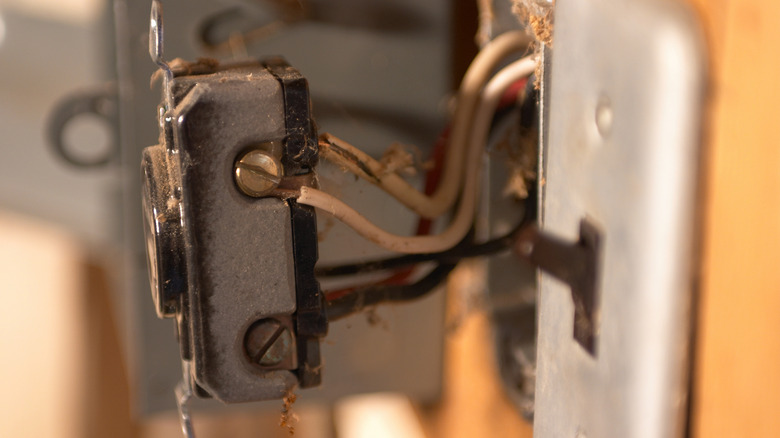
An average single-family dwelling (like a house) uses anywhere from one to two feet of wire per square foot, and can have as much as two miles of wire running through it when all is said and done. The wires running through the walls and ceiling of your home are out of sight and out of mind, unless something goes wrong or you find yourself installing a new light fixture or replacing a light switch yourself. While you should always leave serious repairs and troubleshooting to professionals, anyone can benefit from having a basic understanding of electrical safety and function. A core part of that is understanding wire colors.
There is no shortage of ways to get electrocuted, but one fast way to get there is to handle wires without knowing what those wires are doing. Even for electricians, the first indication of what a wire is doing is its color, and this is what electrical tape colors are for. While most wire colors follow industry conventions rather than building codes, the National Electric Code (NEC) does mandate specific colors for certain connections. Those connections are ground, neutral, and high-leg delta –- the last of which a homeowner or DIYer need not worry about, as you won't encounter that in a residential setting.
These colors come together to form something of a standardized safety language. In a home, the most common colors you'll encounter are green, black, red, and white. Green and white are always ground and neutral, respectively. Black and red are always current-carrying line conductors, but their roles may vary a bit depending on the wiring. You shouldn't attempt to handle or identify wires if you're not confident in your ability to do so, and should call an electrician if you're unsure of what you're looking at.
Wire colors: green, black, red, and white

Green is an NEC-defined color; under NEC 250.119, equipment grounding conductors can be bare, green, or green with one or more yellow stripes. Equipment grounding conductors connect a load to ground, bond metal parts (like metal boxes and enclosures), and provide a safe ground-fault current path. There are exceptions where a green wire can be used as a conductor in low-voltage applications, but you won't see them in a house. Another NEC-mandated (NEC 200.6) color is white or gray for the neutral. The neutral wire is the return path for 120V loads and is what completes the AC circuit. A neutral wire is a core part of modern polarized plugs in North America, and is why electrical plugs have different-sized prongs.
In residential wiring, black and red are always current-carrying, or "hot" wires –- but their role can vary. In split-phase 120V/240V wiring, black is considered L1 (120V) and red is considered L2 (120V). You might see this in your breaker panel, a subpanel, or a disconnect. You can also see it in 240V appliances such as electric dryers or hot water heaters. Red and black wires can also form two halves of a multi-wire branch circuit, which is two 120V circuits that share a single (common) neutral connection.
Black and red wires can also identify switch legs, which are the switched conductors in a switched load, like a ceiling fan and light combination. In a 3-way or 4-way lighting circuit, black and red wires can also be used as "travelers," which are specific wires used to let power flow back and forth between 3-way and 4-way switches, which is what allows multiple switches to independently control a light. Red wires also act as a signal wire for hardwired, interconnected smoke detectors.
The difference between wire and cable, and when to call an electrician
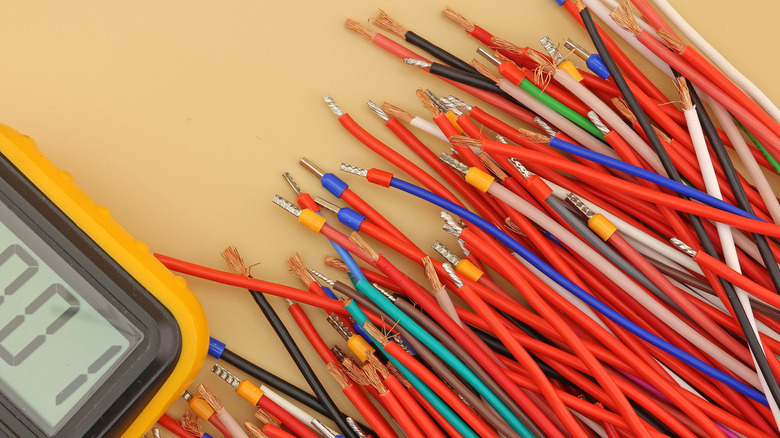
You've probably heard the term cable being used in the same sentence as wire, but they are not the same. A wire is a single conductor made of aluminum or copper, whereas a cable is a bundle of multiple insulated wires, typically with a ground wire (either insulated or bare), that are wrapped in an outer sheath. Examples of cables would be non-metallic sheathed cables, such as what you would see from the Romex brand owned by Southwire, or metallic cable (MC). The color codes for wires only apply to wire insulation, not sheathing. Sheathing colors are not subject to any codes and are at the discretion of manufacturers and industry practices.
It's important to remember these colors are visual guides meant to illustrate the intended role of a given wire, but they are not guarantees of that. These colors don't apply to homes that predate wire color codes and non-metallic sheathed cable (re: Romex) and have not had the wiring updated, nor do they apply to modified wiring where it isn't uncommon to see wire colors misused. This is why we emphasize using a tester –- or even better, a multimeter –- to confirm what the wire is doing. A simple multimeter is a handy tool to have around the home, and is invaluable in electrical testing.
If you aren't sure of what you're doing, or lack experience with basic electrical wiring, then you should not hesitate to call a professional. Mishandling or misidentifying wires can lead to shock and fire hazards, or damage to anything connected to those wires –- or all of the above. Wire colors make understanding and working on electrical systems easier, safer, and faster –- but only when everyone is following the same rules.