

How Much Bigger Has The Average TV Gotten Since The '70s?
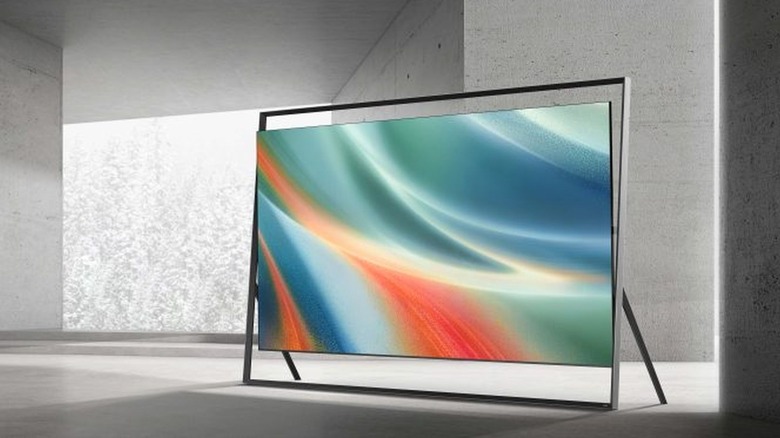
In January 2026, Samsung unveiled the Micro RGB R95H – with its 130-inch screen (10.8 feet diagonally) – at the Consumer Electronics Show (CES) in Las Vegas. It may not be as massive as the screen at your local movie theater, but there's a good chance it's bigger than any wall in your home. Meanwhile, Samsung's 115-inch (9.5 feet diagonally) Neo QLED 4K can be had for $15,000, but the Micro RGB 4K version has a shocking sticker price of $30,000. The R95H will be considerably more expensive.
Still, the "average" size screen that most consumers seem attracted to today is a much more reasonable 55 to 64 inches. How much bigger is that than the average television we had back in the 1970s? Well, this transformative decade brought us the portable cassette player, personal computer, video games, the cellphone, and the VCR. Color television also became a standard, and cable channels began to proliferate, all of which drove more attention to the television itself, which at the time had an average screen size of just 25 inches.
Although that's diminutive by today's standards, TVs in the 70s were behemoths due to the technology of the day. Instead of tiny microchips like the NQ8 AI Gen3 Processor powering Samsung's Neo line, they were weighed down by cathode ray tubes (CRTs) made from components like phosphors, electron guns, aperture grilles, circuit boards, wiring, and steel frames. Plus, screens were composed of thick lead or specialized barium-strontium glass, not liquid crystals, glass substrates, or optical filters that make our modern TVs razor-thin.
How big were the biggest TVs in the '70s?
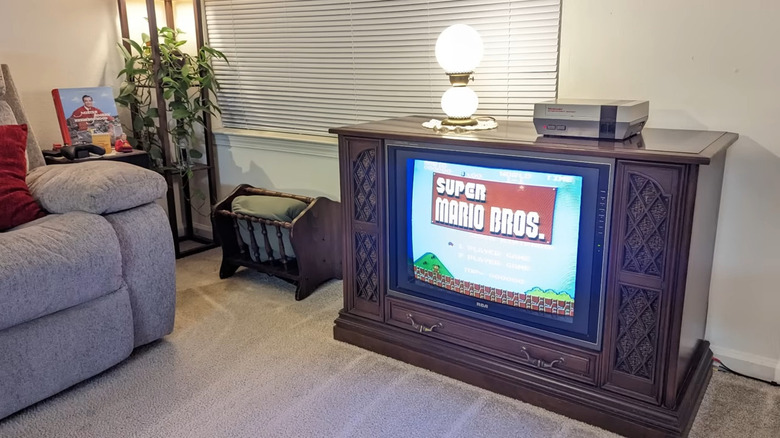
All that bulky technology needed to be hidden. So, manufacturers built TVs inside heavy wooden boxes that, for all intents and purposes, turned them into a piece of furniture. Sears offered TVs with "Spanish" and "Colonial" style cabinets bearing names like "The Rutland," "The Cordoba," and "The Barcelona," pushing the console out to 43 inches and making them so heavy they remained in the same spot in the living room virtually forever.
Then, in 1978, things began to change. General Electric released the Widescreen 1000 with a 45-inch screen that was three times the size of a standard 25-inch set. It, too, came in a gigantic cabinet (70 inches wide, 50 inches high, and 24 inches deep) and was powered by a solid-state design using the then-latest technology — transistors and chips instead of old vacuum-tube technology. At a list price of $2,800 (roughly $14,000 in 2026 money), it cost almost as much as the family vehicle sitting in the garage.
In what might come as a shock to some, only about 60% of households in the U.S. had cable by 1989. And despite the rise of the "big screen" TV, average screen sizes remained relatively stagnant throughout the 1980s and even into the early 1990s. In fact, the average screen size for old school CRTs — which are now making a huge comeback – was around 28 inches.
Bigger is better
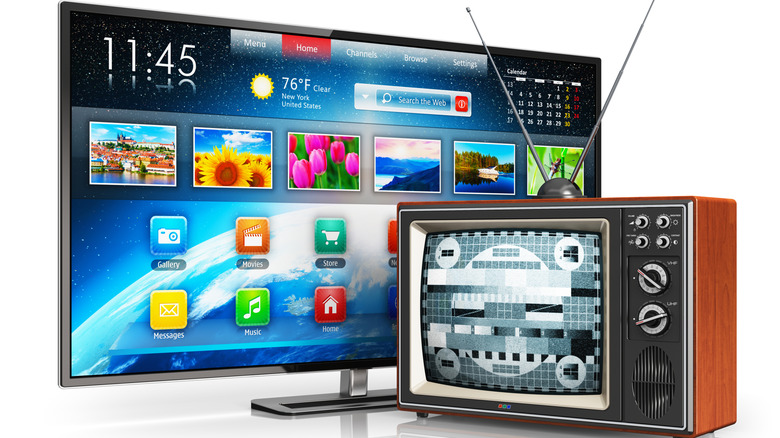
The transition from CRT technology to transistors and chips enabled TVs to truly begin shrinking their overall dimensions while simultaneously expanding their screen size. Liquid Crystal Display (LCD) technology began appearing in devices like calculators and digital watches in the early 1970s. However, it wasn't used in televisions until the late 1980s and didn't become truly "mainstream" until the early-to-mid 2000s. Plasma TVs first hit the market in 1997, and a jump in size to 32- and 35-inch screens became fairly standard. Even in 2015, the most popular size was still 32 inches, despite the average available size being 38 inches. Today, TVs with screens over 65 inches are seeing the most growth.
Then you have COVID. According to Robert Zohn – president and founder of New York-based specialty retailer and integration company Value Electronics — the global pandemic triggered a "more aggressive" desire for bigger televisions starting in 2020 because we were all stuck inside, watching TV. This, in turn, drove major advancements in technologies needed to handle the images displayed on these bigger screens, which leads us to where the industry is headed.
AI Integration is key to enhancing UHD TV performance, especially for important tasks like image and audio processing and upscaling lower-resolution content. As such, manufacturers are embedding generative AI and large language model interfaces into the operating systems of their increasingly smarter televisions. Thanks to reasonable prices, LEDs still hold the largest market share, but OLED and QLED displays are growing, with Mini- and Micro-LED technologies starting to garner more consumer attention.