

How Long Do Ball Joints Last And How Can You Tell When They're Going Bad?
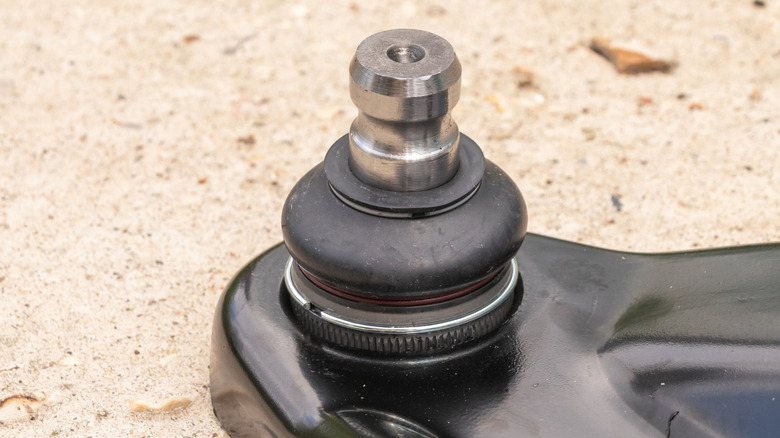
This may seem obvious, but when you steer the car, the wheels turn left and right — those wheels are connected to larger hub assemblies, which themselves must also turn left and right. Brakes, CV (constant velocity) axles, tie rods, the wheel hub itself — it's all designed to flex and move constantly as you go down the road. That's the point of your front suspension, and connecting it all is a set of two ball joints — an upper and lower ball joint, respectively.
Think of a typical double-wishbone front suspension setup like two hands grasping on your wheel hub from the top and bottom. Their job is to hold everything steady and make sure the wheel doesn't fall off, but it's got to do that while the wheel turns and moves with the bumps in the road. Hence why the ball joints are shaped like, well, balls — they're actually omnidirectional joints seated in a casing, similar to your shoulders. And like your shoulders, they can rotate around on two axes, allowing the wheel to move up and down as well as left and right.
Naturally, all that motion wears these devices down. It depends on your driving habits, but generally you're looking at around 70-100,000 miles depending on the make and model. There are a variety of symptoms you'll notice when they're going bad as well, ranging from strange noises to bizarre suspension behavior, with more severe cases having plenty of play in the front suspension. Worst-case scenario is that the ball joint fails entirely, at which point your wheel will literally fall off. So it's vital to identify this problem early — here's how to do it.
How ball joints work
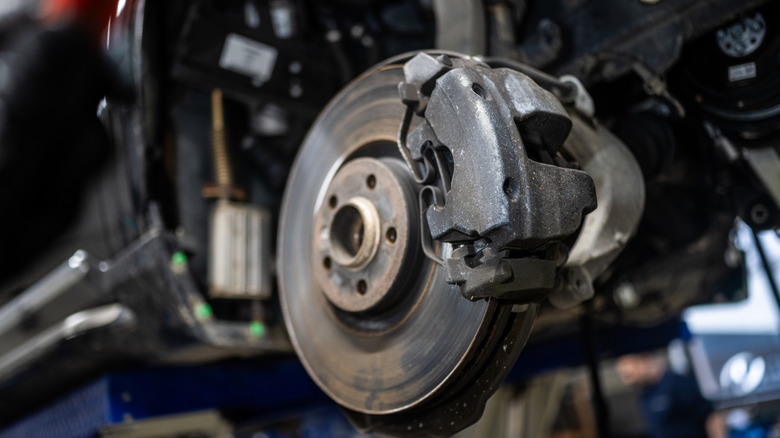
This goes back to the shoulder analogy — you have the ball itself and the casing. Now, in your body's joints, you have fluid that keeps the bones from directly rubbing on each other and causing pain and friction; a car's ball joints have that, too. The inside is coated in grease and the ball itself rests snugly inside, providing no play up or down to keep everything nice and tight.
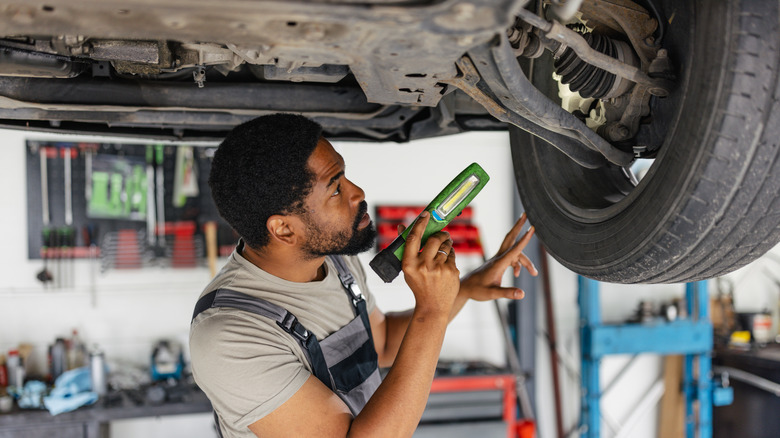
Having that vertical play is why your suspension clunks when you go over bumps and is one of the symptoms of a bad ball joint. You can physically check this by securely jacking up your car and physically pulling the tire up, as if you want to push the top of the tire into the car. If there's play and you hear noises, that's the ball joint.
The ball joints are located right where your suspension meets your wheel hub. If you were to jack up your car and shine a light underneath, you'll be looking right by the wheel where the horizontal parts — your control arms — meet the hub containing the brake and rubber CV axle joint. The ball joint will sit opposite of the tie rod, which is responsible for your wheels' left and right motion when you steer, so it's easy to confuse the two.
Because ball joints are sealed units, you'll also notice various elements that might look worn. They have rubber seals by the joints themselves, the body will appear cracked or otherwise weathered with corrosion, or there will be signs of damage. Either way, a visual inspection coupled with obvious movement is a surefire sign to you that they need replacement, though that also applies to many other suspension components.
How to tell if your ball joints are bad and what to do
Assuming we're not at the stage of jacking the car up, how do you tell if your ball joints are bad when you're just driving along? Usually the first symptom is the noise — bad ball joints make noise, often a clunking or clicking sound, especially going over bumps or steering in a certain direction. Because the ball joint is what's holding the suspension and wheel hub, you'll also notice some sort of shimmy in the steering wheel that'll feel like the car has a mind of its own at higher speeds. Jeep drivers know it as the infamous death wobble.
These symptoms will progress over the course of months as stuff accumulates into the ball joints, wearing them out. Because of this, factors like road salt, dirt, large potholes, and other similar conditions cause stress on the ball joints, wearing seals prematurely. Eventually the metal can become so bad that the ball joint dislodges from its seating in the control arm or the socket pops out entirely, at which point your wheel falls off, so please don't let it get that bad.
Ball joints themselves aren't particularly expensive, but it is a labor-intensive job — generally it'll be a several hundred-dollar bill for a replacement. They typically require a mechanic to press-fit the lower joint into place, and demand a complete upper control arm if your upper is bad. It's possible to DIY it if you have the correct tools as well, but it's not for the faint of heart; it'll likely take a weekend for an inexperienced wrencher, so YouTube is your friend in this instance.